
24in Bar Stools: The Complete Guide to Counter Height Seating
Learn how to measure, choose, and pair 24-inch bar stools with your kitchen island or counter for comfortable, everyday seating.
A 24-inch bar stool is one of the most practical seating choices for a kitchen counter, a breakfast bar, or a low island. It sits at what the furniture industry calls counter height, which is the standard elevation for most residential kitchen counters. If you have been searching for seating that fits comfortably under a 36-inch countertop, this guide will walk you through sizing, back styles, materials, and the details that separate a good stool from one you will enjoy for years.
Choosing the right stool is not only about looks. Seat height, footrest placement, back support, and frame construction all affect how long you can sit comfortably. Below, we break down each factor so you can shop with confidence, whether you need a single accent stool or a matching set of four.
Quick rule of thumb: The seat of a 24-inch bar stool should sit roughly 9 to 12 inches below your countertop. With a standard 36-inch kitchen counter, a 24-inch seat leaves about 12 inches of clearance, which is the comfortable sweet spot for most adults.
Why 24-Inch Bar Stools Are the Standard for Kitchen Counters
Kitchen counters in most homes are built at 36 inches above the floor. That height is designed for standing food preparation, but it also creates a natural seating zone when you add stools. A 24-inch seat height places the sitter at a comfortable level for eating, chatting, or working on a laptop while someone cooks nearby.
This is different from a true bar stool, which typically has a 30-inch seat and is designed for 42-inch bar counters. Choosing between the two comes down to measuring your surface first. If your countertop is closer to 36 inches, a 24-inch stool is the correct match. If it is closer to 42 inches, you will need a 30-inch model. Mixing them up leads to dangling feet or knees pressed against the counter, both of which make seating uncomfortable.
Because counter height is so common in residential kitchens, 24-inch stools are widely available in nearly every style, from simple backless designs to upholstered stools with arms. You can explore related seating options in our guide to 24-inch counter stools if you want a broader comparison of models built specifically for this height.
How to Measure Before You Buy
Measurement is the single most important step, and it takes only a few minutes. Start by measuring from the floor to the top of your countertop or island surface. Write that number down. Then subtract 9 to 12 inches. The result is your ideal seat height range.
- 36-inch countertop: a 24-inch seat gives about 12 inches of clearance, ideal for most adults.
- 34 to 36 inches: 24-inch stools still work well, especially for taller users.
- Below 34 inches: consider a lower stool or a dining chair instead.
- Above 38 inches: move up to a 30-inch bar stool for proper legroom.
Also measure the depth of your overhang. A counter overhang of at least 12 inches gives knees room to tuck under. If your overhang is shallow, a backless or low-profile stool will fit more naturally than a deep upholstered model. For households with children or older adults, a stool with a back and a well-placed footrest adds safety and comfort.
Backless vs. Backed: Which Style Fits Your Space
Backless 24-Inch Stools
Backless stools slide completely under the counter, which keeps sightlines open and makes small kitchens feel less cluttered. They are a strong choice for islands used mainly for quick meals or as a secondary prep surface. Because there is no back to bump against the counter edge, they also work well in tight footprints where stools need to tuck away between uses.
The trade-off is support. Without a back, longer sitting sessions become tiring. If your counter doubles as a homework station or a place to linger over coffee, a backed model is usually the better long-term choice.
Stools With Backs and Arms
A low back provides lumbar support without blocking the view into the kitchen. Many 24-inch stools with backs are designed with a backrest that rises only 10 to 14 inches above the seat, which keeps the stool visually light while still offering support. If you want added comfort for extended seating, look at models with arms, which give the sitter a place to rest their forearms and make getting in and out easier for guests who need extra stability.
Our guide to 24-inch bar stools with back and arms covers the specific considerations for this configuration, including arm clearance and how much overhang you need to accommodate them.
Frame Materials and What They Mean for Durability
The frame determines how stable the stool feels and how well it holds up to daily use. Each material has a different character, and the right choice depends on your household and your design preferences.
| Material | Best For | Key Traits |
|---|---|---|
| Solid wood | Warm, traditional kitchens | Durable construction, repairable finish, classic look |
| Metal (steel or iron) | Industrial and modern spaces | High-grade steel frames, heavy-duty feel, slim profiles |
| Wood and metal mix | Transitional interiors | Balanced look, reinforced joints, easy to match with other furniture |
| Rattan or wicker | Coastal and casual settings | Lightweight, textured, pairs well with natural materials |
| Upholstered seat on any frame | Longer sitting sessions | Added cushioning, easier on the body during meals |
Metal frames with a rust-proof finish are a smart pick for kitchens that see moisture or heavy traffic. Solid wood frames, particularly in oak or hardwood, are a long-term investment because they can be sanded and refinished if they show wear. If you want the stool to match an existing wood dining table, look for finishes that echo the same tone. You can browse coordinating pieces in our wooden kitchen table guide if you are building a matched set.
Footrests, Swivels, and Other Comfort Details
Small design decisions have a big effect on comfort. A footrest is not decorative. It gives the sitter a stable place to rest their feet, which reduces pressure on the legs and keeps posture upright. Look for a footrest that is positioned roughly 7 to 9 inches below the seat and that spans the full width of the frame for easy placement.
Swivel mechanisms are useful on stools where people need to turn to talk to someone behind them or get in and out without pushing the stool back. A quality swivel returns smoothly to center and does not wobble. Entry-level swivels can feel loose over time, while mid-range and premium mechanisms typically use heavier bearings and tighter tolerances. If you plan to use the stools daily, it is worth choosing a model with a well-reviewed swivel.
Seat shape also matters. Saddle seats and contoured wooden seats distribute weight better than flat planks. Upholstered seats add cushioning but need a breathable fabric or a wipeable surface in kitchens where spills are common. For outdoor-adjacent spaces, consider a stool built for covered patios; our guide to outdoor bar swivel stools explains which finishes hold up best to humidity.
Matching Stools to Your Kitchen Layout
Kitchen Islands
An island with a seating overhang is the most common home for 24-inch stools. Allow about 24 inches of width per stool so elbows and plates have room. If the island has a sink or cooktop, keep a clear walking path behind the seating row. For islands that also need storage, a movable kitchen island with seating can combine both functions in a flexible footprint.
Peninsulas and Breakfast Bars
Peninsula seating is often narrower, so backless stools or stools with slim frames make the most sense. Two stools are usually the practical maximum on a standard peninsula. If your counter also serves as a casual dining spot, a stool with a low back gives just enough support without crowding the walkway.
Open-Concept Spaces
In open-plan homes, the stool is visible from the living room, so style consistency matters. A stool that echoes the wood tone of your dining table or the metal finish of your lighting creates a cohesive look. Our guide to kitchen bar stools with backs explores options that look polished from every angle.
Style Directions for 24-Inch Stools
Because counter height is so versatile, 24-inch stools are made in nearly every design language. A few directions worth considering:
- Modern farmhouse: wood frames with cross-back details and a matte or distressed finish.
- Mid-century modern: tapered legs, curved backs, and warm wood tones.
- Industrial: metal frames, exposed rivets, and wood or metal seats.
- Coastal: rattan or wicker seats with light natural frames.
- Contemporary: upholstered seats, slim metal legs, and neutral palettes.
If you are furnishing a larger dining area at the same time, it helps to coordinate finishes across pieces. Our guides to a rustic dining table set and a mid-century modern dining table and 6 chairs show how stool finishes can tie into a broader room palette.
Set Size: How Many Stools Do You Need?
Set size depends on the length of your counter and the width of each stool. A simple formula works well: divide the usable seating width by 24 inches. For example, a 6-foot island with a 60-inch usable seating span comfortably fits two stools with generous spacing, or three narrower backless stools if you want maximum seats.
Most buyers choose sets of two or three for a kitchen counter. If you are matching a larger dining arrangement, you may also be shopping for a dining room table and chairs set for 8 at the same time, and it helps to keep material and finish continuity between the two zones. For compact kitchens, a kitchenette table set can complement counter seating without duplicating function.
Care and Maintenance Basics
Keeping 24-inch stools in good condition is mostly about routine habits. Wipe wooden seats with a slightly damp cloth and dry them immediately to avoid water rings. Use a wood conditioner a few times a year on solid wood frames to prevent drying and cracking. Metal frames benefit from a quick wipe-down with a mild cleaner, and any exposed hardware should be checked periodically for tightness.
Upholstered seats should be vacuumed regularly and spot-cleaned according to the fabric care code. If the stool sits near a window, rotate it occasionally so sunlight does not fade one side more than the other. Felt pads under the legs protect hardwood floors and reduce noise when stools are pulled in and out.
Common Mistakes to Avoid
- Buying 30-inch stools for a 36-inch counter. The seat will be too high and the sitter's legs will dangle.
- Ignoring the overhang. A shallow overhang with a deep backed stool leaves no knee room.
- Choosing style over stability. A narrow base on a tall stool can wobble; check the footprint and weight rating.
- Skipping the footrest. Stools without foot support become uncomfortable quickly.
- Buying a set before measuring. Always confirm the number of stools your counter can hold with comfortable spacing.
Frequently Asked Questions
What height counter do 24-inch bar stools fit?
A 24-inch seat height pairs best with countertops that are 34 to 38 inches high, with 36 inches being the most common residential standard. The goal is 9 to 12 inches of clearance between the seat and the countertop.
Are 24-inch stools the same as counter stools?
Yes. In most furniture catalogs, 24-inch stools are classified as counter height stools. A true bar stool typically has a 30-inch seat and is intended for 42-inch bar counters.
Should I choose backless or backed 24-inch stools?
Backless stools are better for tight spaces and quick meals because they tuck fully under the counter. Backed stools are better for longer sitting sessions and for guests who need extra support. Many kitchens use a mix, such as backed stools on the island and backless stools at a secondary bar.
How much space do I need between stools?
Allow roughly 24 inches of width per stool. This gives each sitter room for their arms and a plate. If your counter is tight, backless stools with slim frames can be spaced slightly closer.
Can 24-inch stools be used outdoors?
Only if the stool is specifically built for outdoor use with weather-resistant materials and a rust-proof finish. Indoor wood and upholstered stools will degrade quickly in humidity and rain. For covered patios, look for outdoor-rated frames and cushions.
What is the best seat material for a busy kitchen?
Wipeable surfaces such as sealed wood, metal, or performance fabric are the most practical for busy kitchens. Upholstered seats add comfort but need a fabric that can handle spills. Solid wood and metal are the easiest to maintain long term.
Final Checklist Before You Buy
- Measure floor to countertop and confirm a 9 to 12 inch clearance.
- Measure the overhang depth for knee room.
- Decide between backless, low-back, and armed styles.
- Confirm the frame material and finish suit your kitchen humidity and traffic.
- Check that a footrest is included and well positioned.
- Plan the number of stools with 24 inches of width each.
- Review the weight rating and stability of the base.
- Coordinate finish with nearby dining furniture.
With these steps complete, you are ready to choose a set that fits your counter, your household, and your design taste. A well-matched 24-inch stool is one of the hardest-working pieces in a kitchen, and getting the height and support right makes everyday seating noticeably better.
Recommended 24in Bar Stools
⚠️ AFFILIATE DISCLOSURE: This website contains affiliate links. As an affiliate Associate, we earn from qualifying purchases. If you make a purchase through these links, we may receive a small commission at no additional cost to you. Read our full affiliate policy.
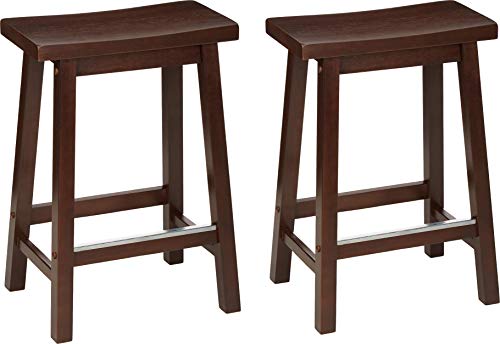
Amazon Basics Solid Wood Saddle-Seat Counter Height Bar Stools for Kitchen Island with Footrest, 24-Inch Height, Walnut, Set of 2
Check price on Amazon
FDW | 24" Metal Bar Stools | Black | Set of 4 | 330lbs Load Capacity, Counter Height, Stackable, Stools with Footrest | Space-Saving Design | For Kitchen, Bar, Patio & Cafe
Check price on Amazon
DUMOS 24 Inch Counter Height Bar Stools Set of 4, Kitchen Island, Brown | Backless Saddle Seat, PU Leather, Metal Base Footrest for Dining Room, Kitchen
Check price on Amazon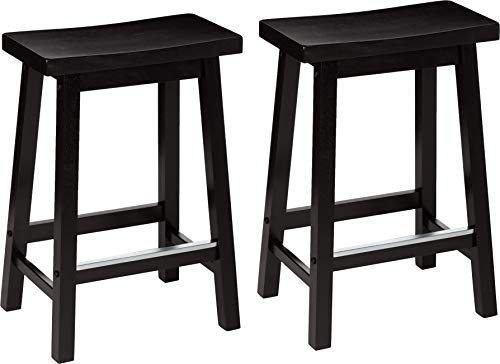
Amazon Basics Solid Wood Saddle-Seat Counter Height Bar Stools for Kitchen Island with Footrest, 24-Inch Height, Black, Set of 2
Check price on Amazon
Raynesys 24 Inche Bonded Leather Counter Height Bar Stools Set of 2 Square | Barstools with Thick Bonded Leather Saddle Seats & Heavy Duty Metal Base for Kitchen Counter, Easy Assembly, All Black
Check price on Amazon
HOOBRO Bar Stools, Set of 2 Bar Chairs, 23.6 Inch Saddle Stools, Kitchen Counter Seat with Footrests, Industrial Barstools for Dining Room, Kitchen, Counter, Rustic Brown and Black BF02MD01
Check price on Amazon