
4 Seat Dining Room Table: The Complete Buying Guide
A 4 seat dining room table is the sweet spot for many homes. It is large enough for a family of four to share daily meals, yet compact enough to fit comfortably in a dedicated dining room, an open-plan kitchen, or a cozy apartment corner. Whether you are furnishing your first home or replacing a worn-out set, choosing the right four-seater requires more thought than simply picking a shape you like.
This guide walks you through the practical details that matter most: dimensions and clearance, table shapes, materials, seating compatibility, and placement strategy. By the end, you will have a clear picture of which configuration fits your room and your lifestyle — so you can move from research to confident selection.
Why a Four-Seat Table Is the Practical Choice
Four seats hit a useful middle ground. Two-seat bistro tables are romantic but limited for family life, while six- and eight-seat tables can overwhelm smaller rooms and force awkward walking paths. A four-seat table comfortably serves:
- Couples who host another couple regularly
- Families with one or two young children
- Apartment dwellers with a defined dining zone
- Homeowners who want a breakfast area separate from a formal dining space
Because the footprint is modest, a four-seater also frees up room for a sideboard, a bar cart, or additional circulation space. If you are still mapping out your room, the broader dining furniture buying guide can help you plan the full layout before committing to a table.
Table Shapes for Four Seats
Shape drives how the table feels in a room and how diners interact. Each option below has a distinct advantage.
Square Tables
A square table is the classic four-seat configuration. Each diner gets a side, elbow room is balanced, and conversation flows naturally across the center. Square tables work beautifully in compact dining rooms and breakfast nooks, and they can be pushed into a corner to free up floor space when guests leave. Many square models are also extendable, letting you seat six for holidays without buying a larger table.
Round Tables
Round four-seat tables soften a room and eliminate sharp corners, which is helpful in high-traffic areas and homes with young children. A round table also encourages conversation because everyone faces the center. In small rooms, a round table can feel more spacious than a square one of similar diameter because there are no corners to navigate around. If a round silhouette appeals to you, a round table with four chairs is a ready-made pairing that removes guesswork.
Rectangular Tables
Rectangular tables suit narrow dining rooms and open-plan layouts where the table runs parallel to a kitchen island or wall. A four-seat rectangular table typically seats two on each long side, though some designs allow one diner at each end. Rectangular models are also the most common extendable format, making them a flexible long-term choice. For tighter kitchens, a rectangle dining set keeps the proportions tidy.
Dimensions and Clearance: Getting the Numbers Right
Comfort depends on more than the tabletop size. You need room for chairs to pull out, knees to fit under the apron, and walkways to remain usable. Use the table below as a planning reference.
| Table Shape | Typical Footprint | Best For | Minimum Room Clearance |
|---|---|---|---|
| Square | 36–42 in per side | Compact dining rooms, breakfast nooks | 36 in on all open sides |
| Round | 36–48 in diameter | Small rooms, high-traffic zones, families with kids | 36 in on all sides |
| Rectangular | 48–60 in long, 30–36 in wide | Narrow rooms, open-plan layouts | 36 in at ends, 30 in along walls |
A reliable rule of thumb is to leave 36 inches between the table edge and the nearest wall or furniture piece. That gap gives a chair room to slide out and gives a person room to walk behind a seated diner. If your room is tighter than that, consider a round table with a pedestal base, which lets chairs tuck in closer without legs getting in the way.
Seat Height and Apron Clearance
Standard dining tables are about 30 inches high, with 24 to 26 inches of clearance beneath the apron. Chairs with seat heights around 18 to 19 inches pair correctly with this height. If you are mixing a table with existing chairs, measure the apron depth first — a thick apron can block knees even when the tabletop height is correct.
Materials: Matching Durability to Daily Use
The material you choose affects maintenance, longevity, and the visual warmth of the room. Here is how the main options compare.
Solid Wood
Wood is the most traditional choice and offers the longest service life when cared for. Oak, maple, and walnut are common for four-seat tables. Solid wood can be refinished after years of wear, which makes it a strong long-term investment. It does require protection from heat and moisture, so coasters and trivets are essential.
Wood Veneer and Engineered Wood
Veneered tops use a thin layer of real wood over a stable core. They resist warping better than some solid slabs and are generally lighter. Entry-level veneer tables can be susceptible to edge chipping, while mid-range and premium veneers use thicker layers and better bonding.
Glass Tops
A glass top reflects light and visually opens up a small room. Tempered glass is durable, but it shows fingerprints and smudges more readily than wood. Glass pairs well with metal or wood bases and suits modern and minimalist interiors. If you prefer this look, explore glass dining room table sets for coordinated options.
Stone and Marble
Stone tops bring a luxury feel and resist heat well. They are heavy, so the base must be engineered to support the weight, and they can chip if struck hard. Marble requires sealing to prevent staining from acidic foods and drinks.
Metal
Metal frames and tops suit industrial and modern styles. Powder-coated steel resists rust and scratches, while brushed finishes hide fingerprints. Metal is often used for the base of glass and wood tables to combine stability with visual lightness.
Choosing Chairs That Fit the Table
The table and chairs should be chosen together. A table that seats four comfortably can feel cramped if the chairs are oversized, and a delicate table can look unbalanced with heavy armchairs.
- Seat width: Allow at least 24 inches of table edge per diner. A 48-inch side comfortably seats two.
- Chair depth: Standard dining chairs are 18 to 22 inches deep. Measure the pull-out zone before buying.
- Arm vs. armless: Armchairs need more clearance and may not tuck under the table. For a four-seat setup, armless chairs on the long sides and armed chairs at the ends can work if space allows.
- Style harmony: Mixing chair styles is acceptable, but keep the seat height and overall scale consistent.
If you want a coordinated starting point, a 4 chair dining set bundles the table and seating in matched proportions. For a more curated look, browse modern dining chairs set of 4 to pair with a table you already own.
Placement Strategy for Small and Open Rooms
Where you place the table matters as much as which table you choose. A few placement principles apply across room types.
Dedicated Dining Rooms
Center the table on the room's longest axis, or align it with a window for natural light. Hang a pendant or chandelier 30 to 36 inches above the tabletop. Leave a clear path to the kitchen doorway — at least 36 inches wide.
Open-Plan Kitchens
Use the table to define the dining zone without blocking circulation. A rectangular table parallel to the kitchen island creates a clear work triangle. A round table works well in a corner of an open plan because it has no sharp edges to catch traffic.
Apartments and Compact Spaces
Choose a table with a pedestal base or tapered legs to reduce visual clutter. Drop-leaf and extendable designs let you shrink the footprint when the table is not in use. A 4 person dining table with a small diameter can fit into a corner nook and still seat four for dinner.
Extendable and Convertible Options
If you occasionally host more than four people, an extendable table adds flexibility without committing to a permanently large footprint. Butterfly-leaf and self-storing leaf designs are the most convenient because the extension stores inside the table. When extended, a four-seat table can often seat six, which covers holiday meals and casual gatherings.
For homes where the dining table doubles as a workspace, look for models with a durable top finish and enough knee clearance for a laptop and chair. A 4 seater dining table with a matte finish hides fingerprints better than a high-gloss surface.
Style Directions That Suit a Four-Seat Table
Because four-seat tables are compact, they adapt to a wide range of interior styles. A few directions work especially well:
- Mid-century modern: Tapered legs, warm wood tones, and streamlined silhouettes.
- Modern farmhouse: Painted bases, distressed wood tops, and bench seating on one side.
- Industrial: Metal frames, reclaimed wood, and exposed hardware.
- Scandinavian: Light woods, white accents, and simple lines.
- Transitional: Classic shapes with updated finishes that bridge traditional and contemporary rooms.
If you lean toward warm natural textures, a rustic dining table set pairs well with a four-seat footprint in a farmhouse or cabin-style home. For a cleaner look, a mid-century modern dining table and 6 chairs can be scaled down by choosing the four-seat variant of the same design.
Care and Longevity
A four-seat table gets daily use, so a little maintenance goes a long way. Wipe spills promptly, use coasters under cold and hot drinks, and avoid placing the table in direct sunlight for extended periods. Wood tables benefit from a quality furniture polish every few months. Glass tops should be cleaned with a non-ammonia cleaner to protect any coatings. Stone tops should be resealed according to the manufacturer's guidance. For a deeper routine, see the dining care and maintenance section.
Recommended 4 Seat Dining Room Tables & Sets
⚠️ AFFILIATE DISCLOSURE: This website contains affiliate links. As an affiliate Associate, we earn from qualifying purchases. If you make a purchase through these links, we may receive a small commission at no additional cost to you. Read our full affiliate policy.

IRONCK Dining Table Set for 4, Extendable Kitchen Table Chairs Set of 4 | Dining Room Table with 4 Upholstered Chairs, Folding for Small Space, Apartment, Walnut
Check price on Amazon
IRONCK Dining Table Set for 4, Rustic Brown | Wood Kitchen Table with Upholstered Chairs for Kitchen Room and Small Spaces
Check price on Amazon
IRONCK Dining Table Set for 4, Kitchen Table and Chairs Set, Rustic Brown | Kitchen Table with Upholstered Bench and 2 Chairs for Small Space, Apartment
Check price on Amazon
Itaar 5-Piece Dining Table Set for 4-6 People, 63" Extendable Kitchen Table and 4 Cushion Chairs, Dining Room Table with MDF Board & Metal Frame for Small Space, Easy Clean, Brown
Check price on Amazon
VECELO 43.3" Dining Table Set for 4, Space-Saving Kitchen Table with 1 Bench and 2 Stools, Tuck-Away Seating, Rustic Farmhouse Style, Adjustable Foot Pads, Black
Check price on Amazon
IRONCK Dining Table Set for 4, Grey | Wood Kitchen Table with Upholstered Chairs for Kitchen Room and Small Spaces
Check price on Amazon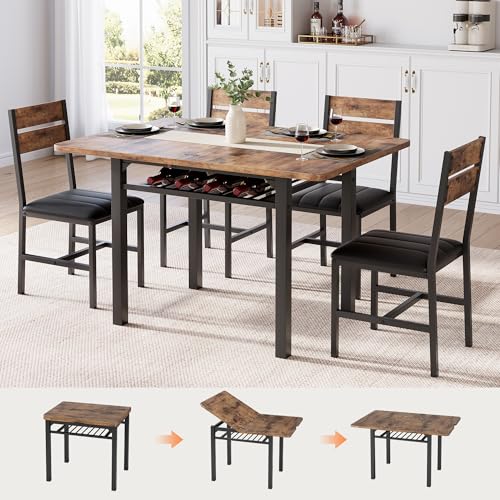
MapleGrace Extendable Dining Table Set for 4 with Built-in Shelf Rack Brown | Kitchen Table Set with 4 PU Leather Upholstered, Wood Dining Room Chairs for Dining & Small Spaces
Check price on AmazonFrequently Asked Questions
What is the best shape for a 4 seat dining room table?
Square and round tables work best for four seats because they allow each diner equal elbow room and easy conversation. Rectangular options are also popular in narrow rooms since they can be pushed against a wall when not in use.
How much floor space do I need for a 4 seat dining table?
Allow roughly 36 inches of clearance on all sides of the table for comfortable chair pull-out and walking space. A typical 4 seat table is around 36 to 48 inches wide, so plan for a footprint of roughly 9 by 9 feet in an enclosed dining area.
Can a 4 seat dining table fit in a small apartment?
Yes. Round and square four-seater tables, extendable models, and drop-leaf designs are ideal for apartments. A round 4 seat table placed in a corner or near a window maximizes flow in compact open-plan layouts.
How many people can a 4 seat table really hold?
Four adults fit comfortably when each diner has about 24 inches of table edge. With children or a tight arrangement, a 48-inch table can occasionally seat five, but four is the reliable everyday capacity.
Should I choose a pedestal or four-leg base?
A pedestal base keeps the floor clear and lets chairs tuck in from any side, which is helpful in small rooms. Four-leg bases offer more stability and a traditional look, but the legs can interfere with chair placement at the corners.
Final Checklist Before You Choose
Use this checklist to confirm your choice before ordering:
- Measure the room and confirm at least 36 inches of clearance on open sides.
- Decide on shape based on traffic flow and room proportions.
- Confirm tabletop height and apron clearance match your chairs.
- Match material durability to daily use and maintenance willingness.
- Check whether an extendable leaf is needed for occasional guests.
- Plan lighting height and placement above the table.
- Verify the return policy and assembly requirements.
With the right measurements and a clear sense of how you use the room, a four-seat dining table becomes a long-lasting centerpiece. Take your time, compare shapes and materials, and choose the configuration that fits your space and your daily routine.