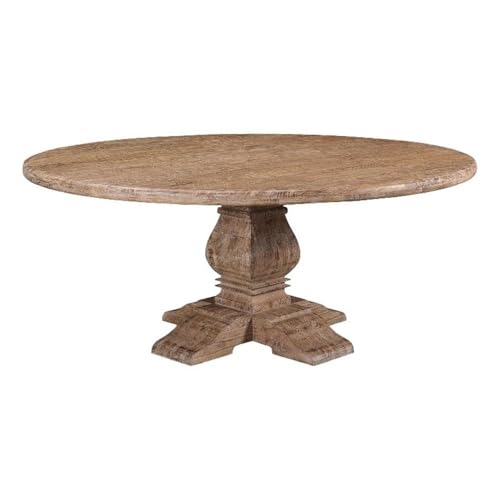
Why Choose a 72 Inch Round Dining Table?
A 72 inch round dining table sits at the sweet spot between generous entertaining capacity and elegant proportions. With a six-foot diameter, it provides enough circumference to seat eight adults comfortably while keeping every diner within easy conversation distance. Unlike long rectangular tables where guests at opposite ends can feel disconnected, a round table creates an inherently social arrangement.
The round silhouette also softens a room. In square or nearly square dining spaces, a round table eliminates the awkward corners and tight walkways that rectangular tables can create. Traffic flows naturally around the curve, making the room feel more open even when the table itself is substantial. If you are working with a formal dining room or a dedicated eating area, a white round table or a warm wood finish can anchor the space beautifully.
For families and hosts who regularly seat eight, this size is the practical ceiling for round dining before you step into banquet-style or extension tables. It is large enough for holiday gatherings yet still manageable for everyday use.
Space Planning: How Much Room Do You Really Need?
The most common mistake buyers make is underestimating the clearance required around a large round table. A 72 inch table needs a room that is at least 12 by 12 feet to function comfortably. Here is the math behind that recommendation:
- Table footprint: 72 inches (6 feet) in diameter.
- Chair pull-out zone: 36 inches on all sides so diners can slide chairs back and stand up without hitting a wall.
- Total required diameter: 72 + 36 + 36 = 144 inches, or 12 feet.
If your room is 14 by 14 feet or larger, you have room for a sideboard, a buffet, or a wine rack and cabinet along the perimeter without crowding the table. In a tighter 12 by 12 foot room, keep the perimeter clear and choose armless chairs to maximize usable space.
Consider the shape of your room as well. A round table in a square room creates a pleasing symmetry. In a long rectangular room, a round table can work if you use the extra length for storage or a serving station rather than forcing the table to fill the space.
Seating Eight: Chair Selection and Spacing
Seating eight around a 72 inch round table requires attention to chair width and style. The table's circumference is approximately 226 inches. Dividing that by eight gives roughly 28 inches of linear space per person — the industry-standard allowance for comfortable dining.
Chair styles that work best
- Armless side chairs: These are the most space-efficient choice. Without arms, chairs can tuck closer together and slide under the table more fully. Curved-back wicker dining chairs or wood dining chairs follow the table's contour nicely.
- Upholstered dining chairs: A brown leather dining chair or fabric-upholstered seat adds comfort for long dinners. Just verify that the seat width stays at or below 20 inches so eight chairs fit without overlap.
- Curved-back designs: Chairs with a gentle curve echo the round table and look intentional rather than boxy.
Chairs to avoid
Overly wide chairs, chairs with large arms, and heavily padded club-style seats can reduce your effective seating count to six or seven. If you love a chair with arms, consider placing armchairs at the two most accessible positions and armless chairs elsewhere.
For a coordinated look, a white and gold dining chairs set of 4 paired with a second set of four can create a cohesive eight-chair arrangement. Alternatively, mix materials deliberately — wood chairs with a white marble dining table creates a crisp, modern contrast.
Material Tiers: What to Expect at Each Level
Large round dining tables are available across a wide spectrum of construction quality. Rather than focusing on numbers, use these universal tier descriptors to understand what each level typically delivers.
| Tier | Typical Construction | Best For | Longevity Outlook |
|---|---|---|---|
| Entry-Level | Engineered wood core with laminate or thin veneer; metal or basic wood legs | First apartments, rental units, occasional-use dining rooms | Solid for light use; may show wear in high-traffic households |
| Mid-Range | Hardwood veneer over plywood; solid wood legs; factory-applied protective finish | Everyday family dining, regular entertaining | Good durability with proper care; refinishable in some cases |
| Premium | Solid hardwood construction (oak, walnut, maple); dovetail or mortise-and-tenon joinery | Formal dining rooms, heirloom-quality aspirations | Excellent longevity; can be sanded and refinished multiple times |
| Luxury | Solid premium hardwood or stone top with hand-finished details; artisan joinery | Statement dining spaces, design-forward homes | Decades of service; often repairable and refinishable indefinitely |
Within the premium and luxury tiers, a white oak dining table or a solid wood dining table offers the most versatile foundation. Solid oak and walnut are particularly well-suited to round tables because they can be shaped and finished without the edge-banding issues that affect veneered tops.
If you prefer a stone surface, a white marble dining room table delivers a luxury-tier look but requires sealing and careful maintenance. Glass tops paired with a wrought iron dining room table with glass top offer a lighter visual footprint, which can help a large table feel less imposing in a smaller room.
Base and Pedestal Options
A 72 inch round top needs robust support. You will typically encounter three base styles:
- Single pedestal: A central column with a spreading foot. This is the most legroom-friendly option because there are no corner legs to negotiate. High-quality pedestals use wide, weighted bases to prevent tipping. A wood table base in a trestle or X-form can be a stylish alternative.
- Double pedestal: Two columns positioned along the centerline. This offers excellent stability for a large top and is common on premium and luxury tiers.
- Four-leg design: Traditional and stable, but corner legs can interfere with chair placement. If you choose four legs, look for legs that are set inward from the table edge.
When evaluating stability, lean gently on the table edge. A well-built 72 inch round table should not wobble or lift on the opposite side. Premium and luxury tiers typically include adjustable levelers and reinforced mounting plates.
Styling a Large Round Dining Table
A 72 inch round table offers a generous canvas for centerpieces, but scale matters. A centerpiece that is too small will look lost; one that is too tall will block sightlines. Aim for a centerpiece arrangement that is 12 to 18 inches tall and roughly 18 to 24 inches wide.
For everyday styling, a low bowl of fruit, a pair of candlesticks, or a simple vase works well. For formal occasions, a round table lends itself to a symmetrical centerpiece with a low floral arrangement flanked by candles. Table linens can also define the look — a white tablecloth (if available in your collection) or a richly textured runner adds polish.
Lighting deserves equal attention. A round table pairs naturally with a round chandelier or pendant centered above it. Hang the fixture so the bottom sits roughly 30 to 36 inches above the tabletop, which keeps it out of sightlines while providing warm illumination.
Room Layout Ideas for Eight
Once the table is in place, the surrounding layout determines how the room functions. Here are three proven arrangements:
- Symmetrical formal: Center the table under a chandelier, place a wood buffet or white sideboard against one wall, and keep the other walls relatively clear. This works well in square rooms of 13 by 13 feet or larger.
- Open-concept anchor: Use the round table to define the dining zone within a larger open space. A low-profile sideboard or a wine rack can serve as a subtle divider between the dining and living areas.
- Compact entertaining: In a 12 by 12 foot room, skip the sideboard and use a bar cart that can be wheeled in for parties and stored away afterward. This keeps the floor clear while still providing serving space.
Whatever the layout, preserve at least 36 inches of clearance between the table edge and any wall or large furniture piece. This is non-negotiable for chair pull-out and comfortable movement.
Care and Maintenance for a Large Round Table
Proper care extends the life of any dining table. For wood surfaces, dust regularly with a soft cloth and use coasters under drinks. Avoid placing hot dishes directly on the table — use trivets. A quality wood polish and conditioner applied every few months helps maintain the finish and prevents drying.
For stone tops, wipe spills promptly and reseal according to the manufacturer's recommendations. Glass tops should be cleaned with a non-ammonia glass cleaner to avoid clouding. Upholstered chairs benefit from regular vacuuming and spot cleaning; a upholstery cleaning guide can walk you through deeper maintenance.
Humidity control matters for solid wood tables. Keep indoor humidity between 40 and 60 percent to minimize seasonal expansion and contraction. Avoid placing the table directly in front of heating vents or in prolonged direct sunlight.
Frequently Asked Questions
How many people can comfortably sit at a 72 inch round dining table?
A 72 inch round dining table comfortably seats 8 adults when using chairs with a standard seat width of 18 to 20 inches. The circumference provides roughly 28 inches of linear space per person, which is the recommended allowance for comfortable dining without elbow collisions.
How much room do I need for a 72 inch round dining table with 8 chairs?
You should plan for a dining room that is at least 12 by 12 feet. The table itself spans 6 feet in diameter, and you need a minimum of 36 inches of clearance on all sides for chairs to pull out and for walkways. A 14 by 14 foot space is ideal for a more generous layout.
What is the best material for a large round dining table?
Solid hardwood such as oak, walnut, or maple offers the best long-term durability for a large round table. Mid-range options often use hardwood veneers over engineered wood, while entry-level tiers may use MDF with a laminate finish. Marble and glass tops are premium choices that require more careful maintenance.
Does a round dining table save space compared to a rectangular one?
Yes, a round table can be more space-efficient because it has no corners to navigate around. In a square room, a round table allows for smoother traffic flow and eliminates the sharp corners that can make tight spaces feel cramped. However, a 72 inch round table still requires a substantial footprint.
What chair style works best with a 72 inch round dining table?
Curved-back chairs, armless side chairs, and upholstered dining chairs work best because they follow the table's contour and maximize seating capacity. Avoid overly wide chairs or those with large arms, as they can reduce the effective seating count around a round table.
Final Checklist Before You Buy
Before finalizing your choice, run through this quick checklist to avoid costly mistakes:
- Measure the room twice: Confirm you have at least 12 by 12 feet of usable floor space and 36 inches of clearance on all sides.
- Verify doorways and stairwells: A 72 inch round top may arrive in two halves or require a wide entry path. Check the delivery route before ordering.
- Confirm chair count and width: Ensure eight chairs fit without overlap, and check seat heights match the table's apron height.
- Review the base style: Prefer a pedestal or double pedestal for maximum legroom, and test stability if shopping in person.
- Match the finish to your room: Consider a white oak table for a light, airy look or a darker walnut for a formal, moody feel.
- Plan the lighting: A centered chandelier or pendant completes the arrangement and defines the dining zone.
With the right measurements, material tier, and chair pairing, a 72 inch round dining table with 8 chairs becomes the social heart of your home — a place where eight people can gather, eat, and converse without anyone feeling stranded at the end of a long table.