
Circular Expanding Table: The Complete Buying & Design Guide
Everything you need to know about round extendable dining tables — how the expansion mechanisms work, which sizes seat your family, which materials last, and how to style a circular expanding table in any dining room.
Explore the GuideWhy research a circular expanding table before buying? A round expandable table is one of the smartest investments for a dining room that must serve both everyday meals and larger gatherings. The right model gives you a compact footprint day to day and generous seating when guests arrive — but only if the mechanism, size, and material match your space. This guide walks you through every decision so you can choose with confidence.
What Exactly Is a Circular Expanding Table?
A circular expanding table is a round dining table engineered to increase its seating surface on demand. Unlike a fixed round table, it incorporates an extension system that widens the top — usually by opening the table apart and unfolding a stored leaf, inserting an extension panel, or expanding the rim outward. When fully closed, it behaves like a compact round dining table; when opened, it becomes a large round or oval surface that seats additional diners.
This dual personality is why the circular expanding table has become a favorite for apartments, open-concept homes, and dining rooms that double as workspaces. If you are still comparing basic round shapes, our guide to the circle dining room table covers fixed-top options, while this article focuses specifically on the expanding variants and their mechanisms.
Most models fall into one of three mechanical families: the butterfly leaf (a hinged leaf that folds inward and stores beneath the top), the self-storing leaf (a separate panel tucked inside the table apron), and the drop-leaf or gate-leg design (sections that fold down at the sides). Each has different implications for setup effort, structural rigidity, and long-term durability — which we break down next.
How the Expansion Mechanism Works
Understanding the mechanism is the single most important part of choosing a circular expanding table, because the hardware determines how often you will actually use the extension. A table that is awkward to open tends to stay closed, defeating the purpose of buying an expandable model in the first place.
- Butterfly leaf: The top splits and a hinged leaf folds out from the center. Entry-level and mid-range models commonly use this design; the better mid-range and premium versions add smooth glides and reinforced hinges so one person can open the table in under a minute.
- Self-storing leaf: A separate extension panel is stored inside the table and slides into place on metal tracks. This design typically offers the most rigid extended surface and is common in premium and high-end tier tables.
- Drop-leaf / gate-leg: Side sections fold down against the frame. These are excellent for very tight spaces because the closed table is dramatically smaller, but the extended surface is usually narrower than a full leaf system.
- Rim-expansion: A less common design in which the circular rim itself expands outward on a geared track, preserving the round silhouette when open. This is a luxury-tier feature prized for aesthetics and seamless seating.
Whichever mechanism you choose, test the action in person if possible, or read owner reviews about smoothness and wobble. A table with a stiff or rattling mechanism will undermine the experience no matter how good the top looks. For a closer look at the classic folding approach, see our article on the butterfly leaf dining table.
Recommended Circular Expanding Tables & Round Extendable Dining Sets
⚠️ AFFILIATE DISCLOSURE: This website contains affiliate links. As an affiliate Associate, we earn from qualifying purchases. If you make a purchase through these links, we may receive a small commission at no additional cost to you. Read our full affiliate policy.

41 in-78 in Extendable Dining Room Table for 4-8, Round Expandable Kitchen Table with Fluted Base, Modern Farmhouse Oval Dinner Tables for Dining Room Kitchen Living Room (Walnut)
Check price on Amazon
DHH 47"-63" Extendable Round Dining Table for 4–8 with Storage, Mid Century Modern Farmhouse Wood Oval Dinner Table with Pedestal Base for Kitchen, Living Room (Black)
Check price on Amazon
41 in-78 in Extendable Dining Room Table for 4-8, Round Expandable Kitchen Table with Fluted Base, Modern Oval Dinner Tables for Dining Room Kitchen Living Room (Black)
Check price on Amazon
41 in-78 in Extendable Dining Room Table for 4-8, Round Expandable Kitchen Table with Fluted Base, Modern Farmhouse Oval Dinner Tables for Dining Room Kitchen Living Room (Natural)
Check price on Amazon
42"-58" Extendable Round Dining Table for 4-6,with Butterfly Leaf | Space‑Saving Modern Oval Dining Table, Storage Shelf & Sturdy Metal Legs, for Kitchen & Dining Room,Office,Apartments
Check price on Amazon
Modern Extendable Round Dining Table with Storage | 38.6" to 110.2" Expandable Fluted Table for 2-12 People, Space Saving Table for Party, Celebration
Check price on Amazon
Extendable Round Dining Table: 47″–63″ Kitchen Table for 4 6 8 with Dust-Proof 2-Tier Storage Shelf Space Saving, Modern Farmhouse Expandable Wood Oval Circle Dinner Furniture with Pedestal Base
Check price on Amazon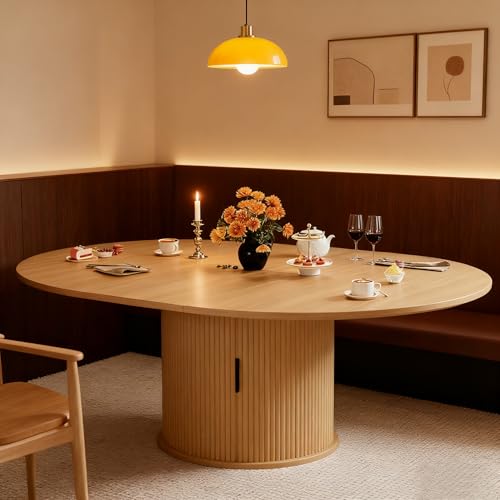
Wildhome Extendable Round Dining Table for 2-4-6, 59 Inch Dining Room Kitchen Table with 2-Tier Storage Shelf, Modern Farmhouse Fluted Wood Slide Door Dinner Furniture,Oval Circle,Oak
Check price on AmazonSpace-Saving Benefits of a Round Extendable Dining Table
The practical case for a circular expanding table rests on three advantages that rectangular tables struggle to match.
- Compact closed footprint: A round table with a modest diameter tucks neatly into corners and small dining zones, leaving walkways clear. This makes it a natural fit for apartments and breakfast areas.
- No corner crowding: Every seat at a round table has equal access to the center, and there are no sharp corners to navigate around in tight rooms. Guests can slide in and out without asking neighbors to move.
- Better conversation flow: Round tables keep everyone within eye contact range, which is why they remain popular for hosting and family meals alike.
When the extension opens, these benefits scale up rather than disappear — an extended round table still distributes seating evenly, unlike a rectangular table where the ends can feel disconnected. If your room is genuinely tight, pair this guide with our recommendations for a compact dining room table and explore chairs for small spaces to complete the layout.
Sizing Your Circular Expanding Table Correctly
Sizing mistakes are the most common reason buyers regret a dining table purchase. For a round table, the key measurements are the closed diameter, the extended diameter, and the clearance around the table.
As a working rule, allow roughly 24 inches of table edge per seated diner and at least 30 to 36 inches of clearance between the table edge and walls or other furniture so chairs can pull out comfortably. A closed diameter in the range of 36 to 42 inches typically seats four; an extended diameter of 54 to 60 inches comfortably seats six; larger premium models that extend beyond 60 inches can seat eight. Always measure your room and tape out the extended footprint on the floor before committing.
Height matters too. Standard dining height is around 30 inches, while counter-height and high-top variants sit near 36 inches. If you are considering a taller format, our guide to the circular high top table explains the trade-offs in seating comfort and stool pairing. For a fixed round option with a leaf, the circle dining table with leaf article offers useful comparisons.
Materials, Construction & Quality Tiers
Circular expanding tables span a wide quality spectrum. Rather than focusing on any single figure, it helps to think in tiers that describe where a model sits in the market. The table below summarizes what each tier typically delivers so you can match expectations to your needs.
| Tier | Typical Construction | Best For |
|---|---|---|
| Entry-level | Engineered wood with veneer, basic butterfly leaf, standard hinges | Occasional use, starter apartments, first dining setup |
| Mid-range | Solid wood frame with veneer top, smoother glides, reinforced leaf hardware | Daily family meals with regular extension use |
| Premium | Solid hardwood throughout, self-storing leaf on metal tracks, refined finish | Frequent hosting, long-term investment |
| Luxury | Hardwood or stone top, rim-expansion or precision gear mechanisms, hand-finished details | Design-led dining rooms and formal entertaining |
Material choice affects more than appearance. Solid wood and high-grade veneer offer durable construction and can be refinished over time; glass tops create an airy look but show smudges; marble and stone deliver a luxury statement with heavier weight and specific care requirements. Whatever the surface, the extension hardware deserves equal scrutiny — a premium top on a flimsy mechanism is a false economy. If wood is your priority, our solid wood dining overview and the cherry wood dining table guide are useful companions.
Entry-Level
Solid choice for the tier when the table will be extended only a few times a year. Prioritize stable legs and a clean hinge action over decorative extras.
Mid-Range
Feature-rich for its class: better glides, stronger aprons, and finishes that resist daily wear. The sweet spot for most families who extend weekly.
Premium & Luxury
A long-term investment. Self-storing leaves, precision hardware, and hand-finished surfaces justify the higher tier for frequent hosts.
Styles That Suit a Circular Expanding Table
Because the round silhouette is inherently versatile, a circular expanding table can anchor several design directions. Choose the style first, then the mechanism.
- Modern farmhouse: Warm wood tones, turned or tapered legs, and a simple butterfly leaf pair beautifully with benches and slipcovered chairs.
- Mid-century modern: Splayed legs, walnut or teak finishes, and a self-storing leaf create a clean, iconic look.
- Contemporary minimalist: Glass or matte stone tops with slim pedestal bases keep the room feeling open even when extended.
- Coastal and bright: Light oak or whitewashed finishes with a rim-expansion design suit airy, light-filled dining rooms.
If you are drawn to a particular aesthetic, browse our dining room styles hub for palette and lighting guidance. Round tables also pair naturally with compact seating arrangements, so review comfortable dining chairs and contemporary dining chairs before finalizing your set.
Key Buying Factors to Check Before You Commit
Use this checklist to evaluate any circular expanding table you are considering. It reflects the questions experienced buyers wish they had asked before purchasing.
- Mechanism smoothness: Ask whether one person can operate the leaf, and look for reinforced hinges or metal tracks on mid-range and premium models.
- Extended stability: An extended table should not wobble. Check for locking mechanisms and apron reinforcement.
- Closed and extended dimensions: Confirm both footprints against your room measurements, including chair clearance.
- Seating count per configuration: Verify how many diners the closed and extended states actually accommodate with standard 24-inch place settings.
- Material and finish durability: Solid wood and high-grade veneer resist daily wear; glass and stone need appropriate cleaners and care.
- Assembly and delivery: Larger premium models may require two-person assembly. Check delivery terms before ordering.
- Warranty and returns: Hardware warranties matter most for expanding tables, since the mechanism is the failure point.
Our broader buying guides library covers measurement strategy, warranty comparisons, and delivery logistics in more depth if you want a structured research process.
Care & Maintenance for Expanding Round Tables
An expanding table has moving parts, so maintenance extends beyond wiping the surface. Keep the leaf tracks and hinges free of crumbs and dust, and apply a light lubricant to metal glides once or twice a year if the manufacturer recommends it. Wood tops benefit from periodic conditioning to prevent drying and cracking, especially in heated or air-conditioned rooms. Glass and stone surfaces should be cleaned with appropriate non-abrasive products.
Also protect the extended surface during gatherings: use trivets for hot dishes and coasters for drinks, and avoid dragging heavy serving pieces across the leaf seam. For a full routine, see our care and maintenance section, and consider a protective table pad for premium tops.
Styling a Circular Expanding Table
Round tables reward a centered styling approach. A single focal centerpiece — a low bowl, a pair of candlesticks, or a seasonal arrangement — reads better than a long runner, which suits rectangular tables. Keep the centerpiece low enough that diners can see across the table, and scale it up slightly when the table is extended so the surface does not feel empty.
For inspiration, explore our collections of center pieces for dining room table, candles, and chargers. Table linens are another opportunity: a round cloth or a fitted round placemat set frames the circular top elegantly. When the table is extended, choose linens sized for the largest configuration so the setting remains cohesive. Our table decor & settings hub gathers all of these ideas in one place.
Common Mistakes to Avoid
- Buying without measuring the extended footprint: The closed table fits; the extended one may not. Tape out both sizes on the floor.
- Underestimating mechanism quality: A stiff leaf means the table stays closed. Test the action or read owner reviews carefully.
- Ignoring chair clearance: Even a perfectly sized table fails if chairs cannot pull out comfortably.
- Choosing a style before a mechanism: Decide how you will use the table first, then let style follow.
- Skipping maintenance: Tracks and hinges need occasional cleaning; wood needs conditioning. A little upkeep preserves the investment.
Related Guides for Your Dining Research
Frequently Asked Questions
How does a circular expanding table work?
A circular expanding table uses a butterfly leaf, self-storing leaf, or drop-leaf mechanism that opens the round top outward or inserts an extension piece, transforming a compact round table into a larger seating surface for gatherings.
What is the advantage of a round expandable dining table over a rectangular one?
Round expandable tables offer even seating access with no corner crowding, smoother conversation flow, and a smaller closed footprint that fits compact dining areas better than most rectangular models.
How many people can a circular expanding table seat?
Seating depends on the table diameter and extension size. A compact entry-level round table may seat four, while a mid-range or premium circular expanding table with a leaf can comfortably seat six to eight when fully extended.
What materials are best for a round extendable dining table?
Solid hardwood, engineered wood with veneer, glass tops, and marble or stone surfaces are common. Solid wood and high-grade veneer offer durable construction, while glass and stone deliver a premium visual statement with varying care needs.
Do circular expanding tables require special maintenance?
Yes, the extension mechanism should be kept clean and lightly lubricated, wood surfaces need periodic conditioning, and glass or stone tops require appropriate cleaners to preserve their finish over the long term.