
Farmhouse Sideboard: The Complete Buying & Styling Guide
Everything you need to choose, place, and style a farmhouse sideboard that brings rustic warmth and practical storage to your dining room.
Why a farmhouse sideboard deserves a place in your dining room: A farmhouse sideboard is more than a storage piece—it is a design anchor that blends rustic character with everyday function. Whether you are serving a holiday buffet, storing dinnerware, or displaying seasonal decor, the right sideboard transforms an empty wall into the hardest-working corner of your dining space. This guide walks you through materials, sizing, configuration, styling, and care so you can choose with confidence.
What Exactly Is a Farmhouse Sideboard?
A farmhouse sideboard is a low, wide storage cabinet traditionally used in dining rooms to hold plates, linens, and serving pieces. What distinguishes the farmhouse style is its visual language: honest wood grain, painted or distressed finishes, straightforward hardware such as cup pulls and bar handles, and details like barn-door sliders, planked fronts, and turned or tapered legs. It borrows from the practical furniture found in rural kitchens and homesteads, where every piece had to earn its place through utility.
The terminology can be confusing. A sideboard, a buffet, and a credenza all describe similar low storage furniture, but the farmhouse sideboard leans toward a warmer, more relaxed aesthetic than a formal dining buffet. If you are still mapping out the broader furniture plan for your space, our farmhouse dining room ideas and dining room furniture overview are useful starting points before you commit to a single piece.
Why the Right Sideboard Matters for Your Dining Room
A well-chosen farmhouse sideboard solves several design problems at once. It provides closed storage to hide clutter, a flat surface for serving and display, and a visual counterweight that balances the dining table. In open-concept homes, it can act as a subtle divider between the kitchen and the dining zone without blocking sightlines.
Functionally, the sideboard keeps your table clear during meals because serving dishes, extra glassware, and napkins live within arm's reach rather than on the dining surface. Aesthetically, it introduces texture and warmth—think whitewashed oak, natural pine, or a muted sage paint finish—that softens the room and makes it feel lived-in rather than showroom-stiff.
Materials: What to Look For
Material choice affects durability, weight, and the character of the piece. Use the tier descriptors below to compare options within their class.
Solid Wood
Oak, pine, mango, and acacia are the classic farmhouse choices. Solid wood accepts paint and stain beautifully, can be refinished decades later, and develops a patina that suits the rustic look. It is the top-tier choice for long-term investment.
Reclaimed Wood
Salvaged barn wood and reclaimed timber deliver authentic texture and a story. Expect variation in color and grain. A premium option when authenticity is the priority; inspect for stability and pest treatment before buying.
Engineered Wood with Veneer
A mid-range and entry-level option that offers consistent finishes and lighter weight. Look for high-grade substrates and thick veneers. Good value for its tier when the sideboard will not face heavy daily wear.
Painted Finishes
White, cream, sage, and soft gray painted finishes are hallmarks of the farmhouse look. A factory-applied finish with a sealed topcoat resists chipping better than a hand-painted surface. Distressed edges add character but hide scratches well.
Sizing and Placement: Getting the Fit Right
A sideboard that is too large crowds the room; one that is too small looks stranded. Measure twice and use these guidelines:
- Length: A common rule is to choose a sideboard roughly two-thirds the length of your dining table for visual balance. If the sideboard sits on the same wall as the table, allow at least 36 inches of clearance in front so chairs can pull out comfortably.
- Depth: Standard depths run from 15 to 20 inches. Deeper models hold platters and serving trays upright; shallower models are better for narrow rooms and hallways.
- Height: Most sideboards stand between 30 and 36 inches, which aligns with typical dining table height and makes the top surface useful for serving. If you plan to use it as a buffet station, confirm the height is comfortable for reaching.
- Wall space: Leave at least a few inches on each side so the piece does not look wedged against door frames or windows. For small rooms, consider a vertical configuration with open shelving or a wall-mounted floating design.
Placement matters as much as size. The sideboard works best on the longest uninterrupted wall opposite the table, or perpendicular to it if the room is narrow. Avoid blocking traffic paths between the kitchen and dining area.
Configuration: Doors, Drawers, and Open Shelving
The internal layout should match what you actually store. Consider these configurations:
- Cabinet doors with adjustable shelves: Best for dinnerware, serving bowls, and tall items. Adjustable shelves let you reconfigure as your collection changes.
- Drawers: Ideal for flatware, linens, candles, and small accessories. Dovetail joints and soft-close glides signal higher build quality.
- Open shelving: Great for displaying cookbooks, baskets, and decorative objects, but requires discipline to avoid clutter.
- Barn-door sliders: A signature farmhouse detail that saves swing space and adds visual interest.
- Wine storage or glass racks: Useful if the sideboard doubles as a beverage station.
If your dining room also serves as a home office or craft area, look for a model with a mix of closed and open storage so you can hide the messy items and display the beautiful ones.
Styles Within the Farmhouse Family
"Farmhouse" is a broad umbrella. The right interpretation depends on the rest of your room:
Classic Rustic
Heavy reclaimed wood, visible knots, dark stains, and iron hardware. Pairs well with a farmhouse dining table and bench seating. Best for rooms with generous space and lots of natural light.
Modern Farmhouse
Crisp white or soft gray paint, clean shaker doors, matte black pulls, and tapered legs. A balanced tier choice that suits both traditional and contemporary homes. Works beautifully alongside modern farmhouse dining tables.
Coastal Farmhouse
Whitewashed or limewashed finishes, light wood tops, and airy proportions. Ideal for bright rooms and smaller footprints. Combine with woven baskets and linen runners for a relaxed feel.
Industrial Farmhouse
Wood paired with blackened steel, exposed rivets, and pipe-style legs. A high-end tier look for loft-style spaces. Choose a sideboard with a wood body and metal frame to keep it from feeling too cold.
How to Style a Farmhouse Sideboard
Styling is where a sideboard becomes personal. Use the rule of three—group items in odd numbers, vary heights, and leave breathing room—to keep the surface looking curated rather than cluttered.
- Anchor the wall: Hang a large mirror, a rustic window frame, or a piece of art above the sideboard. The mirror trick reflects light and makes the room feel larger.
- Create height: Place a table lamp or a tall vase on one side. A pair of candlesticks or a small plant adds vertical interest.
- Layer with a tray: A wooden or metal tray corrals small items—salt and pepper shakers, a small bowl, a candle—and makes them easy to move for serving.
- Add texture: A linen runner, woven baskets beneath the surface, or a stack of books introduces tactile contrast.
- Keep it seasonal: Swap in seasonal accents like a fall centerpiece or fresh greenery. Rotating decor keeps the piece feeling fresh without a full redesign.
- Balance the table: If your dining table is visually heavy, keep the sideboard styling lighter; if the table is slim and airy, you can layer more on the sideboard.
Comparing Farmhouse Sideboard Tiers
Use this tier comparison to match the build quality to your expected use. The descriptors are relative to the category, not absolute.
| Tier | Typical Construction | Best For |
|---|---|---|
| Entry-level | Engineered wood body with wood veneer, basic hardware, painted finish | Guest rooms, first apartments, seasonal use |
| Mid-range | Solid wood frame with veneer panels, soft-close glides, dovetail drawers | Everyday family dining rooms, regular entertaining |
| Premium | Solid hardwood throughout, reinforced joinery, high-grade hardware, factory-sealed finish | Frequent hosting, long-term use, rooms with heavy daily traffic |
| Luxury | Reclaimed or sustainably sourced hardwood, hand-finished details, custom hardware, artisan joinery | Design-forward interiors, heirloom pieces, statement dining rooms |
Recommended Farmhouse Sideboards & Buffet Cabinets
⚠️ AFFILIATE DISCLOSURE: This website contains affiliate links. As an affiliate Associate, we earn from qualifying purchases. If you make a purchase through these links, we may receive a small commission at no additional cost to you. Read our full affiliate policy.

HOSTACK Kitchen Buffet Sideboard Storage Cabinet, Coffee Bar Cabinet, White | 55"W Farmhouse Kitchen Cabinet with Doors and Adjustable Shelves, Buffet Cabinet with 3 Drawers for Entryway Living Room
Check price on Amazon
VASAGLE Buffet Cabinet, Coffee Bar, Adjustable Shelf | Sideboard Storage with Cable Hole, Rustic White and Honey Brown, LIRY Collection ULSC381W01
Check price on Amazon
VASAGLE Buffet Cabinet, Sideboard, 3 Doors, 42.1 x 15.8 x 31.8 Inches | Farmhouse Coffee Bar Cabinet with 2 Drawers, Adjustable Shelves, Rustic White and Honey Brown, SIREN Collection ULSC531WJ01S
Check price on Amazon
BOTLOG 71” Large Kitchen Buffet Cabinet with Adjustable Shelves | Farmhouse Sideboard Wood with 2 Drawers and 6 Barn Doors, Coffee Wine Bar Console Table for Kitchen, Dining Room, White
Check price on Amazon
ONBRILL 48 Inch Buffet Cabinet with Storage, Washed Grey | Farmhouse Sideboard Buffet w/2 Drawers and 3 Doors, Wood Coffee Bar Cabinet with Adjustable Shelves for Kitchen, Living Room
Check price on Amazon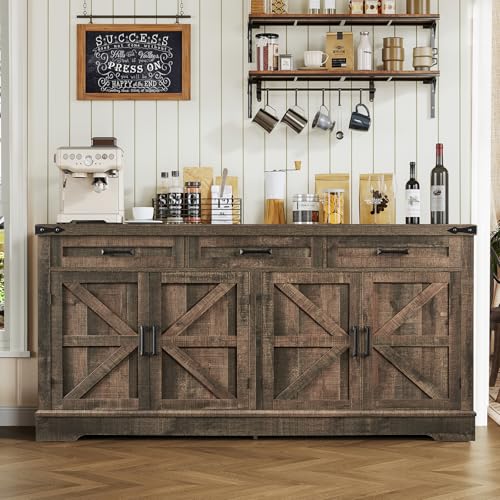
usikey Buffet Cabinet, 61” Large Sideboard Buffet Storage Cabinet with 3 Drawers, Farmhouse Coffee Bar with 4 Doors, Buffet Table for Kitchen, Living Room, Antique Oak
Check price on Amazon
Homhedy Coffee Bar Storage Cabinet with Drawers, Kitchen Buffet Cabinet | Sideboard Cabinet with Doors, Farmhouse Buffet Cabinet, Adjustable Shelves, for Kitchen / Dining / Living Room, White
Check price on Amazon
HOSTACK Kitchen Buffet Cabinet with Storage, Sideboard Coffee Bar, White | Farmhouse Kitchen Storage Cabinet with 3 Drawers & Adjustable Shelf & Doors, 42.5"W Buffet Table for Dining Living Room
Check price on AmazonPairing Your Sideboard With the Rest of the Room
A farmhouse sideboard should feel like part of a family, not an orphan. It does not need to match the dining set exactly, but it should share at least one visual cue—wood tone, hardware finish, or a similar leg profile.
If your dining table is a warm natural pine, a whitewashed sideboard creates a pleasing contrast without clashing. If the table is a dark stained oak, a sideboard with matching dark hardware ties the two together. For bench seating, consider a farm table and bench set and a sideboard that echoes the table's apron detail. If you are building the room around a farmhouse dining set for eight with bench, choose a sideboard long enough to serve as a buffet station without crowding the table.
Lighting matters too. A sideboard under a farmhouse light fixture or flanked by wall sconces becomes a focal point. If your ceiling height allows, a pendant or chandelier centered above the sideboard can define the zone even in an open floor plan.
Care and Maintenance
Farmhouse finishes are designed to age gracefully, but a little care extends the life of the piece:
- Dust regularly with a soft, lint-free cloth. Avoid abrasive cleaners that dull the finish.
- Use coasters and trivets under hot dishes and damp glasses to prevent rings and heat marks.
- Re-oil or wax natural wood surfaces once or twice a year with a furniture-grade product to maintain moisture balance.
- Keep out of direct sunlight where possible; rotate decorative items so the finish fades evenly.
- Address spills promptly with a slightly damp cloth, then dry immediately. Avoid soaking the wood.
For a deeper dive into protecting wood surfaces, see our wood polish and conditioner guide.
Farmhouse Sideboards for Small Dining Rooms
Small rooms can absolutely accommodate a farmhouse sideboard—the trick is choosing the right proportions and finish. A narrow, tall model with open shelving keeps the floor footprint minimal while adding vertical storage. Light or whitewashed finishes reflect light and recede visually, making the room feel larger. Consider a wall-mounted or floating design if you need to preserve floor space for a drop-leaf small dining table.
If the room is genuinely tight, a farmhouse kitchen island with seating and storage can serve double duty as both prep space and buffet, freeing up wall space entirely.
Placement Ideas by Room Layout
- Opposite the table: The classic layout. The sideboard becomes the visual backdrop to every meal and provides easy access for serving.
- Perpendicular to the table: Works well in narrow rooms and creates a more intimate dining nook feel.
- In an open-concept space: Position the sideboard as a low divider between the dining area and living room. Keep both sides styled so it looks intentional from every angle.
- In a hallway or entryway: A shallow farmhouse sideboard can double as a console table, catching mail and keys while adding rustic character.
Frequently Asked Questions
What size farmhouse sideboard do I need for my dining room?
Measure the available wall space and aim for a sideboard that leaves at least 36 inches of clearance in front for comfortable movement. A common guideline is to choose a sideboard approximately two-thirds the length of your dining table for visual balance.
How do I style a farmhouse sideboard without clutter?
Use the rule of three: group items in odd numbers, vary heights, and leave negative space. Anchor with a large piece like a mirror or artwork, add a lamp or vase for height, and finish with a small tray or bowl for function.
What materials are best for a farmhouse sideboard?
Solid wood such as oak, pine, or mango is the most traditional and durable choice. Reclaimed wood adds authentic rustic character. For a lighter look, painted finishes over solid wood or high-grade engineered wood with wood veneer are popular options.
Can a farmhouse sideboard work in a small dining room?
Yes. Choose a narrow depth, opt for a vertical configuration with open shelving, and select light or whitewashed finishes to keep the space feeling airy. Wall-mounted or floating designs also save floor space.
Should the sideboard match the dining table?
It does not need to match exactly. Sharing one visual cue—wood tone, hardware finish, or leg profile—is enough to create cohesion. Deliberate contrast can also look intentional when the rest of the room is consistent.
Ready to Choose Your Farmhouse Sideboard?
Browse our curated selection of farmhouse sideboards and buffet cabinets, compare configurations, and find the piece that fits your room and your storage needs.
View Recommended Sideboards