
Fluted Sideboard Buying Guide
Everything you need to know about choosing a fluted sideboard for your dining room — from ribbed detailing and material options to sizing, storage layout, and styling.
What Is a Fluted Sideboard?
A fluted sideboard is a dining room storage piece defined by vertical ribbed detailing — the "fluting" — running across its doors or drawers. The look draws from classical architecture, where fluted columns used shallow vertical grooves to create rhythm and shadow. In furniture, that same principle translates into a textured front that catches light, hides fingerprints, and adds visual depth without relying on ornate carving.
Unlike a plain slab-front buffet or sideboard, a fluted design is tactile. The ribbing gives the cabinet a sculptural quality that reads as modern in a minimalist room and as softly traditional in a transitional one. Most fluted sideboards fall into two families: vertical fluting across the full door face, or fluting confined to drawer fronts for a subtler effect.
Why Choose a Fluted Sideboard
A fluted sideboard earns its place in a dining room for several practical and aesthetic reasons:
Visual Texture
The ribbed front adds depth and shadow, so the piece reads as a design feature rather than a flat storage box.
Hides Wear
Vertical grooves break up surface area, which helps disguise light scratches, smudges, and everyday marks better than a glossy flat panel.
Style Versatility
Works in modern, mid-century, Japandi, and transitional rooms. The fluting keeps the silhouette clean while adding interest.
Concealed Storage
Doors and drawers keep serveware, linens, and glassware out of sight — ideal for open-plan dining and kitchen areas.
If your dining space already has strong focal points, such as a fluted dining table or a statement lighting fixture, a lightly fluted sideboard can echo those lines without competing. In a quieter room, a fully ribbed piece can carry the design on its own.
Materials and Finishes
The fluting effect depends heavily on how the piece is constructed. There are three main approaches, each with different characteristics:
- Solid wood fluting: The ribs are milled from solid timber. This gives the crispest shadow lines and the most authentic texture. Solid wood is a long-term investment and can be refinished, but it is sensitive to humidity swings.
- MDF or engineered wood with routed fluting: The ribs are cut into a manufactured panel and then veneered or painted. This is common in mid-range and premium pieces and can look very close to solid wood. Paint finishes hide joints well; veneers show the grain pattern.
- Applied ribbing: Separate strips are attached to a flat door. This appears mostly in entry-level and decorative pieces. It can look convincing from a distance but may show gaps or loosening over time.
Finish choice affects maintenance. Matte lacquer and oil finishes soften the ribbing and are easy to touch up. High-gloss finishes make the fluting pop but show dust in the grooves. For painted fluted pieces, a satin or eggshell sheen is usually the most forgiving in a dining room.
Sizing and Placement
Sideboard size should follow the wall and the table, not the other way around. As a rule of thumb, a sideboard should be shorter than the dining table it accompanies and leave at least 36 inches of clearance in walkways. For a wall-mounted placement, aim for a piece that spans roughly two-thirds to three-quarters of the wall width it sits against.
| Room Type | Suggested Length | Depth Range | Best For |
|---|---|---|---|
| Small dining room or apartment | Compact (around 40–48 inches) | Shallow (14–16 inches) | Narrow walls, entryways, tight circulation |
| Standard dining room | Mid-size (around 54–66 inches) | Standard (16–18 inches) | Everyday serveware and linen storage |
| Large or open-plan space | Wide (around 72–84 inches) | Standard to deep (17–20 inches) | Buffet service, display, and glassware storage |
Height matters too. A sideboard that sits around 30–36 inches tall aligns roughly with the dining table surface and works comfortably for buffet service. If you plan to hang art or a mirror above it, leave 8–12 inches of breathing room between the top of the sideboard and the bottom of the wall piece.
Storage Layout and Function
Fluted fronts can hide a range of internal layouts. Before choosing, think about what you actually store and how often you reach for it:
- Door-and-shelf layouts suit large platters, stacks of plates, and folded linens. Adjustable shelves are worth prioritizing.
- Drawer-heavy layouts work well for flatware, napkins, candles, and small serving tools. Soft-close runners make a noticeable difference in daily use.
- Mixed layouts — doors on one side, drawers on the other — are the most flexible and common in mid-range and premium fluted sideboards.
- Open or glass sections are less common on fluted pieces, but some designs pair ribbed doors with a glass display section for stemware.
Also check cable management if you plan to place a lamp or small appliance on top, and confirm whether the interior has felt-lined drawers or adjustable shelving. A fluted sideboard with a solid internal layout will do more for a dining room than an elaborate exterior with shallow, awkward compartments.
Quality Tiers Explained
Fluted sideboards vary widely in build quality. Rather than focusing on any single number, it helps to understand where a piece sits in the market. The tiers below describe relative positioning and construction expectations.
| Tier | Typical Construction | Best For |
|---|---|---|
| Entry-level | Engineered wood with applied or routed fluting, basic hinges, limited shelf adjustment | First apartments, guest rooms, short-term styling needs |
| Mid-range | Veneered or painted engineered wood with clean routed fluting, soft-close hardware, adjustable shelves | Most family dining rooms and open-plan living areas |
| Premium | Solid wood or high-grade veneer fluting, dovetail or dowel joinery, quality soft-close runners, solid wood legs | Long-term dining room centerpieces and frequent entertaining |
| Luxury / commercial-grade | Hand-finished solid timber, bespoke fluting profiles, precision joinery, custom hardware and finishes | Design-led spaces, custom interiors, high-traffic hospitality use |
Across tiers, the most reliable quality signals are consistent rib spacing, flush door alignment, smooth drawer action, and a back panel that is properly attached. A mid-range fluted sideboard with excellent hardware will usually outperform a premium-looking piece with sloppy internals.
Styling a Fluted Sideboard
Because the front of a fluted sideboard is already visually busy, the top surface benefits from restraint. A common approach is to group objects in threes: a taller element, a medium piece, and a low accent. For example, a vase, a stack of dinnerware or a decorative bowl, and a small candle holder or fruit bowl.
Consider the room's palette. Warm neutral fluted pieces pair well with linen table runners and natural textures. Dark or painted fluted sideboards can handle bolder glassware and metallic accents. If the sideboard is used for buffet service, leave one clear zone on top for serveware and keep decorative items to the edges.
Hanging a mirror or artwork above the sideboard can anchor it, but keep the bottom edge clear so the fluting remains visible. Lighting is equally important — a pair of wall sconces or a small table lamp will graze the ribs and emphasize the texture.
Care and Maintenance
Fluted fronts collect dust in the grooves, so a routine that includes the ribs specifically will keep the piece looking sharp. Use a soft microfiber cloth or a vacuum brush attachment for weekly dusting. For painted or lacquered finishes, a slightly damp cloth followed by a dry buff is usually enough.
- Avoid abrasive polishes on painted fluting — they can dull the edges of the ribs.
- For solid wood fluting, apply a furniture conditioner occasionally and keep the piece away from direct heat and prolonged sunlight.
- Use coasters and trivets on the top surface, especially for hot serveware.
- Check door hinges and drawer runners periodically; a small adjustment keeps the rib lines aligned.
If the fluted sideboard sits in an open-plan kitchen, wipe down the front more frequently — airborne cooking residue settles into the grooves. For deeper guidance, see the dining furniture care section.
Recommended Fluted Sideboards & Dining Storage
⚠️ AFFILIATE DISCLOSURE: This website contains affiliate links. As an affiliate Associate, we earn from qualifying purchases. If you make a purchase through these links, we may receive a small commission at no additional cost to you. Read our full affiliate policy.

OneBlis 63" Fluted Sideboard Buffet Cabinet with Sliding Door, Mid-Century Modern Wood Sideboard, Adjustable Shelf, Coffee Bar Cabinet with Storage for Kitchen, Walnut
Check price on Amazon
Homleke Fluted Buffet Cabinet with Storage, Modern Sideboard Cabinet | Double Doors, Adjustable Shelf, Accent Buffet Table for Kitchen, Dining Room, Living Room, Entryway & Hallway, Natural
Check price on Amazon
Evermagin 67" Fluted Oak Buffet Cabinet with Storage | Mid-century modern wood sideboard, large credenza with 6 doors for kitchen or living room, 67"W x 31.5"H x 15.7"D
Check price on Amazon
OneBlis 55" Fluted Sideboard Buffet Cabinet with Sliding Door, Mid-Century Modern Wood Sideboard, Adjustable Shelf, Coffee Bar Cabinet with Storage for Kitchen, Walnut
Check price on Amazon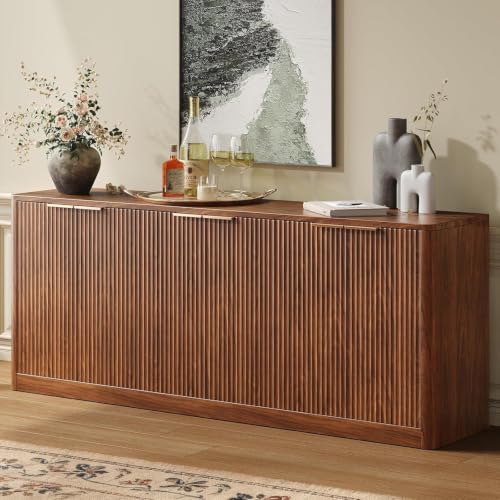
Evermagin 67" Fluted Walnut Buffet Cabinet with Storage | Mid-Century Modern Wood Sideboard, Large Credenza With 6 Doors for Kitchen or Living Room, 67"W x 31.5"H x 15.7"D
Check price on Amazon
VASAGLE Storage Cabinet, Sideboard with Adjustable Shelves | Mid-Century Modern Buffet Cabinet, 55.1 x 15.7 x 29.5 Inch, for Living Room, Walnut, MIRIANA Collection ULSC631KX01
Check price on AmazonFrequently Asked Questions
Is a fluted sideboard suitable for a small dining room?
Yes, provided you choose a compact, shallow model. Fluting adds visual texture, but a compact piece with a shallow depth keeps circulation clear. Measure the wall and leave at least 36 inches of walkway clearance before committing.
Does fluting make a sideboard harder to clean?
It requires slightly more attention than a flat front because dust settles in the grooves. A soft brush attachment and a microfiber cloth make weekly cleaning quick. Painted and lacquered finishes are generally the easiest to maintain.
Can I pair a fluted sideboard with a fluted dining table?
Yes, but keep the scale balanced. If both pieces are strongly ribbed, choose a quieter chair and lighting scheme. Alternatively, pair a fluted sideboard with a smooth-top table to let the sideboard carry the texture.
What should I check before buying a fluted sideboard online?
Confirm the exterior dimensions, interior shelf adjustability, door and drawer hardware, and the return policy. Look for close-up photos of the rib profile and door alignment. Check whether the back panel is finished, especially if the piece will float in an open-plan space.
How do I know if the fluting is solid wood or applied?
Check the product description and close-up images. Solid or routed fluting usually shows continuous grain or clean routed channels; applied ribbing may show seams at the edges. If the listing is unclear, contact the seller before purchasing.
Ready to compare options? Explore fluted sideboards and coordinating dining storage above, then check measurements and availability before you decide.
Explore Fluted Sideboard Options