
Folding 2 Step Stool: The Complete Buying Guide
Everything you need to know before choosing a folding two-step stool for your kitchen, dining room, or utility space — safety ratings, weight capacity, materials, and the features that matter most.
View Recommended ModelsWhat Is a Folding 2 Step Stool?
A folding 2 step stool is a compact, portable two-tier stepping platform that collapses flat for storage. Unlike a fixed step ladder, it is designed to be kept close at hand in the kitchen, pantry, or dining area — ready to reach high cabinets, top shelves, or overhead storage without dragging out a full-size ladder.
Most models feature two wide, non-slip steps, a folding hinge mechanism, and rubberized feet for floor protection. When folded, the stool typically measures just 2–3 inches thick, making it easy to slide into a narrow gap or hang on a hook. The two-step design is the sweet spot for residential use: high enough to reach standard upper cabinets (around 18–24 inches of elevation) but low enough to feel stable and approachable for everyday use.
These stools are especially popular in homes with limited storage, open-concept kitchens, and dining rooms where a permanent ladder would be an eyesore. They also serve well in laundry rooms, garages, and closets. If you are outfitting a dining space and want to keep the area uncluttered, pairing a folding step stool with a drop-leaf folding dining table creates a flexible, space-smart setup.
Why Every Kitchen and Dining Space Needs One
Upper cabinets are a fact of kitchen life, and the items stored there — seasonal dinnerware, serving platters, bulk pantry goods — are usually the ones you need a boost to reach. A folding 2 step stool solves this without the bulk of a permanent ladder.
- Instant access to high storage: Reach the top shelf of a pantry or the upper row of kitchen cabinets safely, with two stable steps instead of balancing on a chair.
- Compact storage: Folds to a slim profile that tucks beside the refrigerator, inside a closet, or under a console.
- Versatile across rooms: Useful in the kitchen, dining room, laundry, garage, and even the living room for high shelving or window cleaning.
- Safer than improvised solutions: Standing on a dining chair or a bucket is a leading cause of household falls. A dedicated step stool with non-slip treads and a locking mechanism is far safer.
- Senior-friendly options: Many models include handrails, wider platforms, and gentle step heights that make them accessible for older users.
For families, a step stool is also a practical companion to kid-friendly dining setups. If you are designing a space that works for all ages, our kid-friendly dining guide covers additional considerations for safe, adaptable furniture.
7 Key Buying Factors for a Folding 2 Step Stool
Before you compare models, understand the features that separate a solid, long-lasting stool from one that wobbles or fails early. These seven factors matter most.
Material Comparison: Aluminum, Steel, Wood, and Plastic
The material of your folding 2 step stool affects weight, durability, aesthetics, and how well it fits your kitchen's design. Here is how the main options compare.
| Material | Best For | Strengths | Considerations |
|---|---|---|---|
| Aluminum | Portability and everyday kitchen use | Lightweight, rust-proof, easy to carry and hang | Lower weight capacity on some models; can feel less rigid than steel |
| Steel | Heavy-duty and commercial-grade use | High weight capacity, very stable, durable construction | Heavier to move; powder coating must be intact to prevent rust |
| Wood | Traditional and farmhouse kitchens | Warm aesthetic, solid feel, blends with wood cabinetry | Heavier, requires occasional maintenance, less water-resistant |
| Plastic | Light household tasks and budget-conscious setups | Very lightweight, easy to clean, often stackable | Lower weight limits, can crack under heavy loads or UV exposure |
For most homes, aluminum is the sweet spot: light enough to carry one-handed, strong enough for daily kitchen use, and resistant to rust in humid environments. Steel is the choice when the stool will be used by heavier users or in a workshop setting. Wood suits design-conscious spaces where the stool will sit visible in the kitchen. Plastic works for light, occasional use.
If your dining area leans toward a particular style, the stool material should complement it. A wood stool pairs naturally with a farmhouse dining table set, while aluminum or steel fits a mid-century dining room set or glass and metal dining sets.
Safety Features to Prioritize
Step stools are involved in a significant share of household fall injuries, especially among older adults. The right features dramatically reduce risk.
- Wide, non-slip steps: Both tiers should have textured or rubberized surfaces. Avoid models with bare metal or smooth plastic steps.
- Positive locking hinge: The stool must lock firmly open. A stool that can fold while someone is standing on it is dangerous.
- Handrail or grab bar: A vertical or loop handle gives a secure grip when stepping up and down. This is the single most important feature for seniors.
- Rubber feet with a wide stance: Splayed feet increase stability and protect floors. Check that the feet are replaceable.
- Rounded edges: Sharp corners on steps or the frame can cause injuries during handling and storage.
- Weight capacity margin: Choose a stool rated well above the intended user's weight — a 20–30% margin is a sensible buffer.
Fitting a Folding 2 Step Stool Into a Small Space
The main advantage of a folding stool is that it disappears when not in use. Here are practical storage strategies for compact kitchens and dining rooms.
- Beside the refrigerator: The gap between the fridge and wall or counter is often 3–6 inches — ideal for a folded stool.
- Inside a pantry or broom closet: Lean it against the wall or hang it from a hook.
- Under a console or bench: A narrow storage bench can hide the stool out of sight.
- Hanging on a peg or hook: Many models include a built-in handle designed for hanging.
- Behind a door: An over-the-door hook keeps the stool accessible but out of the way.
In small dining rooms, the stool can live in the kitchen and be brought out only when needed. If you are optimizing a compact dining area, our guide to small dining room layouts covers space-saving furniture combinations that work alongside a folding stool.
For households that also need flexible table space, consider how the stool complements other folding furniture — a foldable bar table, a height-adjustable folding table, or a folding high-top table can all be paired with a step stool for a fully adaptable setup.
Tier Guide: From Entry-Level to Premium
Folding 2 step stools fall into distinct market tiers. Understanding these tiers helps you match features to your needs without over- or under-buying.
| Tier | Best For | Typical Characteristics |
|---|---|---|
| Entry-level | Light, occasional household use | Basic folding mechanism, plastic or thin aluminum, lower weight capacity, simple treads |
| Mid-range | Daily kitchen use for most households | Sturdier aluminum or steel frame, wider non-slip steps, reliable locking hinge, rubber feet |
| Premium | Frequent use, heavier users, senior households | Reinforced frame, high weight capacity, handrail, extra-wide treads, smooth folding action, refined finish |
| Commercial-grade | Workshops, restaurants, institutional settings | Heavy-duty steel, 500 lb capacities, industrial locking systems, replaceable parts |
For most homes, a mid-range aluminum or steel model offers the best balance of durability, safety, and portability. Step up to premium if the stool will be used daily by seniors or heavier users, or if you want a handrail and the smoothest folding action. Entry-level works for a guest room or occasional closet use.
Common Buying Mistakes to Avoid
- Ignoring the folded thickness: A stool that folds to 5 inches will not fit the 3-inch gap beside your fridge. Measure first.
- Underestimating weight needs: Choose a capacity with margin. A stool rated exactly at the user's weight offers no safety buffer.
- Overlooking step width: Narrow steps feel unstable. Prioritize wide, deep treads, especially for seniors.
- Skipping the handrail: If anyone in the household has balance concerns, a handrail is not optional — it is the key safety feature.
- Buying plastic for heavy use: Plastic stools are fine for light tasks but can crack under repeated heavy loads.
- Not testing the lock: A folding stool must lock firmly. If the lock feels vague or loose, choose another model.
- Forgetting floor type: Slick tile demands rubber feet with good grip; hardwood needs soft pads to prevent scratches.
Recommended Folding 2 Step Stools
⚠️ AFFILIATE DISCLOSURE: This website contains affiliate links. As an affiliate Associate, we earn from qualifying purchases. If you make a purchase through these links, we may receive a small commission at no additional cost to you. Read our full affiliate policy.

HBTower 2 Step Ladder, Folding Step Stool with Wide Anti-Slip Pedal | Step Stool Foldable with Cushioned Handle for Home and Kitchen, Black
Check price on Amazon
Ligebul 2 Step Stool Foldable for Adults, Plastic Folding Step Stool, Black | 17 Inch Bedside Step Stool for High Beds, Two Step Ladder Collapsible Step Stools for Kitchen, Home, Bathroom, RV, Pool
Check price on Amazon
HBTower 2 Step Ladder, Step Stool for Adults | 2 Step Ladder Folding Step Stool with Wide Pedal Ergonomic Design
Check price on Amazon
HBtower 2 Step Ladder, Step Stool with Wide Anti-Slip Pedal | Step Ladder Folding Step Stool for Adults, Lightweight Steel Portable ladders for Home Kitchen
Check price on Amazon
HBtower 2 Step Ladder, Step Stool with Wide Anti-Slip Pedal | Folding Step Stool with Convenient Handle for Home and Kitchen, Black
Check price on Amazon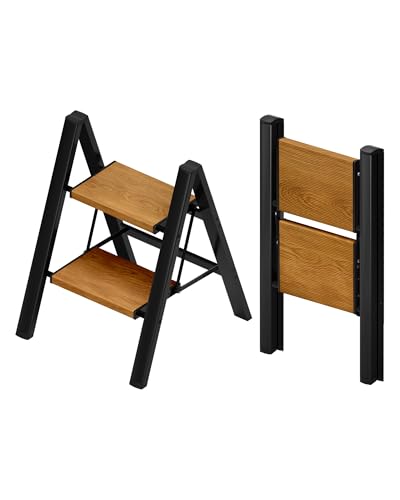
Taranta 2 Step Stool Foldable,Aluminum Step Ladder-Blackwoodgrain | Lightweight,Wide Anti-Slip Pedals,Folding Step Stool,330lbs Capacity for Household,Kitchen,Office
Check price on Amazon
Folding 2-Step Stool for Adults, Non-Slip Collapsible Footstool for Office | Portable Bedside Step Stool, Hold up to 300 lbs, Lightweight & Foldable Step Ladder for Pool Office Home RV
Check price on Amazon
Delxo Folding Step Stool 13 Inch,300 Lbs Step Stool for Adults Black | Foldable Step Stool 13",Non-Slip Foot Stools with Handle,Lightweight Collapsible stools for Kitchen,Bathroom,Bedroom,Garden
Check price on AmazonReady to Choose Your Folding 2 Step Stool?
Use the buying factors above to shortlist models, then compare the recommended options to find the one that fits your kitchen, your storage, and your safety needs.
Compare Top PicksFrequently Asked Questions
What weight capacity should a folding 2 step stool support?
Most quality folding 2 step stools support between 225 and 300 pounds. Heavy-duty models can support up to 500 pounds. Always check the manufacturer's stated weight capacity and choose a model that exceeds the weight of the heaviest expected user — a 20–30% margin is a sensible safety buffer.
Are folding 2 step stools safe for seniors?
Yes, when chosen carefully. Look for models with wide non-slip treads, a built-in handrail or grab handle, a positive locking mechanism, and sturdy construction. A step stool with a safety bar and rubber feet provides extra stability for seniors. Avoid narrow steps and models without a handrail.
What materials are best for a folding 2 step stool?
Aluminum is lightweight, rust-proof, and ideal for portability. Steel is heavier-duty and supports higher weight capacities. Wood offers a warm aesthetic that fits traditional kitchens but requires more maintenance. Plastic is the most lightweight option but typically has lower weight limits. For most homes, aluminum or steel is the best all-around choice.
How do I store a folding 2 step stool in a small kitchen?
A folding 2 step stool collapses flat to about 2–3 inches thick. Store it in a narrow gap between the refrigerator and wall, hang it on a hook in a closet, tuck it beside a cabinet, or slide it under a bed. Some models feature a built-in handle for easy carrying and hanging. Measure your available gap before buying.
How high does a 2 step stool let me reach?
Most folding 2 step stools elevate the user about 18–24 inches. A person of average height can typically reach ceilings and upper cabinets around 8–9 feet. Step height varies by model, so check the manufacturer's specifications if you need to reach a specific height.
Can a folding 2 step stool be used outdoors?
Aluminum and powder-coated steel models can be used outdoors for light tasks, but most folding step stools are designed for indoor use. If you need outdoor stepping, look for rust-proof materials and weather-resistant finishes. For outdoor dining and entertaining, pair the stool with a outdoor dining table and chairs set or an outdoor high-top table and chairs.
Final Thoughts
A folding 2 step stool is one of those small purchases that quietly improves daily life in the kitchen and dining room. It gives you safe access to high storage, disappears when not in use, and — when chosen well — provides years of reliable service.
Focus on the fundamentals: a weight capacity with margin, wide non-slip steps, a positive locking hinge, and rubber feet. If anyone in your household has balance concerns, add a handrail to the must-have list. Match the material to your kitchen's style and your storage constraints, and the stool will earn its place.
For more guidance on outfitting your dining space, explore our related guides on folding chairs with shades, kid-friendly dining, and dining tables to build a home that works for every member of the family.