
Mid-Century Modern Counter Stools with Backs: The Complete Buying Guide
Discover how to choose retro-inspired counter stools that combine ergonomic back support with the clean lines, tapered legs, and warm materials that define mid-century design.
Explore Recommended ModelsWhy this guide matters: If you have already narrowed your search to mid-century modern counter stools with backs, you are past the browsing stage and into decision mode. The remaining questions are practical: which seat height fits my counter, which backrest style supports long meals, how many stools fit my island, and which materials will hold up to daily use. This guide answers each of those questions in sequence, then points you toward models that suit different tiers and needs.
What Defines a Mid-Century Modern Counter Stool?
Mid-century modern design emerged in the middle of the twentieth century and is characterized by clean, organic lines, a lack of ornamentation, and an emphasis on functionality. When those principles are applied to counter-height seating, a few recognizable traits emerge:
- Tapered and splayed legs — often in solid wood or slim metal, angled slightly outward for visual lightness.
- Curved or sculpted backrests — low, wide backs that follow the natural curve of the spine rather than a rigid vertical slab.
- Warm wood tones — walnut, teak, and oak finishes that anchor the design in natural materials.
- Upholstered or molded seats — faux leather, bouclé, and fabric seats that add comfort without bulk.
- Restrained palettes — mustard, olive, rust, and neutral tones that read as intentional rather than trendy.
Stools that carry these traits generally pair well with the broader mid-century modern dining room aesthetic, especially when the kitchen island or counter is visible from the dining area. If you are still deciding between stool types more broadly, the guide to mid-century modern stools covers backless and bar-height variations as well.
Counter Height vs. Bar Height: Getting the Numbers Right
The most common ordering mistake is buying a stool whose seat height does not match the counter. Counter-height surfaces are typically 34 to 36 inches high, while bar-height surfaces are typically 40 to 42 inches. Mid-century counter stools with backs are usually built with seat heights around 24 to 26 inches, which leaves the recommended 9 to 12 inches of clearance between the seat and the counter edge.
Before ordering, measure three things: the finished height of your counter, the depth of the counter overhang, and the distance from the floor to the underside of the counter. Stools with a tall backrest or an angled frame can occasionally collide with an overhang, so check the product's overall height and depth rather than only its seat height.
Why a Backrest Matters More Than You Think
Backless stools are convenient for tucking away, but they push the sitter's weight entirely onto the hips and thighs. A backrest, even a low one, distributes load across the lower back and makes longer conversations at the island far more comfortable. In mid-century design, backrests are rarely tall or rigid; they are usually curved, slightly reclined, and sized to support the lumbar region without blocking sightlines into the kitchen.
Three common backrest styles appear in this category:
- Low curved back — the most authentic mid-century silhouette; supports the lower back while keeping the stool visually light.
- Wraparound back — a continuous curve that extends slightly around the sides; offers more support for longer seating sessions.
- Upholstered shell back — a padded, molded backrest that blends comfort with a sculptural profile.
If the stools will be used for casual breakfasts and quick coffee breaks, a low curved back is usually sufficient. If they double as workspace seating for laptops or homework, a wraparound or upholstered shell back is the more comfortable choice. For households that also need bar-height seating, the options in mid-century modern bar stools follow the same design language.
Materials and Build Quality by Tier
Material choice affects comfort, durability, and how well the stool fits the rest of the room. The table below groups common build configurations by market tier so you can match expectations to what you actually need, without relying on numbers that go stale.
| Tier | Typical Frame | Typical Seat | Best For |
|---|---|---|---|
| Entry-level | Veneered engineered wood, painted metal legs | Faux leather or basic fabric over foam | Occasional use, starter apartments, rental kitchens |
| Mid-range | Solid rubberwood or oak, powder-coated steel accents | Faux leather or woven fabric with denser foam | Daily family use, breakfast bars, open-plan kitchens |
| Premium | Solid walnut or teak, reinforced joinery, brass or blackened metal | Performance fabric, bouclé, or top-grain faux leather | Design-led interiors, long meals, high-traffic islands |
| Luxury / flagship | Hand-finished hardwood, artisan metalwork, mortise-and-tenon joints | Genuine leather or premium wool upholstery | Statement kitchens, formal open-plan entertaining spaces |
Across all tiers, check the following before you commit:
- Joint construction: Look for reinforced corner blocks, visible dowels, or metal brackets rather than staples alone.
- Foam density: Higher-density foam resists flattening; lower-density foam compresses within months of daily use.
- Footrest placement: A well-positioned footrest reduces strain on the legs; on mid-century frames it is often integrated into the front stretcher.
- Floor protection: Glides or felt pads on the leg tips protect hardwood and tile from scratches.
How Many Stools Fit Your Island or Counter?
Spacing is the second most common ordering mistake. A reliable rule is to allow roughly 24 inches of linear space per stool, plus a few inches between seats so elbows do not collide. That translates to:
- 4-foot island: two stools.
- 6-foot island: three stools.
- 8-foot island: three to four stools, depending on seat width.
Mid-century stools sometimes have splayed legs that extend wider than the seat cushion, so measure the overall footprint rather than only the seat width. If your island has a sink or cooktop cut into the surface, leave at least 15 inches between the appliance edge and the first stool to keep the work zone clear.
Styling Mid-Century Counter Stools with the Rest of the Room
Counter stools are rarely the visual focus of a kitchen, but they are almost always visible from the dining area, so their materials and tones should feel related to the adjacent furniture. A few approaches work reliably:
- Match the wood tone to the dining table. A walnut stool frame next to a mid-century dining table in a similar finish reads as a coordinated set, even if the two pieces come from different makers.
- Repeat the upholstery across rooms. If the dining chairs are upholstered in a warm neutral, choosing counter stools in the same or a closely related tone ties the spaces together.
- Use metal accents as a bridge. Blackened steel or brass legs can echo the light fixtures above a dining table or island, creating a subtle vertical connection.
- Keep the palette restrained. Two or three tones are usually enough; adding a fourth accent color tends to make the area feel cluttered.
If the stools sit at an island that opens onto a dining space, the guide to mid-century modern kitchen islands with seating explains how stool choice interacts with island proportions and overhang depth.
Comfort and Ergonomics Checklist
Design details matter, but comfort is what keeps the stools in daily use. Run through this checklist before ordering:
- Seat depth: 15 to 17 inches is comfortable for most adults; deeper seats push shorter sitters forward.
- Seat width: 16 to 19 inches per stool; wider seats are more comfortable but reduce how many stools fit.
- Backrest height: 10 to 14 inches above the seat provides meaningful lumbar support without blocking views.
- Footrest height: 7 to 9 inches above the floor suits most adults; children need a lower footrest or a separate booster.
- Cushion firmness: Medium-firm foam balances support and long-sitting comfort; overly soft cushions compress quickly.
- Swivel or fixed: Fixed stools feel more stable in narrow spaces; swivel models are easier to get in and out of at wide islands.
Assembly, Care, and Long-Term Upkeep
Most mid-century counter stools ship with legs detached or the backrest needing to be bolted on. Assembly usually takes 20 to 40 minutes per stool with basic tools. Tighten all bolts after the first week of use, then check them again every few months, because wood frames expand and contract with seasonal humidity changes.
Care routines depend on the materials:
- Wood frames: Dust weekly and apply a wood conditioner two to three times a year. Keep the stools out of direct sunlight to prevent uneven fading.
- Faux leather seats: Wipe with a damp cloth and mild soap; avoid abrasive cleaners that dull the surface.
- Fabric seats: Vacuum with a brush attachment monthly and spot-clean promptly to prevent stains from setting.
- Metal legs: Wipe with a dry cloth; use a metal polish occasionally on brass or blackened finishes.
For broader maintenance guidance across dining furniture, the care and maintenance section covers wood, upholstery, and metal care in more depth.
Recommended Mid-Century Modern Counter Stools with Backs
⚠️ AFFILIATE DISCLOSURE: This website contains affiliate links. As an affiliate Associate, we earn from qualifying purchases. If you make a purchase through these links, we may receive a small commission at no additional cost to you. Read our full affiliate policy.

Bekrvio Swivel Counter Height Bar Stools Set of 3, 26" Seat Height, Sand | Mid-Century Modern, Counter Stools with Backs, Weathered Beech Wood Legs, Linen Fabric Upholstered, For Kitchen Island, Bar
Check price on Amazon
MOLENE Metal Bar Stools Set of 4, 26″ Counter Height Bar Stools with Backs, Mid Century Modern Upholstered Barstools for Kitchen Island, Dining Room, Green
Check price on Amazon
MALOL Counter Height Bar Stools Set of 3, Kitchen Bar Stools with Back, Mid Century Modern Upholstered Barstools with Wood Legs for Kitchen Island, Beige
Check price on Amazon
COLAMY Counter Height Bar Stools Set of 2, Kitchen Bar Stools with Back, Mid Century Modern Upholstered, with Wood Legs for Kitchen Island Dining Room, Beige
Check price on Amazon
COLAMY Bar Stools Set of 2, Counter Height BarStools with Back, Mid Century Modern Upholstered, with Wood Legs for Kitchen Island Dining Room, Camel
Check price on Amazon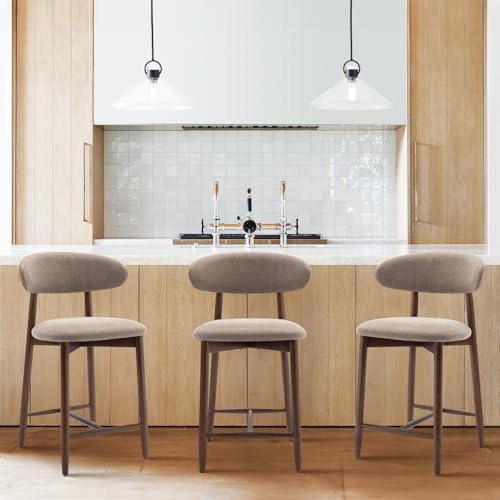
COLAMY Bar Stools Set of 3, Counter Height BarStools with Back, Mid Century Modern Upholstered, with Wood Legs for Kitchen Island Dining Room, Camel
Check price on Amazon
VASAGLE Bar Stools Set of 2, Counter Height, PU Leather, 26-Inch | Mid-Century Modern Bar Stool with Stitching, Kitchen, Home Bar, Dining Room, Caramel Brown, EKHO Collection ULBC086K01
Check price on AmazonFrequently Asked Questions
What seat height should mid-century modern counter stools with backs have?
Counter stools are typically designed to pair with counters that are 34 to 36 inches high. The ideal seat height usually falls between 24 and 26 inches, leaving roughly 9 to 12 inches of clearance between the seat and the underside of the counter. Always measure your counter overhang and confirm the stool's listed seat height before ordering.
Are backless or backed counter stools better for a mid-century kitchen?
Backed stools offer more lower-back support and a more grounded visual presence, which suits mid-century interiors well because the angled or curved backrest echoes the era's furniture silhouettes. Backless stools tuck away more easily and keep sightlines open in compact kitchens. Many homeowners mix both depending on whether the stools sit at an island or against a wall.
Which materials are most common in mid-century modern counter stools?
Walnut and teak-toned solid wood frames are the classic choices, often paired with upholstered seats in faux leather, bouclé, or woven fabric. Metal accents such as tapered steel legs with a black or brass finish are also common. Mixed-material builds combining wood and metal are popular because they balance warmth with a clean, architectural look.
How many counter stools fit under a typical kitchen island?
A common rule is to allow about 24 inches of width per stool, plus a few inches of breathing room between seats. For a 6-foot island, that usually means three stools. Confirm the actual seat width and any armrests, since angled mid-century frames can be wider than their seat cushions suggest.
Do mid-century counter stools with backs require assembly?
Many models ship partially assembled, with legs or base attached on arrival. Others require full assembly of the seat, backrest, and legs. Check the product listing for assembly details, and note whether tools are included. Stools with upholstered backs sometimes need the backrest bolted on separately.
Final Checklist Before You Order
Once you have a shortlist, confirm each of the following for every candidate stool:
- Seat height matches your counter within the recommended clearance range.
- Overall depth and backrest height clear any overhang or cabinetry.
- Seat width and number of stools fit the island length with adequate spacing.
- Upholstery material suits your household's daily use and cleaning habits.
- Assembly requirements match your comfort level and available tools.
- Return policy covers the case where the wood tone does not match the room as expected.
If your search expands beyond counter height, the related guides to mid-century counter stools and mid-century modern bar stools sets of 2 cover adjacent options without overlapping this page's focus.