
Round Table with a Leaf: The Complete Guide
Learn how an extendable round dining table adapts from an intimate breakfast nook to a full holiday gathering. Compare leaf types, seating capacities, and design options before you decide.
Explore Recommended ModelsWhy a round table with a leaf deserves your attention: A round table with a leaf solves one of the oldest dining room dilemmas — how to keep a compact, conversation-friendly footprint day-to-day while still hosting a crowd when the occasion calls for it. Below, we break down how these tables work, who they suit best, and what to examine before clicking "add to cart" on any listing.
What Exactly Is a Round Table with a Leaf?
A round table with a leaf is a circular dining table equipped with one or more extension panels — called leaves — that can be inserted, unfolded, or flipped up to enlarge the tabletop. In its compact form, the table remains a true circle with no wasted corners, which makes it especially efficient in narrow rooms and open-plan kitchens. When guests arrive, the leaf transforms the same table into an oval or larger circle that accommodates additional place settings.
The concept dates back to traditional drop-leaf tables, but modern manufacturing has refined it into several distinct mechanisms. Some models use a single central leaf that slides into a split pedestal base; others rely on two half-moon leaves that fold down at the sides. The best choice depends on how often you entertain, how much storage you have, and whether you prefer a seamless surface or a visible seam where the leaf joins the main top.
Types of Leaves Explained
Not all leaves function the same way. Understanding the mechanism helps you match the table to your routine, your storage situation, and the visual style of your dining room.
Drop Leaf
Hinged panels fold down along the sides of the table. When lowered, the table becomes a narrow console or a small round surface. Ideal for apartments and multifunctional rooms where the table doubles as a desk or prep area.
Butterfly Leaf
Two half-moon panels fold outward from the center like wings. The table stays circular in compact form and becomes an oval when open. A classic choice for traditional and farmhouse interiors.
Removable Center Leaf
A single solid panel slides into a gap created by pulling the table halves apart. Offers the most seamless expanded surface and is common on pedestal-base round tables. The leaf must be stored separately when not in use.
Self-Storing Leaf
The leaf tucks into a compartment beneath the tabletop or inside the pedestal. Premium and luxury tiers increasingly offer this convenience, eliminating the need for closet space and protecting the leaf from damage.
Each mechanism has trade-offs. Drop leaves are the most space-efficient when closed but often leave a visible hinge line. Butterfly leaves preserve the round silhouette but can be fiddly to operate on lower-tier models. Removable center leaves deliver the cleanest expanded surface but require storage planning. Self-storing leaves are the most convenient but appear primarily on high-end and flagship-tier tables.
How Many People Will It Seat?
Seating capacity is the single most practical consideration for anyone shopping this category. The good news is that a round table with a leaf scales predictably. A typical 42- to 48-inch round table seats four comfortably. Adding a 12- to 18-inch leaf usually accommodates six. Larger pedestal models with a 20-inch leaf can seat eight, particularly when the expanded shape becomes oval and allows place settings along the long sides.
Keep in mind that capacity also depends on chair width and whether you use armchairs or side chairs. A table that technically seats eight with narrow bistro chairs may feel crowded with upholstered armchairs. If you regularly host eight or more, consider a model with a built-in lazy susan, which improves serving access on larger round surfaces. You can explore dedicated configurations in our guide to a round dining table with built-in lazy susan.
| Tier | Typical Construction | Best For |
|---|---|---|
| Entry-level | Engineered wood top, basic metal or wood legs, single drop leaf | First apartments, casual breakfast nooks, occasional hosting |
| Mid-range | Solid wood or veneered top, butterfly or removable leaf, reinforced apron | Family dining rooms, regular entertaining, everyday use |
| Premium | Hardwood pedestal base, self-storing leaf, smooth extension mechanism | Formal dining rooms, design-conscious households |
| Luxury | Marble or stone top, precision-machined extension hardware, hand-finished base | Statement dining spaces, long-term investment pieces |
Space Planning: Why Round Beats Rectangular in Tight Rooms
The circular footprint of a round table eliminates corners, which means you can push chairs in closer and still walk around the table without clipping a hip. In a narrow dining room or an open-plan kitchen, this often translates into one or two extra feet of usable circulation space compared with a rectangular table of similar seating capacity.
A leaf-equipped round table compounds that advantage. In daily use, the table occupies a compact circle. When the leaf is deployed, the expanded table projects into space that is temporarily available — typically toward a window, an open doorway, or a living area. This is why the format is so popular in apartments and in homes where the dining room doubles as a home office or homework station.
If your room is particularly tight, a drop-leaf variant may be the best fit. Our overview of a round drop leaf table covers the most space-efficient configurations in more detail.
Materials and Finish Considerations
Because a leaf adds a moving joint to the tabletop, material choice matters more than on a fixed table. Solid hardwood tops handle repeated leaf insertion and removal best, since the joint edges can be refinished if they wear. Veneered tops are a solid mid-range option but require gentler handling around the leaf seam. Glass tops with a leaf are less common and generally rely on a metal frame; they look airy but show fingerprints and require frequent cleaning.
Pedestal bases are the most common support for leaf-equipped round tables because they keep the legs out of the way of chairs on every side. A four-leg round table can still accept a leaf, but the legs limit where chairs can be placed once the table expands into an oval. If you are comparing support styles, our guide to the round table pedestal base explains the stability and legroom trade-offs.
Styling a Round Table with a Leaf
Round tables are forgiving to style because there is no head of the table and no sharp corner to work around. A central centerpiece — a low bowl, a candle cluster, or a small vase — reads well from every seat. When the leaf is deployed and the table becomes oval, shift the centerpiece slightly toward the center of the expanded surface and add a runner along the long axis to visually unify the leaf seam.
Chair selection matters too. Because a round table invites conversation, consider mixing a bench on one side with chairs on the other for a relaxed look, or use four matching chairs in compact mode and add two folding chairs when the leaf goes in. If you prefer a cohesive set, browse our collection of round dining room sets for coordinated table-and-chair combinations.
Buying Checklist Before You Commit
- Measure the expanded footprint, not just the closed one. Add the leaf width to the table diameter and confirm you still have 36 inches of clearance to walls or other furniture on all sides.
- Confirm the leaf storage method. Removable leaves need a flat, dry storage spot; self-storing leaves simplify daily life but usually sit in a higher tier.
- Test the mechanism if possible. A smooth, well-aligned extension is the difference between a table you use and one you avoid. Look for reinforced hardware and alignment pins.
- Check the table height against your chairs. Standard dining height is 28 to 30 inches; counter-height round tables pair with 24- to 26-inch stools. Our guide to a round counter height dining table covers the taller format.
- Match the base to your chair placement. Pedestal bases offer the most freedom; four-leg bases constrain seating once the leaf is in.
- Review the warranty and return policy. Extension mechanisms are mechanical, and a clear warranty protects you if the leaf joint develops play.
Who Should Buy a Round Table with a Leaf?
This format suits three buyer profiles especially well. First, apartment and condo residents who need a compact daily footprint but host family during holidays. Second, families in open-concept homes where the dining table is visible from the living area and a circular shape softens the transition between zones. Third, anyone who values conversation-friendly seating — a round table puts every guest at roughly the same distance from the center, which encourages inclusive dinner-table talk.
If you rarely host and have a dedicated, generously sized dining room, a fixed rectangular table may offer more usable surface for the same footprint. But for the majority of buyers researching this topic, the flexibility of a leaf is the deciding advantage. For related configurations, our overview of round extendable dining sets covers coordinated table-and-chair packages, and our guide to a round dining table with leaves stored inside focuses on self-storing designs.
Care and Maintenance for Leaf-Equipped Tables
Keep the leaf joint clean and dry. Crumbs and moisture trapped in the seam are the most common cause of premature wear. Wipe along the seam with a soft, slightly damp cloth after meals, then dry immediately. Apply a wood conditioner to solid hardwood tops every few months, paying attention to the leaf edges. Avoid dragging the table across the floor when the leaf is deployed — the added leverage can stress the extension hardware. When storing a removable leaf, lay it flat rather than leaning it against a wall, which can cause warping over time.
Recommended Round Tables with a Leaf
⚠️ AFFILIATE DISCLOSURE: This website contains affiliate links. As an affiliate Associate, we earn from qualifying purchases. If you make a purchase through these links, we may receive a small commission at no additional cost to you. Read our full affiliate policy.
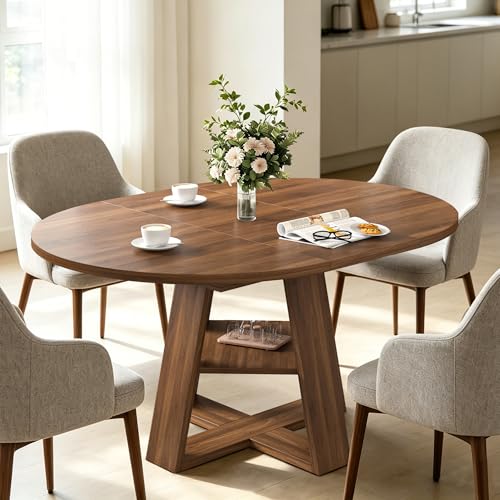
43.3"-59" Extendable Round Oval Dining Table for 4-8 with Storage Shelf | Modern Kitchen Oval Dining Table with Removable Leaves,Space Saving Extendable Table Wood Base for Kitchen Living Room Walnut
Check price on Amazon
Best Choice Products 42in Round Drop Leaf Dining Table W/ Shelf - Chestnut | Solid wood expandable table for 4, a space saving choice for kitchen, dining room & small spaces
Check price on Amazon
41 in-78 in Extendable Dining Room Table for 4-8, Round Expandable Kitchen Table with Fluted Base, Modern Farmhouse Oval Dinner Tables for Dining Room Kitchen Living Room (Walnut)
Check price on Amazon
Merax Rustic Expandable Pedestal Dining Table, 39" Round to 57" with Extension Leaf, Rubberwood Base, Farmhouse Kitchen Table for 4-6, Walnut
Check price on Amazon
East West Furniture DLT-WHI-TP Dublin Modern Kitchen Table - a Round Dining Table Top with Dropleaf & Pedestal Base, 42x42 Inch, Linen White
Check price on Amazon
Fabulcozy 47.2"-63" Extendable Round Dining Table for 4-8, Kitchen Table | Modern Oval Kitchen & Dining Room Table with Removable Leaves & Storage Shelf, Space Saving Drop Leaf Wood Desk, Black Walnut
Check price on AmazonFrequently Asked Questions
What is a round table with a leaf?
A round table with a leaf is a circular dining table with one or more removable or folding extension panels that increase the surface area and seating capacity when needed.
How many people can a round table with a leaf seat?
Most round tables with a leaf seat four people in their compact form and six to eight people when the leaf is inserted, depending on the diameter and leaf size.
Where should the leaf be stored when not in use?
Leaves can be stored in a closet, under a bed, in a sideboard, or inside a built-in storage compartment beneath the tabletop on premium models.
Is a round table with a leaf good for small dining rooms?
Yes. The compact circular footprint minimizes corner clearance issues, and the leaf lets you expand seating only when entertaining, making it an ideal choice for small and open-concept dining spaces.
Drop leaf or removable center leaf — which is better?
Drop leaves are better for very tight spaces because the table becomes narrow when closed. Removable center leaves produce a larger, more seamless expanded surface and are better for households that entertain regularly. Self-storing leaves combine convenience with a clean look but usually sit in a higher tier.
Will the leaf seam be visible when the table is expanded?
On most mid-range and premium models the seam is minimal and nearly flush. Entry-level tables may show a slightly more prominent line. Proper alignment hardware and regular cleaning keep the seam tight and unobtrusive.