
Round Wood Picnic Table With Detached Benches: The Complete Buying Guide
Everything you need to know before choosing a round wooden picnic table with separate benches — sizes, wood species, bench clearance, finish options, and long-term care.
EXPLORE RECOMMENDED OPTIONSWhy this configuration deserves a closer look: A round wood picnic table with detached benches solves a problem that traditional attached-bench picnic tables cannot. Because the benches sit independently, guests can slide in from any side, the table can be used without seating when you need a serving surface, and the round shape encourages conversation rather than rows of diners facing one direction.
This guide is written for buyers who already know they want a round wooden picnic table with separate benches and now need the details that matter: how much seating radius to plan for, which wood species hold up outdoors, how far benches should sit from the table edge, and what finish systems actually protect against moisture and sun. Use the sections below as a research checklist before you commit to a set.
Recommended Round Wood Picnic Tables With Detached Benches
⚠️ AFFILIATE DISCLOSURE: This website contains affiliate links. As an affiliate Associate, we earn from qualifying purchases. If you make a purchase through these links, we may receive a small commission at no additional cost to you. Read our full affiliate policy.

Best Choice Products 6 Person Wooden Picnic Table, Natural | Round Wood Picnic Table, 3 Built-in Benches, Umbrella Hole, 500lb Capacity for Patio, Backyard, Garden, Easy DIY
Check price on Amazon
HAPPYGRILL 8-Person Wood Picnic Table Bench Set, Round Camping Table w/Umbrella Hole, Circular Outdoor Table w/4 Built-in Curved Benches, for Patio, Garden, Backyard, Porch (Brown)
Check price on Amazon
Best Choice Products 6 Person Wooden Picnic Table, Walnut Brown | Round Wood Picnic Table, 3 Built-in Benches, Umbrella Hole, 500lb Capacity for Patio, Backyard, Garden, Easy DIY
Check price on Amazon
Best Choice Products 6 Person Wooden Picnic Table, White | Round Wood Picnic Table, 3 Built-in Benches, Umbrella Hole, 500lb Capacity for Patio, Backyard, Garden, Easy DIY
Check price on Amazon
Best Choice Products 6 Person Wooden Picnic Table, Black | Round Wood Picnic Table, 3 Built-in Benches, Umbrella Hole, 500lb Capacity for Patio, Backyard, Garden, Easy DIY
Check price on Amazon
GIANTEX 6-Person Round Picnic Table Set with 3 Benches, 550 LBS Bench Capacity, 2" Umbrella Hole, Circular Outdoor Wood Dining Table & Chairs for Patio Yard Garden Porch Deck (68”x62”x28”,Brown)
Check price on Amazon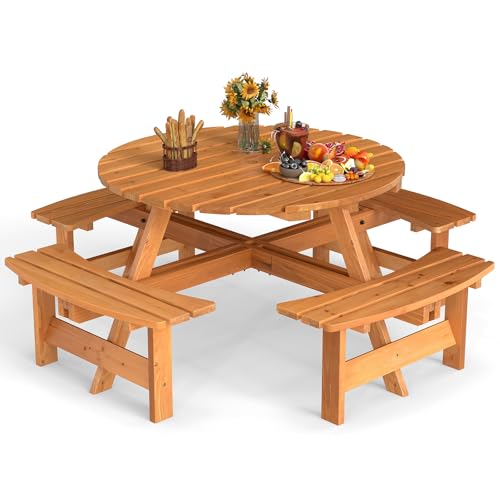
HAPPYGRILL 8-Person Wood Picnic Table Bench Set, Round Camping Table w/Umbrella Hole, Circular Outdoor Table w/4 Built-in Curved Benches, for Patio, Garden, Backyard, Porch (Yellow)
Check price on Amazon
VINGLI 8-Person Wood Picnic Table Outdoor Round Picnic Table with Umbrella Hole and 4 Built-in Benches, Outdoor Dining Tables and Chairs 500 LBS Bench Capacity (Natural, Round)
Check price on AmazonWhat Makes a Round Picnic Table With Detached Benches Different
A standard picnic table binds the benches to the table frame with diagonal braces. That design is stable, but it locks the seating layout and makes it awkward to use the tabletop on its own. A round wood picnic table with detached benches separates the two elements. The table stands on its own legs or pedestal, and the benches are free-standing pieces that you position around the perimeter.
That separation creates three practical advantages. First, the table can serve as a buffet, craft surface, or garden workspace when the benches are pushed aside. Second, guests can approach from any angle — useful for elderly diners or anyone who finds it hard to swing a leg over a fixed bench. Third, you can vary the number of benches: two benches for a four-person setup, three or four benches for larger gatherings around a bigger top.
The trade-off is that detached benches need to be positioned deliberately. If they sit too far from the table edge, diners lean forward awkwardly. If they sit too close, knees collide with the apron or pedestal. The spacing guidance later in this guide addresses that directly. For buyers comparing shapes, our round wood kitchen table guide covers indoor-oriented round tables, while this page focuses on the outdoor picnic configuration.
Size and Seating Capacity: How Many People Fit
Round tables distribute seating evenly, so capacity depends on diameter rather than length. As a working rule, allow roughly 24 inches (about 60 cm) of table edge per diner. A 48-inch round top comfortably seats four; a 60-inch round seats six; a 72-inch round seats eight with some elbow room to spare.
With detached benches, capacity also depends on bench length. Two benches each 60 inches long, placed on opposite sides, support four to six diners depending on how tightly people sit. Three benches around a 60-inch top create a more sociable six- to eight-person arrangement. If you are planning for a larger household or frequent entertaining, our guide to round tables that seat 8 walks through diameter-to-seat ratios in more detail.
| Table Diameter | Typical Seating | Bench Configuration | Best For |
|---|---|---|---|
| 36–42 inches | 2–4 people | Two short benches or two chairs | Balconies, small patios, couples |
| 48 inches | 4 people | Two benches, opposite sides | Family of four, compact decks |
| 60 inches | 6 people | Two long benches or three benches | Standard family outdoor dining |
| 72 inches | 8 people | Three or four benches | Large patios, entertaining |
Also measure the total footprint, not just the tabletop. A 60-inch round table with benches on opposite sides needs roughly 8 feet of clearance in one direction and about 6 feet in the other, plus walking room behind the benches. On a tight patio, a small circular table with two compact benches may be the more realistic choice.
Choosing the Wood Species
The wood determines how the table ages, how much maintenance it needs, and how heavy it will be to move. Four species dominate the round picnic table market, and each sits in a different position in the market.
Cedar — entry-level to mid-range
Cedar is lightweight, naturally resistant to rot and insects, and develops a soft silver-grey patina if left untreated. It is the most common choice for round wood picnic tables with detached benches because it balances durability with manageable weight. The trade-off is that cedar dents more easily than hardwoods and benefits from an annual protective finish if you want to keep the original warm tone.
Pine — entry-level
Pine is the most widely available and easiest to work with, which is why many starter-tier picnic tables use it. It is softer than cedar and needs a sealant or stain to survive outdoor exposure. A well-finished pine set performs well in covered patios but is less forgiving in full sun and rain. If you want the look of a rustic wood dining table outdoors without moving to a hardwood, pine with a quality finish is a reasonable starting point.
Teak — premium tier
Teak contains natural oils that resist moisture, rot, and insects without chemical treatment. It is denser and heavier than cedar, so a teak table with detached benches stays put in wind but is harder to reposition. Teak weathers to a warm grey; many owners apply teak oil annually to preserve the golden tone. Within the premium tier, teak is the benchmark for longevity.
Acacia — mid-range
Acacia is a dense hardwood with a striking grain pattern and good moisture resistance. It sits between cedar and teak: more durable than pine, more widely available than teak. Acacia picnic tables often come with a pre-applied oil finish. Expect some seasonal movement in the slats, which is normal for the species.
If the table will live under a covered porch or pergola, cedar or pine with a good finish is sufficient. If it faces full sun, rain, and freeze-thaw cycles, teak or acacia reduce the maintenance burden. For a broader comparison of outdoor-oriented round wooden options, see our round wooden dining table overview.
Bench Spacing and Ergonomics: The Detail Most Buyers Miss
Because the benches are detached, you control the gap between bench and table edge. The conventional guidance is to leave 10 to 14 inches (25–35 cm) of horizontal clearance from the table edge to the front of the bench. That range lets most adults sit with their knees under the table without pressing against the apron or pedestal.
Two variables shift that number. First, the table's understructure: a central pedestal allows a tighter gap than a four-leg frame with corner braces. Second, bench height relative to table height. Standard picnic tables sit around 28–30 inches high with benches at 17–18 inches. If the bench is lower than that, diners need to sit further back to avoid knee contact.
Detached benches also need a stable surface. On a sloped lawn, a bench with flat feet can rock. Look for benches with slightly angled or adjustable feet if the table will sit on grass or gravel rather than a patio slab. For indoor-adjacent setups, a round wood table for 6 with matching chairs may be more appropriate than benches.
Frame, Apron, and Pedestal Construction
The tabletop gets the attention, but the understructure determines stability and how comfortably people can sit. Three constructions are common on round wood picnic tables with detached benches:
- Four-leg frame with apron: the most traditional layout. Strong and stable, but the apron and corner braces reduce knee room, so benches need a slightly larger gap. Look for a recessed apron rather than one that sits flush with the tabletop edge.
- Central pedestal with cross feet: maximizes legroom on all sides, which pairs well with detached benches because diners can sit anywhere around the perimeter. Check that the pedestal base is wide enough to resist tipping if someone leans on the table edge.
- X-frame or trestle base: common on rustic and farmhouse styles. Visually open and stable, but the diagonal braces can interfere with foot placement. Position benches to avoid the braces.
Hardware matters as much as the wood. Stainless steel or galvanized bolts resist rust far better than standard steel in outdoor conditions. Check that bolt heads are recessed or capped so they do not catch clothing or scrape knees. For a design-focused comparison of round tables with a central support, our round table with lazy Susan in the middle page shows how pedestal tables handle a different kind of centerpiece load.
Finish and Weather Protection
A round wood picnic table with detached benches lives outdoors, so the finish is a maintenance decision, not just a cosmetic one. Four finish approaches dominate:
| Finish Type | Protection Level | Maintenance Rhythm | Best For |
|---|---|---|---|
| Untreated / natural patina | Low — relies on species' natural oils | None, but expect greying | Teak or cedar in dry climates |
| Penetrating oil (teak or linseed) | Moderate — feeds the wood, resists moisture | Reapply annually or biannually | Teak, acacia, cedar |
| Exterior stain | Moderate to high — adds UV pigment | Refresh every 1–2 years | Pine, cedar in sunny exposure |
| Marine-grade spar urethane or varnish | High — film-forming barrier | Touch up annually; sand and recoat every few years | Any species in wet climates |
Film-forming finishes offer the strongest protection but require more surface prep when they fail. Penetrating oils are more forgiving: they wear gradually and can be refreshed without stripping. Whichever route you choose, treat the underside of the tabletop and the bench undersides as well — moisture wicks up from below and causes more rot than top-surface rain. Our sustainable wood care guide covers oil selection and reapplication schedules in more detail.
Care and Seasonal Maintenance
Wood picnic tables with detached benches need less attention than upholstered outdoor furniture, but they are not maintenance-free. A simple seasonal routine keeps the set usable for years:
- Spring: inspect for loose bolts, split slats, and lifted finish. Tighten hardware with a wrench, sand any rough spots, and apply a fresh coat of oil or stain.
- Summer: wipe spills promptly, especially oils and red wine, which can stain if left on bare wood. Keep the table out of standing water.
- Autumn: clear fallen leaves and debris from the tabletop and between slats. Moisture trapped under leaves accelerates rot.
- Winter: if the set stays outdoors, cover it with a breathable cover that allows air circulation. A tarp that traps condensation can do more harm than leaving the table exposed. Move detached benches under shelter if storage space allows.
Scratches and small dents are normal in outdoor wood furniture. Light sanding followed by a spot application of the original finish blends most surface marks. For deeper repairs, our scratch repair guide covers color matching and refinishing small areas.
Round vs Rectangular, and Other Configurations to Consider
A round table with detached benches is a sociable choice, but it is not the only one. Rectangular picnic tables offer more linear seating along a wall or fence, and attached benches keep the seating aligned. Round tables, by contrast, work better in open patio areas where people approach from multiple sides.
If you are still deciding on shape, our rustic farmhouse table with bench and chairs page shows a rectangular alternative with mixed seating. If storage and portability matter more than permanence, a round plastic table with separate benches is lighter to move. And if the table will sit mostly indoors or on a covered porch, a round wood dining table for 6 with proper dining chairs may suit the space better than picnic benches.
For buyers who want the round shape but with fixed seating, a round table with six chairs provides a comparable conversation layout with more back support.
Frequently Asked Questions
Leave roughly 10 to 14 inches (25–35 cm) from the table edge to the front of the bench. Pedestal tables allow a tighter gap; four-leg tables with an apron need the larger end of that range. Sit at the table and check knee clearance before finalizing bench position.
Cedar is lighter and more forgiving on a tighter maintenance routine; teak is denser, naturally oilier, and holds up longer in wet or sunny climates. Teak sits in the premium tier and reduces the frequency of protective treatments. Cedar is the more common choice for round picnic tables with detached benches because it balances durability with manageable weight.
Yes, provided the finish is maintained and the set is covered with a breathable cover during wet or freezing months. Detached benches should be moved under shelter if possible, since they collect moisture at the joints. Teak and acacia handle year-round exposure better than pine.
A 60-inch round top is the standard for six diners, paired with two long benches or three shorter benches. A 72-inch top gives eight people comfortable elbow room. Allow at least 24 inches of table edge per person when planning capacity.
Detached benches are stable when they sit on a level surface and the feet are wide enough. On sloped lawns they can rock, so look for benches with slightly angled or adjustable feet. The advantage of detached benches is flexibility: you can reposition them, add a third bench for a larger gathering, or use the tabletop on its own.
Ready to Choose Your Round Wood Picnic Table?
Review the recommended round wood picnic tables with detached benches above, compare wood species and bench configurations, and pick the set that fits your patio footprint and seating needs.
Compare Recommended Options