
Small Sideboards: Compact Storage & Style Guide
Everything you need to choose a compact sideboard that fits your space, organizes your dining essentials, and elevates your room design — without overwhelming it.
Why small sideboards matter: A dining room doesn't need a large footprint to feel complete. A compact sideboard delivers critical storage for dinnerware, linens, and serving pieces while acting as a visual anchor. For anyone researching before a purchase, understanding dimensions, materials, door styles, and tier positioning is the difference between a piece that fits perfectly and one that becomes a daily frustration.
This guide breaks down what to look for in a small sideboard, how the market is structured across quality tiers, and how to match a compact buffet to your dining layout — including tight kitchens and open-concept spaces.
What Counts as a Small Sideboard?
A small sideboard generally measures under 48 inches in width, with many compact models sitting between 28 and 44 inches. Depth is just as important as width: narrow sideboards typically range from 12 to 16 inches deep, which is what makes them viable in hallways, galley kitchens, and small dining corners.
Height varies from low media-style consoles around 28 inches to taller cabinet-style sideboards near 36 inches. The right height depends on whether you plan to use the top surface for serving, display, or additional storage. For rooms where every inch counts, pairing a narrow sideboard with a small kitchen table or a space-saving dining table creates a functional dining zone that never feels cramped.
Understanding Sideboard Quality Tiers
Small sideboards fall into recognizable tiers based on construction, materials, hardware, and finish quality. Using a consistent framework helps you compare options on equal footing.
| Tier | Typical Construction | Best For | Key Characteristics |
|---|---|---|---|
| Entry-level | Engineered wood with laminate or paper veneer; basic metal or plastic hardware | First apartments, rental units, light-duty storage | Lightweight build, flat-pack assembly common, simple finishes |
| Mid-range | Engineered wood with real wood veneer; solid wood legs or frames; metal drawer glides | Family dining rooms, everyday use, balanced storage needs | Better hardware feel, more finish options, sturdier joinery |
| Premium | Solid wood frames and tops; dovetail drawers; soft-close hinges | Long-term dining room investment, frequent entertaining | Heavier build, refined finishes, durable surface treatments |
| Luxury | Hardwood solids, hand-finished surfaces, premium hardware, custom detailing | Design-forward dining rooms, collector-grade furniture | Exacting joinery, distinctive materials, artisan finishes |
Buying tip: Mid-range models typically offer the best balance between durable construction and refined details for most households. Entry-level sideboards are well-suited to temporary or low-traffic settings, while premium and luxury tiers are worthwhile investments when the sideboard will be used daily and serve as a focal point.
Key Features to Evaluate Before Buying
Beyond dimensions, a handful of construction details determine how a compact sideboard performs day to day:
- Door and drawer configuration: Two doors with one central drawer is the most common layout in compact models. Some small sideboards replace one side with open shelving for display flexibility.
- Interior adjustability: Adjustable shelves let you fit tall pitchers, stacked bowls, or linens. Fixed shelves are more rigid but limit versatility.
- Hardware quality: Soft-close hinges and full-extension drawer glides are hallmarks of mid-range and above. Look for metal rather than plastic components.
- Back panel finish: If the sideboard will float in an open-concept room, a finished back panel matters. Many compact models are designed only for wall placement.
- Leg style and clearance: Tapered legs or a plinth base change the visual weight of the piece. Consider whether you need floor clearance for cleaning or a low-profile base for a grounded look.
- Surface durability: A top surface that resists rings and scratches is essential if you plan to serve from the sideboard directly.
If your dining room is especially tight, look at sideboards that pair well with a small round dining table and chairs for 4 or a small rectangle dining table. Both layouts leave room for a narrow sideboard against the wall without blocking circulation.
Materials: What Works Best for Compact Sideboards
Material choice affects durability, weight, and how the piece ages. Each option has trade-offs worth understanding before you commit:
- Solid wood: The most durable option for frames and tops. Solid oak, walnut, and maple hold up to daily use and can be refinished. A solid wood sideboard cabinet is a long-term investment that develops character over time.
- Engineered wood with veneer: Stable and resistant to warping, with a broad range of finishes. Quality veneer over a dense core performs well in mid-range models.
- Metal accents: Powder-coated steel legs and hardware add industrial character and structural strength. Check that metal finishes are rust-resistant if humidity is a concern.
- Glass doors: A glass-front compact sideboard displays dinnerware and glassware while keeping dust out. Glass panels add visual lightness in small rooms.
For rooms where texture and tone are central, consider how the sideboard complements the rest of your furniture. A solid wood sideboard pairs naturally with solid wood dining tables, while painted or veneer finishes offer more flexibility with mixed-material schemes.
Space Planning: Making a Small Sideboard Fit
Before ordering, confirm three measurements: the wall width available, the walking clearance you need, and the doorway width for delivery. A sideboard that technically fits the wall can still crowd a room if it leaves less than 36 inches of clearance in primary walkways.
In open-plan layouts, a compact sideboard can define the dining zone without walls. Place it perpendicular to the table or against a shared wall to create a subtle boundary. If you're working with a sofa and dining table in the same small room, a narrow sideboard helps consolidate storage so the space stays visually calm — see our guide on fitting a sofa and dining table in the same small room.
For kitchens, a small sideboard often doubles as a coffee station, a prep surface, or a landing spot for mail and keys. Pair it with a small kitchen table set to complete a compact eat-in area.
Styling a Compact Sideboard
Small sideboards reward restraint. A few well-chosen pieces on top make a stronger impression than a crowded surface. Consider a layered approach: a tray to corral small items, one tall element such as a vase or lamp, and one horizontal element like a stack of books or a low bowl. Leave breathing room between objects.
Wall space above a compact sideboard is prime real estate. A mirror adds light and depth, while a single piece of art or a pair of small prints anchors the arrangement. If the sideboard sits in a dining room, use the top surface for serving during meals and clear it afterward to maintain visual calm.
Recommended Small Sideboards & Compact Storage Cabinets
⚠️ AFFILIATE DISCLOSURE: This website contains affiliate links. As an affiliate Associate, we earn from qualifying purchases. If you make a purchase through these links, we may receive a small commission at no additional cost to you. Read our full affiliate policy.

HOSTACK Kitchen Buffet Cabinet with Storage, Sideboard Coffee Bar, White | Farmhouse Kitchen Storage Cabinet with 3 Drawers & Adjustable Shelf & Doors, 42.5"W Buffet Table for Dining Living Room
Check price on Amazon
SWTYMIKI Coffee Bar Cabinet for Home - Farmhouse Coffee Stand Station Multi-Purpose Buffet Sideboard Cabinet with Drawers - Kitchen Bar Table for Living Room, Corner, Small Space, Espresso
Check price on Amazon
Joaxswe Sideboard Buffet Cabinet with Storage, 46" Arc-Shaped Credenza | 3 Doors & Adjustable Shelves, Stable Leg, Mid Century Modern Coffee Bar Cabinet for Kitchen, Living Room, Entryway, Dark Wood
Check price on Amazon
HORSTORS Farmhouse Kitchen Storage Cabinet, Small Buffet, Coffee Bar, White | Buffet Sideboard with 2 Drawers & 2 Doors, 35.8"W Coffee Table, Sapce-saving Kitchen Cabinet for Dining Living Room, Entryway
Check price on Amazon
VASAGLE Storage Cabinet, Sideboard with Adjustable Shelves | Mid-Century Modern Buffet Cabinet, 39.4 x 15.7 x 29.5 Inch, for Living Room, Walnut, MIRIANA Collection ULSC621KX01
Check price on Amazon
SILKYDRY Buffet Cabinet, 47" Vintage Sideboard w/ Adjustable Shelves(Green) | Mid Century Credenza w/ 3 Drawers,2 Doors,Anti-tip Kits; Accent Storage Cabinet for Dining&Living Room,Entryway & Coffee Bar
Check price on Amazon
Smuxee Oak Sideboard Cabinet, Freestanding Buffet Cabinet with Line Groove Design, Wood Storage Cabinet with Adjustable Shelf for Living Room, Entryway, Hallway
Check price on Amazon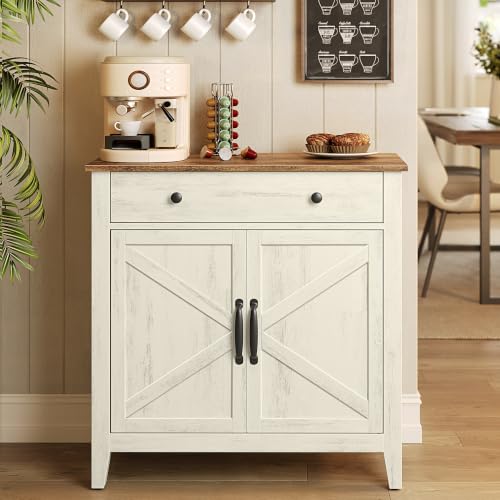
VASAGLE Buffet Cabinet, Coffee Bar with a Drawer, Adjustable Shelf | Sideboard Storage with Cable Hole, Drawer Divider, Rustic White and Honey Brown, LIRY Collection UBBK341W01
Check price on AmazonQuick Buying Checklist
- Measure wall width, available depth, and walking clearance before ordering.
- Confirm doorway width and delivery path — compact does not always mean easy to move.
- Decide between doors, drawers, and open shelving based on what you need to store.
- Check hardware quality: soft-close hinges and metal glides signal better construction.
- Verify whether the back panel is finished if the sideboard will be visible from behind.
- Match the finish and material to your existing dining furniture for visual cohesion.
- Review assembly requirements — flat-pack models may need two people and additional tools.
Frequently Asked Questions
What is the ideal depth for a small sideboard in a narrow dining room?
A depth of 14 to 16 inches is generally ideal for narrow dining rooms. This allows the sideboard to hold dinnerware and serving pieces while leaving enough walking clearance. Always measure your doorway and the path to the intended wall before ordering.
Can a small sideboard work in an open-concept kitchen and dining area?
Yes. A compact sideboard can act as a visual divider between the kitchen and dining zone while providing serving and storage space. Choose a model with a finished back if it will be visible from multiple angles.
What materials are best for a long-lasting small sideboard?
Solid wood and high-grade engineered wood with veneer are strong choices. Solid wood frames with dovetail drawers offer the most durable construction. For high-humidity climates, sealed finishes and powder-coated metal hardware help prevent warping and corrosion.
How do I choose between a small sideboard with doors versus open shelving?
Doors conceal clutter and protect items from dust, making them ideal for everyday dinnerware and linens. Open shelving works better for display pieces you want to showcase. Many compact sideboards combine both, which offers a balanced mix of concealed and visible storage.