
Table Bar Stool Set: The Complete Buying Guide
Everything you need to choose a bar table and stool set that fits your space, matches your height needs, and holds up to daily use. Learn sizing, materials, and styling before you commit.
Explore SetsWhy this guide matters: A table bar stool set is one of the few dining purchases where getting the height wrong ruins the experience. Too-low stools force an awkward posture; too-tall ones leave knees pressed against the table. This guide walks through the measurements, materials, and layout decisions that separate a set you enjoy daily from one you regret.
What Is a Table Bar Stool Set?
A table bar stool set pairs a raised table with matching stools designed for short, casual sittings rather than long formal meals. These sets are common in kitchen breakfast corners, open-plan living areas, home bars, and small apartments where a full dining table would overwhelm the room. The defining feature is height alignment: the stool and table are built to work together, so the seat-to-table gap stays comfortable for eating, working, or socializing.
Most sets fall into two families. Counter-height sets place the table around 34 to 36 inches tall, which feels close to standard dining height and suits families with children. Bar-height sets raise the table to roughly 40 to 42 inches, creating a pub-like feel that works well in dedicated bar zones. If you are still deciding between a raised set and a traditional arrangement, comparing against a 5-piece dining set helps clarify how much seating and floor area each option really needs.
Height Matching: The Single Most Important Decision
The relationship between table height and stool seat height determines comfort more than any other factor. A useful rule is that the stool seat should sit about 10 to 12 inches below the table surface. That gap gives enough room for legs and a plate without forcing an uncomfortable reach.
| Set Type | Typical Table Height | Matching Stool Seat Height | Best For |
|---|---|---|---|
| Counter-height | 34–36 in | 24–26 in | Kitchen islands, family breakfast areas, mixed-age households |
| Bar-height | 40–42 in | 28–30 in | Home bars, entertaining zones, open-plan lofts |
| Extra-tall bar | 44+ in | 30–32 in | Commercial-style setups, tall-ceiling spaces |
Two additional measurements deserve attention. First, footrest placement: a well-designed stool places the footrest where your feet land naturally, which reduces pressure on the thighs during longer sittings. Second, knee clearance: measure from the seat to the underside of the table apron. Anyone tall in the household should be able to cross their legs without hitting the table structure.
If your ceiling or room proportions feel tight, a swivel counter bar stool can make a compact set feel more flexible because users rotate out rather than pushing back. For setups where the table doubles as a workspace, an adjustable bar chair adds a layer of adaptability that fixed-height sets cannot match.
How Many Stools Do You Actually Need?
Set size is a function of table length and intended use. A two-stool set suits a compact kitchen corner or a couple's breakfast spot. Three stools work for narrow bars where each person gets a defined place. Four stools are the practical choice for households that host casually and want a full row along an island or bar table.
As a rough guide, allow about 24 inches of table length per stool for comfortable elbow room. That means a 48-inch table handles two stools generously or three with tighter spacing. If you expect frequent gatherings, a bar stools set of 4 paired with a longer table gives you the most flexibility without adding a second piece of furniture.
Also consider traffic flow. A bar table set placed against a wall needs less clearance than one floating in an open-plan room. In tight layouts, backless stools tuck fully under the table and visually shrink the footprint. In rooms with space to spare, bar stools with backs set of 2 add comfort and a more finished look.
Materials and Construction: What to Look For
Construction quality separates sets that last a decade from those that wobble within a year. Focus on the frame first, then the seat, then the finish.
Frames
Solid wood frames offer warmth and can be refinished if scratched. Look for joinery that uses mortise-and-tenon or reinforced corner blocks rather than staples alone. Metal frames, particularly high-grade steel with a rust-proof finish, deliver stability and a cleaner modern profile. A mixed-material set, such as a wood top on a metal base, balances the strengths of both.
Seats
Upholstered seats add comfort for longer sittings but need a durable fabric or easy-clean faux leather. Wooden seats are simple to wipe down and suit high-traffic households with children. Woven seats, such as rattan or cane, bring texture and breathability but require more careful maintenance.
Finish and Hardware
Check that the finish is sealed against moisture, especially if the set sits near a kitchen. Hardware should be heavy-duty and, ideally, replaceable. Swivel mechanisms deserve extra scrutiny: a smooth, quiet swivel signals better internal components than a grinding or loose one.
Quality Tiers: A Relative Framework
Rather than thinking in absolute terms, it helps to place sets within a tier system. The descriptors below describe relative market position and construction ambition, not any specific figure.
Entry-Level Tier
Basic frames with simpler joinery and standard finishes. Suitable for light use, rental spaces, or a secondary breakfast corner where the set is not the focal point.
Mid-Range Tier
Better frame stability, smoother swivel mechanisms, and more refined upholstery. A solid choice for daily family use and the most common sweet spot for long-term value.
Premium Tier
Heavy-duty frames, premium materials, and careful detailing. Designed for frequent entertaining and for buyers who want the set to anchor the room visually.
Luxury / Commercial-Grade
Built to hospitality standards with reinforced joints and high-grade finishes. Appropriate for home bars that see constant use or for design-led spaces where longevity is the priority.
Across all tiers, a set that is well-specified for its class will show consistent alignment between stool and table, no rocking at the base, and hardware that feels solid when you test it. Those signals matter more than any single feature.
Style Directions That Work
The visual language of a bar set should connect to the rest of the room rather than stand apart. A few directions tend to work reliably:
- Industrial: metal frames with wood tops, exposed hardware, and dark finishes. Pairs well with open shelving and concrete or brick surfaces.
- Modern farmhouse: painted or distressed wood with simple silhouettes. A natural fit for kitchens with shaker cabinetry.
- Mid-century modern: tapered legs, warm wood tones, and upholstered seats. Works in smaller rooms because the lines stay visually light.
- Contemporary minimalist: slim profiles, monochrome palettes, and backless stools that disappear under the table.
If the set will sit beside a traditional dining arrangement, consider how the two read together. A wood dining table set for 6 in a warm finish can be echoed in a bar set with similar wood tones, which keeps an open-plan room coherent. Conversely, a deliberate contrast, such as a dark metal bar set near a white dining table and chairs set of 4, can define separate zones without walls.
Placement and Layout Considerations
Bar sets are often placed in spaces that were not designed for dining, so layout deserves real attention. Start with clearance: allow about 24 inches behind each stool so people can pull out comfortably. If the set backs onto a wall, a backless stool can reduce the required depth.
Lighting is the second consideration. A pendant hung 30 to 36 inches above the table surface gives focused light without glare. If the set sits near a window, check that the finish is protected against UV fading, particularly on upholstered seats.
Finally, think about adjacency. A bar set near a buffet and sideboard becomes a natural serving station for casual gatherings. A set in a small apartment might sit opposite a small square table used for formal meals, with the bar set handling quick breakfasts and laptop work.
Practical Checklist Before You Buy
Measure Twice, Sit Once
- Measure the table height and confirm the stool seat height sits 10–12 inches below it.
- Check knee clearance from seat to table apron for the tallest user in the household.
- Confirm footrest position feels natural when seated.
- Allow 24 inches behind each stool for pull-out space.
- Verify the set fits the room's traffic path, especially in open-plan layouts.
- Test the swivel mechanism if included; it should feel smooth and quiet.
- Check that the finish is sealed against moisture if the set is near a kitchen.
- Confirm hardware is heavy-duty and, ideally, replaceable.
One more point on durability: sets used daily in a kitchen see more wear than a formal dining table used a few times a week. If the set will host breakfast, homework, and evening drinks, lean toward the mid-range tier or above. The smoother mechanism and reinforced joints make a noticeable difference over years of use.
Recommended Table Bar Stool Sets
Top Picks: Table Bar Stool Sets for Every Space
⚠️ AFFILIATE DISCLOSURE: This website contains affiliate links. As an affiliate Associate, we earn from qualifying purchases. If you make a purchase through these links, we may receive a small commission at no additional cost to you. Read our full affiliate policy.

HOOBRO Bar Table and Chairs Set, 47.2” Rectangular Pub Table with 2 Stools for Small Space, 3-Piece Breakfast stools Set, Sturdy Metal Frame, Easy to Assemble, Rustic Brown BF52BT01
Check price on Amazon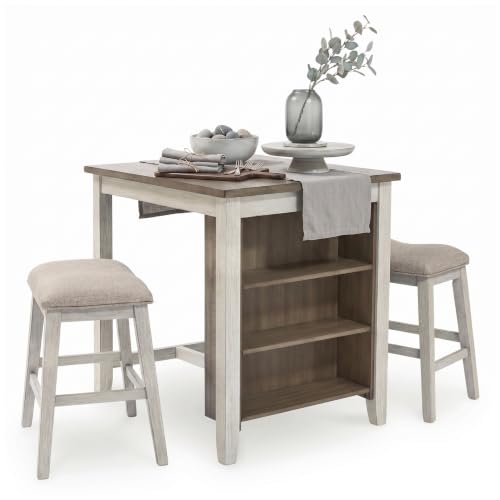
Signature Design by Ashley Skempton 3-Piece Counter Height Dining Table Set | Two-tone acacia wood set, 3 built-in open shelves, 2 upholstered saddle stools, Space-saving tuck-away design, Dining room
Check price on Amazon
YATINEY 70.9" Bar Table and Chairs Set, Dining Table and Chair Sets, 3 Piece Counter Height Table and 2 Stools, Kitchen Table for Home Restaurant, Bar, Black BT09BB
Check price on Amazon
YATINEY 70.9" Bar Table and Chairs Set, Dining Table and Chair Sets, 3 Piece Counter Height Table and 2 Stools, Kitchen Table for Home Restaurant, Bar, Rustic Brown BT09BR
Check price on Amazon
Karl home 83.8" Bar Table and Chairs Set, 4 Adjustable PU Stools, Brown | High Top Counter Height Table with 24‑26" Stools for Kitchen Breakfast, Bistro, Dining Room, Living Room
Check price on Amazon
Nalupatio Modern Bar Stools Set of 2, Adjustable Faux Leather Upholstered Swivel Bar Stools, Counter Height Bar Chairs with Back for Kitchen Island, Black
Check price on Amazon
HOOBRO Bar Table Set, Pub Tables Bar Height with Stools Set of 2, Bar Chairs Under Counter Height Table for Small Spaces, Industrial Dining Table Sets for Kitchen, Living Room, Parties BF54BT01
Check price on Amazon
AWQM 3 Piece Bar Table Set of 2,39.3" Pub Bar Table and Chairs Set,Faux Marble Bar Height Table with 2 Backrest Stools,Small Dining Table for 2,Kitchen Table Set for Small Space,White & Brown
Check price on AmazonFrequently Asked Questions
What is the standard height for a bar table and stool set?
A standard bar-height set pairs a table around 40 to 42 inches tall with stools around 28 to 30 inches. Counter-height sets use tables around 34 to 36 inches with stools around 24 to 26 inches.
How many stools should a bar table set include?
Two-stool sets suit compact kitchens and breakfast corners. Three- and four-stool sets work better for open-plan spaces and households that entertain. Choose based on table length and how much elbow room each person needs.
What material is best for a table bar stool set?
Solid wood offers warmth and easy refinishing, metal frames provide stability and a modern look, and upholstered seats add comfort for longer sittings. Mixed-material sets combine a wood top with a metal base for a balanced result.
How much clearance do I need around a bar table set?
Allow roughly 24 inches of clearance behind each stool so people can pull out and sit down comfortably. Also check that the tallest user has enough knee room between the seat and the table apron.
Can a bar table set replace a traditional dining table?
For some households, yes. Bar sets work well for casual meals and small spaces, but they are less comfortable for long formal dinners, especially for children and older guests. Many homes use a bar set alongside a standard dining table rather than instead of one.
Should I choose backless stools or stools with backs?
Backless stools tuck fully under the table and save visual space in small rooms. Stools with backs offer more comfort for longer sittings and a more finished look. If the set sits in a prominent spot and will be used for meals, backs are often the better choice.
Bottom line: Choose the height first, then the set size, then the materials and style. A set that matches your table height to your stool seat height, fits the room's clearance requirements, and uses construction suited to daily use will serve you far better than one chosen on looks alone. Browse the recommended sets above, compare their specs against the checklist, and pick the tier that matches how often you will actually use the space.