
Counter Height Table with Butterfly Leaf and Storage
The complete guide to choosing a versatile, space-saving dining solution that extends when guests arrive and stores everything you need between meals.
Explore Buying GuideWhy this combination matters: A counter height table with a butterfly leaf and built-in storage solves three dining challenges at once — comfortable standing-height seating for casual meals, expandable surface area for holidays, and a discreet place to tuck away linens, dinnerware, and serving pieces. This guide explains how these features work together, what to check before buying, and which configurations suit different spaces.
What Is a Counter Height Table with Butterfly Leaf and Storage?
A counter height table sits taller than a standard dining table — typically around 34 to 36 inches at the surface — so it pairs with counter stools or taller chairs rather than conventional dining chairs. The butterfly leaf is a folding extension mechanism: two hinged panels fold outward from the center of the tabletop (or fold inward when not in use), letting the table grow from a compact footprint to a larger seating surface without storing a separate leaf elsewhere. Storage usually refers to integrated shelving, cabinets, drawers, or a lift-top compartment built beneath the tabletop or into the table's base.
Combined, these three features create a single piece of furniture that works as a breakfast nook, a homework station, a prep surface, and a formal dining table — all while keeping the room uncluttered when the table is not in use. That versatility is why this configuration is especially popular in open-plan homes, apartments, and kitchens where square footage is limited but entertaining still happens regularly.
How a Butterfly Leaf Works on a Counter Height Table
The butterfly leaf mechanism is simple but effective. The tabletop is split down the middle, and each half carries a hinged panel underneath. When you need more surface area, you pull the two halves apart along the table's sliding rails, then flip the two hinged panels up and outward until they lock flat and meet in the center. When the meal is over, the panels fold back down and the halves slide together again — no separate leaf to carry to a closet or store under a bed.
On a counter height table, this mechanism deserves closer inspection than on a standard table, because the added height changes how the leaf hinges and slides behave under load. A few practical points to check:
- Slide quality: The rails should glide smoothly without wobble when the table is fully extended. Mid-range and high-end tier tables typically use metal ball-bearing slides rather than simple wooden tracks.
- Locking mechanism: Each leaf panel should have a positive lock that engages when fully open, so the table does not flex if someone leans on the center seam.
- Height consistency: When deployed, the leaf surface should sit perfectly flush with the main tabletop. Any lip or gap is a sign of an imprecise mechanism.
- Seam placement: The seam where the two leaf halves meet runs down the center of the table. On a counter height surface used for serving platters, a well-engineered seam should be tight enough that dishes sit level.
Butterfly leaves on counter height tables usually add between 12 and 20 inches of length, which is typically enough to seat two additional people comfortably. The exact extension depends on the table's starting size and the leaf's depth.
Storage Configurations to Look For
Storage on these tables appears in several forms, and the right choice depends on what you plan to keep at hand. Most models fall into one of these categories:
Under-Table Shelving
Open shelves beneath the tabletop — often two tiers — are the most common storage format. They are ideal for stacked plates, folded table linens, board games, or a fruit bowl. Because they are open, they keep the table feeling light and airy, which suits smaller rooms. The trade-off is that contents are visible, so tidy organization matters.
Enclosed Cabinets and Drawers
Some counter height tables include cabinet doors or drawers built into the base or pedestal. These conceal contents completely, making them a better match for formal dining rooms or for households that prefer a streamlined look. Drawers are useful for flatware, napkins, and small serving tools, while cabinets handle bulkier items like a slow cooker or extra dinnerware sets.
Lift-Top and Drop-Leaf Storage
A subset of models pairs the butterfly leaf with a lift-top section: the tabletop itself hinges upward to reveal a shallow compartment for remote controls, chargers, or placemats. This design is common in dual-purpose furniture that serves as both a dining table and a work surface. If you plan to use the table for laptop work or crafting, a lift-top compartment keeps daily items accessible without cluttering the surface.
Pedestal Storage
Pedestal-base counter height tables sometimes house storage inside the central column — typically a narrow cabinet or a stack of small drawers. This keeps the footprint clean and avoids the knee-clearance issues that can come with under-table shelving. It is a good option when seating wraps around all four sides of the table.
Benefits of This Table Configuration
Homeowners researching this product category usually have a specific set of needs in mind. Here is how the counter height, butterfly leaf, and storage combination addresses them:
- Space efficiency: The compact closed footprint fits into small dining rooms, breakfast nooks, and open kitchens, while the butterfly leaf expands the table only when needed. Nothing extra needs to be stored in a closet.
- Comfortable casual seating: Counter height is easier to get in and out of than bar height, making it suitable for children and older family members while still offering the relaxed, elevated feel of a counter stool setup.
- Reduced clutter: Integrated storage keeps linens, dinnerware, and serving pieces close at hand, so the table stays ready for meals without a separate sideboard or hutch.
- Multi-purpose use: The elevated surface works well as a prep station, homework desk, or standing workspace during the day and converts to a dining table in the evening.
- Visual continuity in open plans: Because the table doubles as storage and seating, it can replace several freestanding pieces, reducing visual clutter in open-concept kitchens and dining areas.
Key Considerations Before You Buy
Measure the Seating Perimeter
Counter height tables are often narrower than standard dining tables, which affects how many people fit around them. Plan for at least 24 inches of table width per person, plus extra room at the ends if you plan to seat guests there. Measure the distance from the table edge to the nearest wall or counter — you want at least 36 inches of clearance behind pulled-out stools so people can pass through comfortably.
Confirm the Height Standard
Counter height typically means a surface of 34 to 36 inches, paired with stools or chairs whose seat height is 24 to 26 inches. Bar height is taller — around 40 to 42 inches with 28 to 30-inch seats. If you already own stools, verify their seat height before choosing a table, because a mismatch of even two or three inches makes the seating uncomfortable. Stools with a seat height in the 24 to 26-inch range pair with counter height tables; taller stools belong with bar height models.
Check the Extended Dimensions
The butterfly leaf adds length, not width. If your room is tight in one direction but generous in another, orient the table so the extension grows along the longer axis. Note the fully extended length before purchase — a table that fits beautifully when closed can block a doorway or walkway when open. It helps to mark the extended footprint on the floor with painter's tape and live with it for a day before committing.
Evaluate the Storage Depth and Access
Open shelves that are too shallow cannot hold dinner plates upright; drawers that are too deep waste space on small items. Check the interior dimensions against what you actually plan to store. Also consider access: shelves that open toward a wall or a fixed bench are awkward to use. If the table will sit against a wall, prioritize storage that opens from the seating side.
Assess the Leaf Mechanism Quality
Entry-level models sometimes use simple wooden slides that can bind over time, while mid-range and premium tables typically feature metal hardware with smoother operation and longer service life. If the table will be extended and collapsed frequently — say, every weekend — invest in a mechanism with a solid reputation. Ask whether replacement leaf hardware is available, since this is the component most likely to need service over the table's life.
Comparing Configurations by Tier
Counter height tables with butterfly leaves and storage span a wide range of construction quality and feature sets. The table below summarizes how the tiers typically differ, using relative market positioning rather than absolute figures.
| Tier | Typical Construction | Leaf Mechanism | Storage | Best For |
|---|---|---|---|---|
| Entry-level | Engineered wood with veneer; basic hardware | Manual slides, may need occasional adjustment | Open shelves, often two tiers | Light use, starter homes, occasional extending |
| Mid-range | Solid wood legs with veneered top; metal slides | Smooth ball-bearing slides with positive locks | Mix of shelves and a drawer or small cabinet | Regular family use, frequent extending |
| Premium | Solid hardwood throughout; reinforced joinery | Precision mechanism with self-leveling leaf | Enclosed cabinets, drawers, sometimes lift-top | Heavy use, formal dining, long-term ownership |
| Luxury | Hardwood with designer finishes; custom hardware | Buttery operation, often with soft-close features | Full cabinetry with fitted organizers | Statement dining rooms, design-led interiors |
Materials and Finish Considerations
The material of the tabletop matters more on a counter height table than on a standard one, because the surface is used more often as a prep area. Solid hardwood tops — oak, maple, and walnut are common — handle daily wear and can be refinished if scratched. Veneered tops offer a consistent look and are generally more stable in humid climates, but they cannot be sanded and refinished the same way. For homes with young children or heavy kitchen use, a matte or satin finish hides fingerprints and minor marks better than a high-gloss surface.
If the table sits near a window, consider how the finish will age. Natural wood tones tend to patina gracefully, while painted finishes can show chips over time. For storage sections, check that interior surfaces are sealed — an unsealed interior in a humid kitchen can absorb moisture and develop odor. Metal hardware should be powder-coated or otherwise protected against rust, especially if the table is used in a kitchen where steam and spills are common.
Where This Table Works Best
The compact closed footprint and expandable surface make this configuration unusually adaptable. Common placements include:
- Breakfast nooks: A corner or bay-window nook pairs well with the smaller closed size; the leaf extends into the room when guests join.
- Open kitchens: The counter height bridges the gap between kitchen work surfaces and a lower dining table, and the storage holds prep tools and serving pieces.
- Apartments and condos: One piece replaces a dining table, a small sideboard, and a desk, which matters when every square foot counts.
- Multi-generational homes: Counter height is easier to access than bar height for guests and family members who prefer not to climb onto tall stools.
- Homes that host seasonally: The table stays compact for most of the year and extends for holidays and family gatherings without requiring a second table.
For very tight rooms, a corner-oriented placement often works better than a wall-flush one, because it leaves the leaf free to extend along the open diagonal. If your room is rectangular and narrow, orient the table so the butterfly leaf extends lengthwise along the room's longer wall.
Care and Maintenance Tips
A table with moving parts and storage needs slightly different care than a plain dining table. A few habits keep the mechanism and finish in good condition:
- Lubricate the slides annually: A light application of silicone-based lubricant on the leaf slides keeps operation smooth. Avoid oil-based products that attract dust.
- Keep the leaf seam clean: Crumbs and spills collect in the center seam. Wipe it with a slightly damp cloth after meals, and dry immediately.
- Do not overload storage: Respect the manufacturer's weight guidance for shelves and drawers. Overloading can warp shelf boards or strain cabinet hinges.
- Use coasters and trivets: Counter height surfaces are often used for hot serving dishes. Heat marks are difficult to remove from both solid wood and veneer.
- Check hardware periodically: Tighten any loose screws on hinges, drawer pulls, and leaf locks every few months, especially in households with children who use the table daily.
Frequently Asked Questions
What is a butterfly leaf, and how is it different from a standard leaf?
A butterfly leaf is built into the table itself as two hinged panels that fold outward from underneath the tabletop. A standard leaf is a separate board stored elsewhere and inserted into a gap when needed. The butterfly design means nothing needs to be stored off-table, which is a major advantage in small homes and apartments.
How much extra seating does a butterfly leaf add to a counter height table?
Most counter height butterfly leaf tables extend by 12 to 20 inches in length, which typically accommodates two additional place settings — one on each long side. Some larger models add enough length for a third seat at one end, depending on the table's width and the seating arrangement.
Can I use regular dining chairs with a counter height table?
No. Counter height tables require stools or chairs with a seat height of roughly 24 to 26 inches. Standard dining chairs sit at about 18 inches, which leaves too little legroom and makes the table surface uncomfortably high. Confirm seat height before pairing any seating with the table.
Is storage under a counter height table practical for everyday use?
Yes, with the right expectations. Open shelves are convenient for items you use daily — plates, napkins, small appliances. Enclosed cabinets suit items you want out of sight. The main constraint is access: if the table is pushed against a wall, storage on that side is hard to reach, so plan the table's orientation around which side opens toward the room.
How do I know if my room is large enough for the extended table?
Measure the fully extended length and width, then add at least 36 inches of clearance on all sides where people will walk or pull out stools. Mark the footprint on the floor with tape and test the walkway for a day. If the extended footprint blocks a doorway or main traffic path, consider a table with a shorter extension or a different orientation.
Do butterfly leaf tables require special assembly or maintenance?
Assembly is usually straightforward — most models arrive with the mechanism pre-installed and require only leg or base attachment. Maintenance is minimal: keep the slides lubricated, clean the leaf seam, and check hardware tightness periodically. Entry-level tables may need occasional slide adjustment, while mid-range and premium mechanisms generally hold alignment well over years of regular use.
If you are comparing this configuration against other space-saving options, our guides on counter height tables with storage and counter height dining table sets with storage cover variations without the butterfly leaf. For pure seating considerations, see our overview of counter height chairs and counter height bar stools with backs and arms. Homeowners planning a full dining room refresh may also find our counter height dining table guide and counter height dining set overview useful for comparing complete configurations.
Recommended Counter Height Tables with Butterfly Leaf and Storage
⚠️ AFFILIATE DISCLOSURE: This website contains affiliate links. As an affiliate Associate, we earn from qualifying purchases. If you make a purchase through these links, we may receive a small commission at no additional cost to you. Read our full affiliate policy.

Sunset Trading Dakota 42-54" Counter Height Expandable Butterfly Leaf Dining Table with Storage Cabinet, Shelf | Square/Rectangle Pub Gathering Kitchen High-Top, Distressed Brown/Ash Gray Wood,Seats 8
Check price on Amazon
Qwtrvlizi Dining Room Furniture Counter Height Dining Table w Butterfly Leaf Rustic Espresso Table w Storage Base 1pc Dining Table Only
Check price on Amazon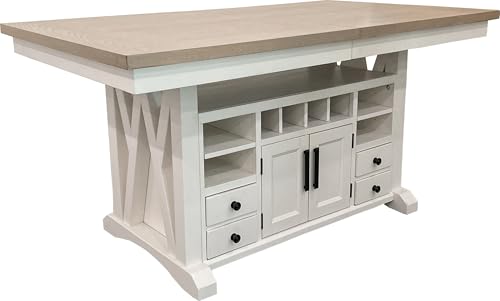
Parker House Americana Modern Dining 72 in. Island Counter-Height Extendable Dining Table
Check price on Amazon
Dining Room Furniture Counter Height Dining Table w Butterfly Leaf Rustic Espresso Table w Storage Base 1pc Dining Table Only
Check price on Amazon
Dining Room Furniture Counter Height Dining Table w Butterfly Leaf Rustic Espresso Storage Base 7pc Dining Set 6X High Chairs Unique Design Back
Check price on Amazon
7PC Dining Table Set with Chairs, Kitchen Dining Room Tables Chair,A25
Check price on Amazon
Dining Room Furniture Counter Height Dining Table w Butterfly Leaf Rustic Espresso Storage Base 7pc Dining Set 6X High Chairs Unique Design Back
Check price on Amazon
Lexicon Meyer 60 Inch Bar Table - Round Counter Height Small Kitchen Table for 2-4, Solid Wood, Oval Extendable Leaf for Small Dining Room, Storage Space, Shelf, Antique White & Rosy Brown
Check price on AmazonReady to Choose Your Table?
Browse the recommended models above, compare their storage layouts and leaf mechanisms, and pick the configuration that matches your room's dimensions and your household's daily routine. A counter height table with a butterfly leaf and storage is a long-term investment in flexibility — choose one that fits the way you actually live.
View Recommended Models