
Extendable Dining Table Set: The Complete Buying Guide
Everything you need to know about choosing a flexible, space-smart dining table set that adapts to everyday meals and larger gatherings.
Explore RecommendationsWhy an extendable dining table set makes sense: Most homes need a dining table that works for a quiet weeknight dinner and a lively holiday gathering. A fixed table forces a compromise in one direction or the other. An extendable set solves this by keeping a compact footprint day to day, then expanding when guests arrive.
This guide explains the extension mechanisms, sizing rules, material trade-offs, and style considerations you need before buying. By the end, you will know exactly which configuration suits your room, household, and hosting habits.
What Exactly Is an Extendable Dining Table Set?
An extendable dining table set pairs a table with a built-in expansion mechanism and a matching set of chairs. The table typically ships with chairs that complement its style and finish, so you avoid the guesswork of mixing and matching separately.
The extension system varies. Some tables use a butterfly leaf that folds in half and stores inside the tabletop. Others use self-storing leaves that slide or fold away within the table structure. A third category uses separate leaves you add manually and store elsewhere. Each approach affects setup effort, storage needs, and how seamlessly the table transitions between sizes.
Because the table can shrink and grow, extendable sets are especially practical for open-plan layouts and apartments. If your room is tight, an extendable dining table for small spaces keeps daily life uncluttered while preserving hosting capacity. For even tighter footprints, a compact extendable set designed for small spaces bundles the table and chairs into one coordinated solution.
Extension Mechanisms Explained
The mechanism is the heart of any extendable table. It determines how quickly you can expand the table, how sturdy the extended surface feels, and whether you need extra storage for leaves. Here are the main types you will encounter.
Butterfly Leaf
The leaf folds in half like a butterfly wing and often stores inside the tabletop. Setup is quick, and there is no separate leaf to misplace. Mid-range and premium models usually offer smoother folding hardware than entry-level versions.
Self-Storing Leaf
One or two leaves slide or fold into the table body. You never need a closet for extra panels. These tables tend to have a slightly thicker apron to house the leaf, so check legroom if you prefer a minimalist look.
Separate Leaf
The table accepts one or more loose leaves stored elsewhere. This design is common on traditional and formal tables. It is straightforward and durable, but you must plan where to keep the leaf when not in use.
Drop-Leaf
Hinged panels fold down on one or both sides. Drop-leaf tables are excellent for very tight spaces and often appear in kitchen nooks. When both leaves are up, the table can seat four to six depending on size.
If you want the convenience of never storing a leaf separately, look for a table with self-storing leaves. If you frequently host large groups, a model built around a expandable interior leaf system can reach substantial lengths without cluttering your storage closet.
How to Size an Extendable Dining Table Set for Your Room
Sizing is where most buyers make mistakes. You must measure two states: the table closed and the table fully extended. Then add clearance for chairs, walking paths, and any nearby furniture or walls.
- Closed footprint: Measure the length and width with all leaves stored. This is what you live with daily, so it must fit comfortably with chairs tucked in.
- Extended footprint: Measure the full length with every leaf deployed. Confirm that the extended table still leaves a walkable path around the room.
- Chair clearance: Allow roughly 36 inches between the table edge and any wall or obstacle when chairs are occupied. For traffic paths behind seated guests, allow more.
- Seating capacity: A closed table around 60 to 72 inches long typically seats six. Extended lengths of roughly 84 to 96 inches usually seat eight. For larger gatherings, an extendable table that seats twelve may be appropriate in a dedicated dining room.
- Ceiling height and lighting: A long extension can shift the table out from under a centered chandelier. Plan lighting placement so the extended table remains well lit.
If your room is rectangular and narrow, prioritize length over width. A narrower table preserves walking space on both sides. If your room is square, a table that extends along its long axis usually works best. For a fuller discussion of table dimensions, see our guide to the standard kitchen table height, which also explains how chair seat height should relate to table height.
Materials and Build Quality
Extension mechanisms put stress on the table structure, so build quality matters more than it does on a fixed table. A flimsy mechanism will wobble, bind, or fail long before the tabletop shows wear.
Solid wood remains the most repairable option. Scratches can be sanded and refinished, and a well-built solid wood table can last decades. The trade-off is weight and sensitivity to humidity swings. Engineered wood with quality veneers offers better dimensional stability and often a smoother extension action because the panels are more uniform. Glass and stone tops deliver a modern look but require careful handling during expansion and are less forgiving of impact.
Pay attention to the mechanism itself. Metal glides and reinforced hinges signal a sturdier build than plastic tracks. A premium-tier table typically uses heavier hardware and tighter tolerances than an entry-level model, which translates to smoother operation and less side-to-side play when extended. If you are comparing a solid wood dining table against a veneered alternative, weigh repairability against stability in your local climate.
Chair construction deserves equal scrutiny. Check joint types, seat support, and upholstery quality. If the set includes fabric chairs, our guide to upholstery fabric for dining chairs explains how to judge durability and cleanability. For sets with leather seating, review the differences between leather dining room chairs before committing.
Comparing Extendable Table Types at a Glance
Use this comparison to match a mechanism and tier to your household. The table deliberately avoids numeric figures and instead uses relative quality descriptors.
| Type | Best For | Setup Effort | Storage Need | Typical Tier |
|---|---|---|---|---|
| Butterfly leaf set | Everyday flexibility with occasional guests | Low | None (stored in table) | Mid-range to premium |
| Self-storing leaf set | Frequent resizing without extra storage | Low to moderate | None | Mid-tier to top-tier |
| Separate leaf set | Formal dining rooms with a storage closet | Moderate | Requires closet or shelf | Entry-level to luxury |
| Drop-leaf set | Very tight kitchens and nooks | Low | None | Entry-level to mid-range |
| Large-capacity extendable set | Holiday hosting and big families | Moderate | Depends on mechanism | Premium to flagship |
Choosing a Style That Fits Your Home
An extendable set should look intentional at both its closed and extended sizes. A table that looks elegant compact but awkward when extended is a poor fit for a room where you host often. Look for proportionally balanced leg placement and an apron that does not look stretched when the leaves are deployed.
Farmhouse, industrial, mid-century, and contemporary styles all offer extendable options. Farmhouse sets usually feature trestle bases and warm wood tones. Industrial designs pair metal frames with wood tops. Contemporary sets favor clean lines, pedestal bases, and finishes that hide seams when the table is closed. If your home leans modern, explore modern kitchen table options, many of which include extension capability. For a bolder aesthetic, an industrial dining table with extension hardware can anchor an open-plan space.
Chair style matters too. If you want a coordinated look, a set with round-back dining chairs reads classic, while black contemporary dining chairs suit a sharper, urban palette. For sets built around benches, review our notes on dining benches with backrests for comfort and support considerations.
Pre-Purchase Checklist
- Measure the room at both the closed and fully extended table size, then confirm chair clearance.
- Decide whether you need self-storing leaves or have a closet for separate panels.
- Confirm the table height and chair seat height work together for comfortable dining.
- Check the mechanism hardware: metal glides and reinforced hinges indicate a sturdier build.
- Verify the seating capacity at full extension with the manufacturer, not just the marketing label.
- Review the chair construction, upholstery, and any included protective cushions.
- Confirm delivery and assembly requirements, especially for heavy solid wood tables.
- Check the warranty terms for the extension mechanism specifically, not just the frame.
Care and Long-Term Use
Extendable tables need a little more care than fixed ones. Keep the mechanism clean and free of crumbs or grit, which can wear down glides over time. Lubricate moving parts according to the manufacturer's instructions. When extending or collapsing the table, support the leaf or panels so the mechanism does not bear the full weight alone.
Protect the tabletop from heat and moisture with trivets and coasters, especially on veneered surfaces where moisture can lift the finish. If the table sits near a window, rotate or cover it to limit sun fading. For chairs with upholstery, address spills promptly and follow the fabric care code. Our broader guides on dining room chair seat covers and back chair cushions explain how to add protection and comfort without compromising the look of the set.
Recommended Extendable Dining Table Sets
⚠️ AFFILIATE DISCLOSURE: This website contains affiliate links. As an affiliate Associate, we earn from qualifying purchases. If you make a purchase through these links, we may receive a small commission at no additional cost to you. Read our full affiliate policy.

ONBRILL 42"-106" Extendable Dining Table for 2-10 with Storage Legs, Walnut | Mid-Century Modern Oval Extendable Dining Table with 4 Removable Leaves, Round Dinner Table for Dining Room, Kitchen
Check price on Amazon
Itaar 5-Piece Dining Table Set for 4-6 People, 63" Extendable Kitchen Table and 4 Cushion Chairs, Dining Room Table with MDF Board & Metal Frame for Small Space, Easy Clean, Brown
Check price on Amazon
iPormis 7 Pieces Dining Table & Chairs Set for 4-6, 63" Extendable Kitchen Table and 6 Chairs, Dining Room Table with MDF Board & Metal Frame, Perfect for Small Space, Easy Clean, Espresso
Check price on Amazon
41 in-78 in Extendable Dining Room Table for 4-8, Round Expandable Kitchen Table with Fluted Base, Modern Farmhouse Oval Dinner Tables for Dining Room Kitchen Living Room (Walnut)
Check price on Amazon
Xazisuo 9 Piece Extendable Dining Table Set for 8, 63-79 Inch Brown Kitchen Table Set with 8 Brown Suede Chairs,Farmhouse Wood Expandable Storage Cabinet Dining Room Table Set 8,Easy Assemble
Check price on Amazon
GarveeHome 63-83" Extendable Dining Table, Industrial Rectangular Dining Room Table for 6-8 People, Expandable Kitchen Table with Heavy Duty Metal Frame for Dining Room, Kitchen & Parties, Brown
Check price on Amazon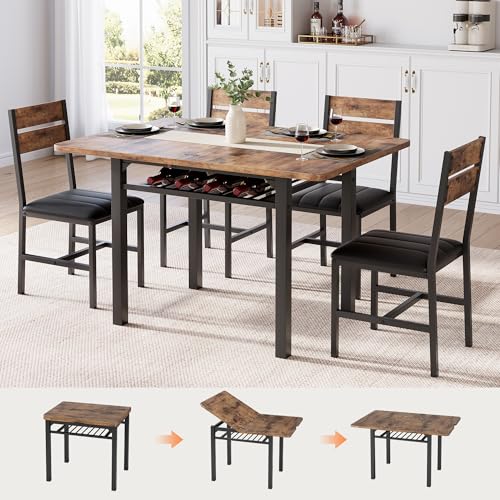
MapleGrace Extendable Dining Table Set for 4 with Built-in Shelf Rack Brown | Kitchen Table Set with 4 PU Leather Upholstered, Wood Dining Room Chairs for Dining & Small Spaces
Check price on Amazon
iPormis 7-Piece Dining Table Set with 6 Chairs, 63" Extendable Kitchen Table & Chairs Set for 4-6, Dining RoomTable with Solid Metal Frame & MDF Board, Perfect for Small Space, Easy Assembly, Walnut
Check price on AmazonFrequently Asked Questions
What is an extendable dining table set?
It is a coordinated package of a table with an expansion mechanism and matching chairs. The table grows to seat more guests and shrinks back for everyday use, giving you flexibility without buying two separate tables.
How do I measure my space for an extendable dining table?
Measure the table both closed and fully extended, then add clearance for chairs and traffic around every side. Leave roughly 36 inches between the table edge and any wall or obstacle when chairs are occupied, and more where people walk behind seated guests.
Are butterfly leaf and self-storing leaf mechanisms the same?
They are related but not identical. Butterfly leaves fold in half and often store inside the table, while self-storing leaves slide or fold away within the table structure. Both reduce separate storage needs, but the exact operation varies by model, so test the action before buying if possible.
What size extendable table seats six to eight people?
A closed table around 60 to 72 inches long typically seats six, while an extended length of roughly 84 to 96 inches usually accommodates eight. Confirm capacity with the manufacturer, because chair width and leg placement affect how many people fit comfortably.
Which material is best for an extendable table set?
Solid wood offers durability and refinishability, engineered wood with quality veneers provides stability in changing humidity, and glass or stone tops suit modern looks but require careful handling. The right choice depends on your climate, household use, and style preference.
Final Thoughts
An extendable dining table set is one of the most practical furniture investments you can make. It gives you a compact footprint for daily life and the capacity to host when it matters. Focus your decision on three things: the mechanism's quality, the extended footprint relative to your room, and the build quality of both table and chairs. Get those right, and the set will serve your household for years.
If you are still narrowing down options, compare a few configurations side by side, confirm the extension range you need, and check the warranty on the mechanism. When you are ready, the recommendations above offer a starting point for sets that balance flexibility and durability across different tiers.