
Extendable Wood Dining Table: Complete Buying & Sizing Guide
One table, two room sizes. Learn how extension mechanisms work, which wood species hold up best, and how to size an expanding dining table for everyday meals and full-house gatherings.
Explore the GuideWhy an extendable wood table earns its place: It solves the most common dining room conflict — a table that fits your room on weekdays but not your guests on holidays. A solid wood build adds years of service and can be refinished, while the extension mechanism adds the flexibility that fixed tables simply cannot match.
This guide walks through mechanism types, wood choices, sizing math, and the practical details that separate a table you keep for a decade from one you regret by the second dinner party.
Recommended Extendable Wood Dining Tables & Matching Seating
⚠️ AFFILIATE DISCLOSURE: This website contains affiliate links. As an affiliate Associate, we earn from qualifying purchases. If you make a purchase through these links, we may receive a small commission at no additional cost to you. Read our full affiliate policy.

NORDEVERRA 63"-83" Extendable Dining Table for 6-8 People, Natural Oak | Farmhouse Expandable Kitchen Table with Sturdy Wooden Top and Legs, Modern Dining Room Table for Kitchen
Check price on Amazon
41 in-78 in Extendable Dining Room Table for 4-8, Round Expandable Kitchen Table with Fluted Base, Modern Farmhouse Oval Dinner Tables for Dining Room Kitchen Living Room (Walnut)
Check price on Amazon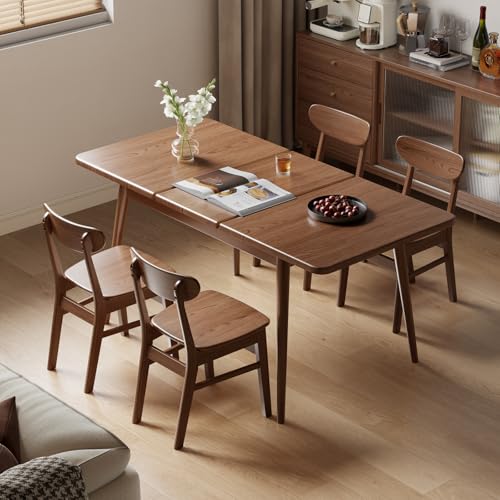
Muwuele 47"-63" Solid Wood Extendable Dining Tables for 4-8, Walnut | Compact Expandable Kitchen Table, Easy Assembly, Mid Century Modern, Dinner Table for Small Space, Dining Room, Apartment
Check price on Amazon
41 in-78 in Extendable Dining Room Table for 4-8, Round Expandable Kitchen Table with Fluted Base, Modern Farmhouse Oval Dinner Tables for Dining Room Kitchen Living Room (Natural)
Check price on Amazon
71-87 Inch Extendable Dining Room Table, Rustic Wooden Kitchen Table 6-10 | STHOUYN Expandable Dining Table, Farmhouse Rustic Style, Rectangular Wooden Top, Seats 6-10, Brown Kitchen or Dining Room
Check price on Amazon
86 in Extendable Dining Table for 6 8 10 People,59"-86" Farmhouse Rectangle Extending Dining Table w/Removable Leaves Space Saving,Wooden Adjustable Tables for Kitchen Office Living Room (Brown)
Check price on Amazon
Signature Design by Ashley Extendable Dining Table, Grayish Brown, Seats 8 | Wood, Acacia veneer, Engineered wood, Rectangular farmhouse style, 2 extension leaves, Moriville Series
Check price on AmazonWhat Makes a Wood Dining Table "Extendable"?
An extendable wood dining table is built with a split or segmented top and a sliding or folding mechanism underneath. In its closed state it behaves like a normal fixed table. When more seats are needed, the top separates, an insert is added or a folded section swings out, and the surface locks back together into one continuous dining area.
The key engineering question is not whether the table extends, but how the joint behaves when it does. A well-designed mechanism keeps the extended surface flush, rigid, and free of visible gaps. That distinction is where entry-level and premium construction diverge most sharply.
The Four Main Extension Mechanisms
- Separate leaf (butterfly-free): One or two boards stored elsewhere — a closet, under a bed, or in a dedicated slot. Simple and reliable, with the widest extension range, but you must store the leaf somewhere.
- Self-storing leaf: The leaf folds or slides into a compartment beneath the tabletop. No storage problem, no loose parts to misplace. Slightly heavier table and a marginally higher build tier.
- Butterfly leaf: A hinged panel folds out from the center of the table. Fast to deploy and nothing to store, but the extension width is usually more modest than a full separate leaf.
- Drop-leaf: Side panels hinge down along the table edges. Excellent for tight rooms and narrow footprints, though the extended shape is often less uniform than a center-leaf design.
If floor space is the real constraint, the drop-leaf approach on a compact drop-leaf kitchen dining table is often the smarter starting point. If seat count is the driver, a center-leaf model on a full dining table platform gives you the widest seating range.
Wood Species: What Actually Matters for an Expanding Table
An extension table puts stress on the joint every time it opens and closes. The wood needs to resist warping, hold screw threads, and move with seasonal humidity without binding the slides.
| Wood Type | Market Tier | Stability & Durability | Best For |
|---|---|---|---|
| Pine / Rubberwood | Entry-level | Moderate; soft enough to dent, needs a protective finish | Occasional-use tables, casual breakfast areas |
| Oak | Mid-range | High; dense grain, resists wear well, holds joinery firmly | Family dining rooms with daily use |
| Walnut | Premium | Very high; stable, rich grain, excellent for fine joinery | Formal dining spaces and design-led interiors |
| Maple / Ash | Mid-range to premium | High; tight grain, takes hard finishes cleanly | Modern and farmhouse styles with light finishes |
| Mango / Acacia | Mid-tier | Good; distinctive grain, variable density between boards | Rustic and eclectic dining rooms |
| Engineered core with wood veneer | Entry-level to mid-tier | Very stable; resists seasonal movement, less refinishable | Humidity-variable homes and apartments |
Solid oak and walnut are the safest long-term investments because they can be sanded and refinished. Engineered cores with a veneer top are more dimensionally stable in apartments with forced-air heating, which reduces the chance of a leaf joint sticking. That trade-off — refinishability versus stability — is the single most useful distinction to understand before you compare options.
Construction check: Look for reinforced aprons, steel or heavy-duty nylon glides, and alignment pins at the leaf joint. Those three details determine whether the extended surface stays flush after years of use. A durable dining table build is defined by its hardware as much as its wood.
How to Size an Extendable Wood Dining Table
Sizing is where most buyers get into trouble. The table must work in both states — closed for daily life, extended for hosting — and the room must accommodate the larger footprint.
Step 1: Seats Per Side
Allow roughly 24 inches of table edge per seated person for comfortable dining. A 72-inch table seats three per long side; a 96-inch table seats four. Extension leaves typically add 12 to 24 inches each, so a table that seats six can often reach eight or ten seats.
Step 2: Clearance Around the Table
Plan for 36 inches from the table edge to any wall or large furniture piece so chairs can pull out and people can walk behind seated guests. In tight rooms, 30 inches is the practical minimum, but it works best with benches or armless chairs.
Step 3: Room Dimensions in Both States
Measure the room, then subtract 60 to 72 inches from the length and width to get the maximum table footprint. The extended length is the number that matters most — that is the configuration you will use when the room is fullest and clearance matters least. For rooms that are tight even when closed, an extendable dining table for small spaces with a drop-leaf or butterfly design is the more workable approach.
| Closed Length | Extended Length | Seats Closed | Seats Extended | Room Length Needed (Extended, with clearance) |
|---|---|---|---|---|
| 48 in | 60–72 in | 4 | 6 | 120–132 in |
| 60 in | 72–84 in | 6 | 6–8 | 132–144 in |
| 72 in | 84–96 in | 6 | 8 | 144–156 in |
| 84 in | 96–108 in | 8 | 8–10 | 156–168 in |
| 96 in | 108–120 in | 8 | 10–12 | 168–180 in |
If you regularly host a dozen people, an extendable dining table that seats 12 is a realistic category rather than an aspirational one — but verify the extended length against your room before committing.
Leaf Storage: The Detail Buyers Forget
Separate leaves have to live somewhere. Before you choose a model, decide where the leaf will go when the table is closed. A closet shelf, a dedicated slot behind a sideboard, or a self-storing compartment are the three workable options.
Self-storing designs solve the problem entirely and are the main reason buyers move up a tier. If storage space is genuinely limited, a table with a self-storing leaf or a dual-leaf self-storing leaves model is worth the step up in construction tier. The alternative — a butterfly mechanism that folds from inside the table — avoids loose parts altogether, though it usually limits the maximum extension.
Practical rule: If you will use the extension more than once a month, prioritize self-storing or butterfly. If the extension is for holidays only, a separate leaf is perfectly workable and widens your choice of designs.
Matching Seating to an Expanding Table
Extension tables change seat count, so seating has to be flexible too. Benches are the most efficient use of the long sides — they seat more people per inch and slide under the table when not in use. A mix of bench on one side and chairs on the other is the most common configuration in family dining rooms.
Pair an extending top with durable dining chairs for the head and one long side, and a bench on the other. This combination keeps the closed footprint compact while letting the extended table reach its full seat count. For a coordinated look, an extendable dining table set packages the top with seating designed to match its proportions.
Style matters here too. A wood extension table suits farmhouse, modern rustic, and transitional rooms especially well. If your room leans in that direction, the modern farmhouse dining tables selection covers the aesthetic range without forcing you into a fixed-top design.
Buying Checklist
- Confirm the extended length fits your room with 30–36 inches of clearance on all sides.
- Choose a mechanism that matches your storage situation: separate leaf, self-storing, butterfly, or drop-leaf.
- Check the apron and glides for reinforcement — this is the main durability differentiator between tiers.
- Verify the leaf joint sits flush when locked; ask for a photo of the extended surface if buying online.
- Match wood species to humidity conditions in your home, not just to style.
- Plan seating that scales with the table: benches for the long sides, chairs for the ends.
- Consider the finished weight — solid wood extension tables are heavy and may need two people to move.
Frequently Asked Questions
What is the difference between a leaf and a butterfly extension?
A standard leaf is a separate board inserted into a gap in the tabletop, either stored elsewhere or self-stored under the table. A butterfly or drop-leaf mechanism folds outward from within the table itself, so there is no loose board to store, though the extension width is usually more limited than with full separate leaves.
How much clearance do I need around an extendable wood dining table?
Plan for roughly 36 inches of clearance from the table edge to any wall or large furniture piece so chairs can pull out comfortably and people can walk behind seated guests. In tight rooms, 30 inches is the practical minimum, but it works best with benches or armless chairs.
Does an extension gap affect table stability?
A well-built table with reinforced aprons and a locking mechanism stays rigid when fully extended. Entry-level tables sometimes show flex or a visible seam at the joint, while mid-range and premium models usually use steel glides, alignment pins, and thicker aprons to keep the surface flush and stable.
Can a solid wood extendable table handle outdoor use?
Only if it is specifically built for outdoor conditions with weather-resistant coating and moisture-tolerant joinery. Standard indoor wood tables should stay inside; humidity swings cause seasonal movement that can bind leaf mechanisms. For patio use, look at a dedicated outdoor extendable model.
How often should the extension mechanism be maintained?
Inspect the glides and locking hardware twice a year. Wipe away dust and debris, and apply a dry lubricant to metal slides if the mechanism feels stiff. Avoid oil-based lubricants on wood-on-wood slides, as they can attract grit and gum up over time.
Ready to Choose Your Extendable Wood Dining Table?
Compare mechanism types, wood species, and seating configurations side by side. The product picks above are filtered to wood extension tables that hold up to regular use.
Explore Table Options