
Round Dining Room Table with Leaf: The Complete Guide
Everything you need to know about choosing an extendable round dining table that adapts from everyday family meals to full-house entertaining.
Why this guide matters: A round dining room table with leaf solves a very specific problem — you love the cozy, conversation-friendly shape of a round table, but you occasionally need to seat extra guests. This guide walks you through leaf mechanisms, sizing, materials, and practical buying considerations so you can decide with confidence before you shop.
Key Takeaways
- A round dining room table with leaf typically expands along the center line, converting from a compact circle into an oval that seats two to four additional guests.
- Leaf storage matters: self-storing leaves (inside the table) are the most convenient, while separate leaves require dedicated closet or sideboard space.
- Pedestal bases are the most common foundation for extendable round tables because they keep legs out of the way when the table grows.
- Solid wood tops handle repeated leaf insertion best, while glass and stone tops are usually fixed and rarely extendable.
- Measure your room's clearance carefully — an extended oval needs walking space on all sides, not just along the long axis.
What Exactly Is a Round Dining Room Table with Leaf?
A round dining room table with leaf is a circular table that includes one or more removable or folding panels — called leaves — that insert into the middle of the tabletop. When the leaf is in place, the table becomes an oval; when removed, it returns to a compact round shape. This dual configuration is why this style is so popular in homes that host both intimate weekday dinners and larger holiday gatherings.
The design concept dates back to early American and European furniture making, where cabinetmakers built "extension tables" with separate leaf boards stored upright in a closet. Modern versions refined the idea with self-storing leaves that slide underneath the tabletop or fold accordion-style, eliminating the storage headache entirely.
If you want to explore the broader category of circular tables before committing to an extendable model, our round dining table guide covers the full landscape of shapes, sizes, and base styles.
How Leaf Mechanisms Work: The Three Main Types
The leaf mechanism is the single most important functional component of an extendable round table. It determines how easy it is to expand the table, how stable the surface feels when extended, and whether you need extra storage space. Here are the three mechanisms you will encounter.
1. Drop-Leaf (Folding Leaf)
Drop-leaf tables have hinged panels on one or both sides that fold down against the table's edge. When raised, they are supported by swing-out brackets or gate legs. This is the most space-efficient mechanism because the leaves never detach — there is nothing to store. The trade-off is that drop-leaf hinges can loosen over time with heavy use, and the table's extended shape is usually wider rather than longer.
Our dedicated guide on the round drop leaf table dives deeper into this style if you prefer a no-storage solution.
2. Butt-Joint Leaf (Separate Board)
The classic extension table uses one or two separate leaf boards that butt together in the center. The tabletop splits into two halves that slide apart on wooden or metal tracks, the leaf drops in, and the halves close to lock it in place. This mechanism offers the most stable extended surface because the leaf is fully supported along its edges. The downside is storage — separate leaves need a flat, dry place to rest when not in use.
3. Self-Storing Leaf
Self-storing designs keep the leaf attached to the table at all times. The leaf either folds in half and tucks under the tabletop, or it slides into a compartment beneath the surface. This is the most convenient option for households that expand and contract their table frequently, because there is no retrieval or storage step. Self-storing mechanisms are typically found on premium and luxury tier tables where the hardware engineering justifies the higher position in the market.
If self-storage is a priority for you, explore the round dining table with leaves stored inside for specific models and considerations.
Sizing Guide: From Compact Circle to Extended Oval
Understanding the relationship between the round diameter, the leaf width, and the resulting oval length is essential before you shop. The table below shows typical configurations across market tiers, expressed in seating capacity rather than measurements alone.
| Configuration | Typical Diameter | With Leaf | Seating (Round) | Seating (Extended) | Best For |
|---|---|---|---|---|---|
| Compact Entry-Level | 36–42 inches | Adds 12–18 inches | 2–4 | 4–6 | Small kitchens, breakfast nooks, apartments |
| Standard Mid-Range | 44–48 inches | Adds 18–24 inches | 4 | 6 | Family dining rooms, everyday meals plus occasional guests |
| Generous Premium | 54–60 inches | Adds 24–30 inches | 4–6 | 6–8 | Formal dining rooms, frequent entertaining |
| Grand Luxury | 60+ inches | Adds 30+ inches | 6–8 | 8–12 | Large dining rooms, holiday hosting, banquet-style gatherings |
A practical rule of thumb: allow at least 24 inches of table edge per seated diner, and keep 36 inches of clearance between the table edge and walls or other furniture so chairs can pull out comfortably. When the table is extended into an oval, re-check the clearance along the long axis — this is where many buyers discover their room is tighter than expected.
For households that regularly seat six, the round dining room table and chairs for 6 collection shows how seating layouts work in practice. If you regularly host eight or more, the round dining room table for 8 page covers the larger footprint considerations.
Materials and Construction: What to Look For
The material of the tabletop and base has a direct impact on how well the leaf mechanism performs over years of use. Here is how the main options compare.
Solid Wood
Solid wood — oak, maple, walnut, rubberwood, or pine — is the gold standard for extendable tables. Wood expands and contracts with humidity, but a well-constructed solid wood table with properly aligned leaf tracks will hold its shape for decades. The leaf edges match the grain and finish of the main top, so the seam is nearly invisible when installed. Heavy-duty solid wood tables fall into the mid-range through luxury tiers depending on the species and joinery.
Wood Veneer over Engineered Core
Veneer tables use a thin layer of real wood over MDF or particleboard. They offer a consistent, uniform grain pattern at a lower position in the market than solid wood. The leaf mechanism on veneer tables is usually a metal slide, and the leaf itself is often veneered on both faces. These tables are a solid choice for the essential tier and starter tier, though they are less resistant to moisture at the seams.
Glass and Stone
Glass and marble or stone tops are rarely extendable because the material cannot be split and rejoined cleanly. If you love the look of glass or stone but need extension capability, consider a round glass table in a fixed size paired with a separate folding table for overflow seating. Our guides to the round glass dining table for 4 and the round marble dining table cover those fixed-size options in detail.
Base Styles
Pedestal bases dominate the extendable round table category because a central column leaves the entire perimeter free for chairs — critical when the table grows into an oval. Trestle and four-leg bases are also available but require careful measurement so the legs do not interfere with the leaf track or the extra seating positions. Our round pedestal dining table guide explains why this base style pairs so naturally with extension leaves.
Style Considerations: Matching the Table to Your Room
An extendable round table is available in virtually every design language, so the challenge is not finding one — it is choosing the one that fits your existing room. Here are the most common directions.
- Farmhouse and rustic: Reclaimed wood tops, turned pedestal bases, and a distressed finish. The leaf seam is often deliberately visible as part of the character. See the round farmhouse dining table collection for examples.
- Mid-century modern: Tapered legs, warm walnut tones, and a clean oval profile when extended. The retro dining table style overlaps heavily with this look.
- Contemporary and minimalist: Thin-profile tops, metal pedestal bases, and a seamless leaf seam. Often paired with upholstered chairs in neutral tones.
- Traditional and formal: Ornate pedestal carving, rich cherry or mahogany finishes, and a self-storing leaf for a polished extended surface.
If you are still deciding between a round table and a rectangular one, the round dining table extendable overview compares the two shapes side by side in terms of traffic flow, conversation, and room fit.
Buying Checklist: Questions to Answer Before You Purchase
Use this checklist to narrow your options and avoid a return. Each question points to a specific decision that affects long-term satisfaction.
- How often will you use the leaf? Daily use points to a self-storing mechanism; occasional holiday use makes a separate butt-joint leaf perfectly acceptable.
- Where will the leaf live when not in use? Measure your closet, sideboard, or under-bed space if the leaf is separate.
- What is the maximum extended length your room allows? Tape the extended footprint on the floor and walk around it before buying.
- Does the leaf lock securely? Ask about the locking mechanism — a table that wobbles at the seam is a daily frustration.
- Will the table accept your existing chairs? Check apron height and leg clearance, especially on pedestal tables where the column sits close to the seat back.
- What is the finish and care routine? Oiled wood needs periodic conditioning; lacquered or polyurethane finishes are more forgiving for busy households.
- Is the base stable when extended? A pedestal with a wide, weighted foot resists tipping better than a narrow one, particularly at the premium tier.
If you are furnishing a complete dining room from scratch, the round dining room sets page bundles table, chairs, and matching storage so you can evaluate a cohesive look rather than piecing it together.
Common Mistakes Buyers Make
These are the pitfalls that show up most often in buyer feedback and return data. Avoiding them early saves time and frustration.
- Underestimating the extended footprint. The oval length is what matters for guest seating, but the diagonal clearance is what matters for walking around the table. Measure both.
- Ignoring the leaf storage problem. A beautiful table with a leaf that has no home becomes a table that is never extended.
- Choosing a base that blocks chairs. Four-leg round tables with wide aprons can make it difficult to push chairs under the table, especially with the leaf installed.
- Overlooking the seam quality. Run your hand across the leaf seam on a floor model — if you can feel a ridge, it will collect crumbs and wear unevenly.
- Buying for the round size only. The extended configuration is the reason you are buying this table; evaluate the oval shape as carefully as the circle.
Recommended Round Dining Room Tables with Leaf
⚠️ AFFILIATE DISCLOSURE: This website contains affiliate links. As an affiliate Associate, we earn from qualifying purchases. If you make a purchase through these links, we may receive a small commission at no additional cost to you. Read our full affiliate policy.
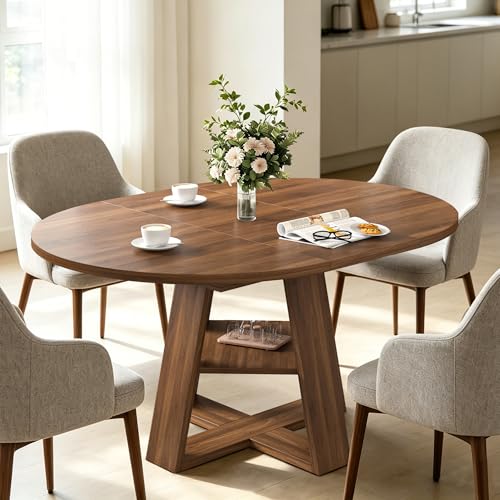
43.3"-59" Extendable Round Oval Dining Table for 4-8 with Storage Shelf | Modern Kitchen Oval Dining Table with Removable Leaves,Space Saving Extendable Table Wood Base for Kitchen Living Room Walnut
Check price on Amazon
47.2"-58.7" Extendable Round Dining Table for 4-6 with Storage Shelf | 2-Tier Modern Oval Kitchen & Dining Room Table with Removable Leaves for Kitchen / Dining / Living room, Black
Check price on Amazon
41 in-78 in Extendable Dining Room Table for 4-8, Round Expandable Kitchen Table with Fluted Base, Modern Farmhouse Oval Dinner Tables for Dining Room Kitchen Living Room (Walnut)
Check price on Amazon
ERYE Retro Style Round Dining Table Functional Wooden Extendable Oval Dining Table with 12" Leaf and Natural Wood Grain Variation Tabletop
Check price on Amazon
ONBRILL 42"-106" Extendable Dining Table for 2-10 with Storage Legs, Walnut | Mid-Century Modern Oval Extendable Dining Table with 4 Removable Leaves, Round Dinner Table for Dining Room, Kitchen
Check price on Amazon
East West Furniture AVT-SBR-TP Avon Kitchen Dining Table - an Oval Wooden Table Top with Butterfly Leaf & Pedestal Base, 42x60 Inch, Saddle Brown
Check price on AmazonFrequently Asked Questions
Can a round dining table with leaf seat eight people?
Yes, but only in the larger configurations. A 54–60 inch round table that extends by 24–30 inches becomes an oval long enough to seat eight comfortably. Smaller 36–42 inch tables typically max out at six when extended. Always confirm the extended length and allow 24 inches of edge per diner when calculating capacity.
Is a self-storing leaf worth the higher position in the market?
For households that expand the table more than a few times per year, yes. The convenience of not retrieving and storing a separate board is substantial, and the engineering on self-storing mechanisms tends to be more robust at the premium tier. If you only extend the table during holidays, a separate butt-joint leaf is a solid choice for the mid-range tier.
What is the difference between a drop-leaf and an extension leaf?
A drop-leaf folds down against the table's side and stays attached, so there is nothing to store. An extension leaf is a separate panel that inserts into the middle of the table, converting a circle into an oval. Drop-leaf tables are more space-efficient; extension tables offer a more stable extended surface and a cleaner round shape when closed.
Can I use a round table with leaf in a small dining room?
Yes — this is one of the best furniture choices for a small dining room because the closed round shape takes up less floor area than a rectangular table of similar seating capacity. The key is to measure the extended footprint and confirm you still have walking clearance when the leaf is installed. Our round small kitchen table guide covers compact options specifically.
Does the leaf affect table stability?
A properly engineered extension table should feel as stable extended as it does closed. The weak point is the leaf seam — look for a locking mechanism that pulls the two halves tightly together and a leaf that is supported along its full edge. Pedestal bases with wide, weighted feet resist tipping better than narrow four-leg bases when the table is extended.
How do I care for a wood table with a leaf?
Dust with a soft cloth, wipe spills promptly, and use coasters and trivets to protect the finish. Condition oiled wood every few months and keep the table away from direct sunlight and heating vents to minimize expansion and contraction. When the leaf is not in use, store it flat in a dry, climate-stable location — never lean it against a wall where it can warp.
Explore Related Round Dining Tables
If you are still comparing shapes and configurations, these pages cover adjacent topics that will help you finalize your decision.