
Small Dinette Sets: Complete Buying Guide for Compact Dining Spaces
Everything you need to choose a compact dinette set that fits your kitchen, apartment, or breakfast nook — without sacrificing comfort or style.
EXPLORE THE GUIDEWhy Small Dinette Sets Deserve Careful Consideration
A dinette set is more than a table with chairs. In a compact kitchen or apartment, it becomes the daily anchor for breakfast, homework, coffee breaks, and quick conversations. Because the available floor area is limited, every inch matters — and the wrong dimensions or material choice can make a small space feel crowded and hard to use.
This guide is written for shoppers who already know they want a compact dining solution but need clarity before committing. You will learn how to measure properly, which table shapes suit tight corners, how materials affect durability and maintenance, and which design details make a small dinette set feel intentional rather than improvised. By the end, you will be able to compare options with confidence and recognize which set genuinely fits your room and daily routine.
Key insight: The best small dinette set is not simply the smallest one available. It is the set that balances seat count, table footprint, chair clearance, and visual weight so the room remains comfortable to move through and pleasant to sit in.
The Small Dinette Buying Framework
Before browsing styles, define the practical constraints of your space. A dinette set works well only when the table, chairs, and surrounding walkways coexist without friction. Use the following framework to narrow your options efficiently.
1. Measure the Room, Not Just the Table
Start by measuring the length and width of the available dining area. Then subtract a minimum of 30 inches (about 76 cm) on every side where a chair will be pulled out. This clearance allows a person to sit down, stand up, and walk behind seated guests. For a two-seat dinette, a footprint of roughly 30 to 36 inches across is typical; four-seat sets usually span 40 to 48 inches. If your room is tighter than these numbers suggest, consider a wall-mounted drop-leaf design or a set with a small pedestal base that reduces leg obstruction.
2. Choose a Shape That Matches the Room Geometry
Round tables soften tight corners and allow smoother traffic flow because there are no sharp edges to navigate around. Rectangular and square tables use wall space efficiently and can seat more people along a straight edge. In narrow galley kitchens, a small rectangular set placed against one wall often works best. In open-plan apartments, a round pedestal table can visually separate the dining zone without creating a hard barrier. If you are considering a round option, a small round drop-leaf table with two chairs is a classic solution for very tight footprints.
3. Confirm Seat Count Against Daily Use
Count the people who will use the dinette on a normal day, not the maximum number of guests you might host once a year. A two-seat set is ideal for singles and couples; a four-seat set suits small families or households that frequently host a guest or two. If occasional extra seating matters, look for sets with a small leaf or benches that tuck underneath. A small dining table set for four often provides the best balance between everyday usability and compact dimensions.
4. Evaluate Material for Durability and Maintenance
Dinette sets endure daily use, so material choice directly affects longevity and upkeep. Solid wood and wood veneer offer warmth and repairability, but require periodic care and protection from moisture. Laminate and glass tops are easier to wipe clean and resist staining, which suits busy households. Metal frames with wood or composite tops are a practical mid-tier choice that combines structural rigidity with low maintenance. For a deeper look at care routines, see our guide on how to clean a solid wood dining table.
5. Match Visual Weight to the Room
A visually heavy dinette set — thick tabletop, chunky legs, dark finish — can overwhelm a small room even if the physical dimensions fit. Lighter finishes, slim profiles, and open chair backs keep the space feeling airy. If the room receives limited natural light, a glass-top or light-wood set will reflect and distribute light more effectively than a dark, solid mass.
Clearance Check
Leave 30 inches (76 cm) between the table edge and any wall or counter where a chair pulls out. This is the single most common planning mistake in small dining areas.
Chair Storage
Chairs that tuck fully under the table save floor space. Look for sets where the seat height and apron depth allow the chair to slide in without the arms colliding with the table edge.
Traffic Path
Keep at least one unobstructed path of 36 inches (91 cm) through the room. If the dinette blocks the main walkway, the set is too large regardless of its seat count.
Recommended Small Dinette Sets for Compact Spaces
⚠️ AFFILIATE DISCLOSURE: This website contains affiliate links. As an affiliate Associate, we earn from qualifying purchases. If you make a purchase through these links, we may receive a small commission at no additional cost to you. Read our full affiliate policy.

Dining Table Set for 4,Kitchen Table and Chairs for 4, Round Dining Room Table with Upholstered Chairs, 5 Piece Space Saving Circle Wood Kitchen & Dining Room Dinner Dinette Table Set (Vintage, 42In)
Check price on Amazon
IRONCK Dining Table Set for 4, Grey | Wood Kitchen Table with Upholstered Chairs for Kitchen Room and Small Spaces
Check price on Amazon
Best Choice Products 3-Piece Dining Set W/ Storage Rack - Med Brown/Black | Modern space saving steel frame dinette built for kitchens, dining rooms & small spaces
Check price on Amazon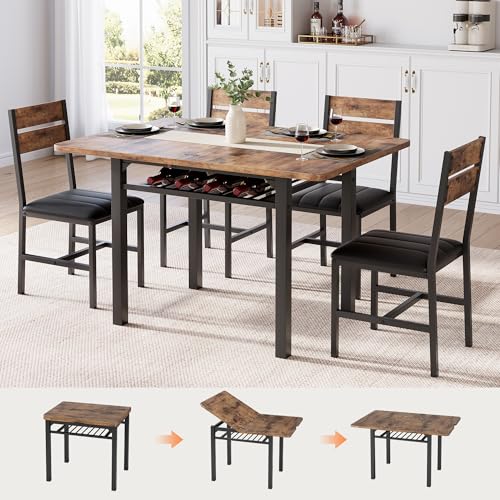
MapleGrace Extendable Dining Table Set for 4 with Built-in Shelf Rack Brown | Kitchen Table Set with 4 PU Leather Upholstered, Wood Dining Room Chairs for Dining & Small Spaces
Check price on Amazon
AWQM 3 Piece Dining Table, Small Kitchen Table Set for 2 with Chairs(Brown) | Wood Breakfast Nook Table and Chairs Set of 2,Dinette Set for Small Space,Dining Room,Office, Apartment
Check price on Amazon
IRONCK Dining Table Set for 4, Rustic Brown | Wood Kitchen Table with Upholstered Chairs for Kitchen Room and Small Spaces
Check price on Amazon
IRONCK Dining Table Set for 2, Rustic Brown | Small Kitchen Table with Upholstered Chairs, Compact Dining Set for Small Spaces, Kitchen & Dining Room
Check price on AmazonComparing Dinette Sets by Quality Tier
Instead of thinking in terms of specific numbers, classify dinette sets by their market position and construction quality. The table below outlines what you can generally expect from each tier so you can align your expectations with the set you are considering.
| Tier | Typical Construction | Best For | Durability Outlook |
|---|---|---|---|
| Entry-Level | Engineered wood, laminate tops, basic metal frames | First apartments, temporary setups, light daily use | Adequate for occasional use; may show wear sooner in high-traffic households |
| Mid-Range | Wood veneer, reinforced joints, powder-coated steel | Everyday family use, breakfast nooks, rental kitchens | Solid balance of durability and maintenance ease; good value for its tier |
| Premium | Solid wood construction, quality hardware, hand-finished surfaces | Long-term daily use, design-focused interiors | Long-term investment with repairable surfaces and stable joinery |
| Top-Tier | Hardwood solids, artisan finishes, precision joinery | Design-led homes, heirloom expectations | Flagship-level craftsmanship intended for decades of use with proper care |
A mid-range set usually offers the most balanced ownership experience for a small dinette because it combines stable construction with finishes that tolerate daily cleaning. Entry-level sets can serve well in low-traffic settings, while premium and top-tier sets make sense when the dinette is a focal point and you intend to keep it for many years.
Matching Dinette Style to Compact Spaces
Breakfast Nooks and Corner Placement
A breakfast nook often benefits from an L-shaped bench or a corner banquette paired with a small table. This arrangement maximizes seating along walls and keeps the center of the room open. If you are planning a nook, an L-shaped breakfast nook can define the dining zone while preserving floor space for movement. For freestanding nooks, a little breakfast table paired with two compact chairs is a practical starting point.
Apartment Kitchens and Open Plans
In apartments, the dinette frequently sits between the kitchen and living area. Choose a set with a small visual footprint — a pedestal base, a glass top, or a light wood finish — so it does not interrupt sightlines. A small pedestal dining table is especially useful because the central base reduces leg clutter and makes chair placement more flexible. If the kitchen island doubles as a dining surface, a kitchen table and chairs and bench combination can provide flexible seating without a large table footprint.
Dual-Purpose and Foldable Solutions
When floor space is at an absolute minimum, foldable and dual-purpose furniture becomes the practical answer. A foldable table with adjustable height can serve as a dining surface and a workspace, while a kitchen table with bench keeps seating tucked away when not in use. These solutions are not compromises — they are deliberate choices for rooms that need to change function throughout the day.
Round vs. Rectangular in Tight Rooms
Round dinette tables are generally more forgiving in compact rooms because they eliminate sharp corners and allow people to move around the perimeter more naturally. A round kitchen table for four can fit into a corner or bay window area that would be awkward for a rectangular set. Rectangular sets, by contrast, work best when placed against a wall or in a defined alcove where the straight edges align with the room geometry. If you are leaning toward a rectangular footprint, a rectangle dining table for four offers efficient use of wall-adjacent space.
Design tip: In a small dinette, the chairs matter as much as the table. Low-back chairs and benches preserve sightlines and make the room feel larger. If you choose a set with high-back chairs, ensure the room has enough visual breathing space so the seating does not dominate the view.
Final Checks Before You Choose a Dinette Set
Once you have narrowed your options to a few candidates, run through these practical checks to avoid common mistakes.
- Verify assembled dimensions: Product listings sometimes show tabletop dimensions without including the chair pull-out zone. Confirm the full footprint when the set is assembled and in use.
- Check chair height and table apron clearance: Chairs should tuck under the table without the arms or seat hitting the apron. This matters more in small rooms where chairs are frequently pushed in.
- Review the assembly requirements: Some compact sets ship partially assembled; others require full assembly. Confirm whether the hardware and tools are included and whether the assembly is manageable for one person.
- Confirm the finish and care instructions: Matte finishes hide fingerprints better than high-gloss surfaces in daily-use dinettes. Check whether the manufacturer recommends specific cleaners or protectants.
- Consider the floor surface: Chair legs and table bases can scratch hard floors. Look for sets with felt pads or adjustable glides, or plan to add floor protection after assembly.
- Think about resale or repurposing: A well-constructed mid-range or premium dinette set holds its usefulness longer and is easier to repurpose in a future home than a low-cost set that may not survive a move.
If you are still comparing styles, our guide on splurge vs. save dining furniture can help you decide where to invest and where to choose a simpler option. For households that need flexible seating, a small dining room table and chairs set may offer more configuration options than a fixed dinette.
Frequently Asked Questions About Small Dinette Sets
What size dinette set fits a small kitchen?
For a small kitchen, a two-seat dinette typically measures 30 to 36 inches across, while a four-seat set usually spans 40 to 48 inches. Always leave at least 30 inches of clearance on all sides for chair pull-out and walkway space.
Are round or rectangular dinette sets better for small spaces?
Round dinette sets generally work better in tight or oddly shaped corners because they have no sharp edges and allow smoother traffic flow. Rectangular sets maximize seating along a wall but require more careful clearance planning.
What materials are best for a small dinette set?
Solid wood and wood veneer offer durability for daily use, while glass tops visually open up compact rooms. Metal frames with wood or laminate tops are a practical mid-tier option that balances durability and easy maintenance.
Can a small dinette set work in an open-concept space?
Yes. Choose a dinette with a visual weight that matches the surrounding room, and use rugs or pendant lighting to define the dining zone without adding physical barriers.
How many chairs should a small dinette set have?
Match the seat count to daily use, not occasional hosting. Two chairs suit singles and couples; four chairs fit small families. If you occasionally need extra seating, consider a set with a bench or a small leaf rather than a larger fixed table.
Ready to Choose Your Small Dinette Set?
Use the buying framework in this guide to measure your space, choose the right shape and tier, and compare sets that genuinely fit your room. Explore the recommended options above to see current availability and features.
View Recommended Dinette Sets