
Small Drop Leaf Table: The Space-Saving Solution for Compact Dining
Learn how a folding-leaf table transforms tight kitchens, apartments, and breakfast nooks into flexible dining areas. This complete research guide covers dimensions, materials, styles, and setup strategies so you can choose with confidence.
Explore Recommended ModelsWhy research a small drop leaf table first? A drop leaf table is one of the few furniture pieces that genuinely adapts to your day: folded flat as a console or desk, one leaf up for a quick breakfast, two leaves open for family meals. Because the hinge mechanism and leaf support determine long-term stability, understanding these details before buying helps you avoid a wobbly table or a leaf that sags over time.
What Exactly Is a Drop Leaf Table?
A small drop leaf table is a compact dining table with hinged sections—called leaves—attached to one or both long sides of the frame. When the leaves are folded down, the table footprint shrinks dramatically, often to the width of a narrow console. When raised, the leaves extend the usable surface to seat two, three, or four people depending on the model's width and depth.
The appeal is simple: you get a full dining surface only when you need it. In a small apartment, that means the table can sit against a wall for most of the day and swing out for meals. In a kitchen, it can double as a prep station and a breakfast spot. If your dining area is tight but you still want a real table rather than a folding tray, this category is the practical middle ground.
Related compact options worth comparing include a small dining table for 2 and a small breakfast nook table if your space has a built-in corner.
How the Folding Mechanism Works (and What to Check)
The mechanism is the heart of any drop leaf design. Most models use one of three support systems:
- Gate-leg supports: Swing-out wooden legs that lock under the leaf. These are the most stable and common on traditional and farmhouse designs.
- Bracket or arm supports: Metal or wooden arms that fold out from the apron. Lighter and easier to operate, but they demand a solid hinge plate.
- Butterfly or rule-joint hinges: A continuous hinge running the full length of the leaf. This distributes weight evenly and is a sign of better construction.
When evaluating a model, check the hinge material and the leaf support. Entry-level models often use stamped metal hinges, while mid-range and premium models typically use solid brass, steel, or heavy-duty piano hinges with reinforced screws. A well-built drop leaf should feel firm when raised—no flex, no creaking, and no gap at the seam.
Sizing Guide: Matching the Table to Your Space
Drop leaf tables vary widely in footprint. The most common configurations are:
- Two-seat compact models: Roughly 30–36 inches wide when open, with leaves down reducing depth to about 12–18 inches. Ideal for one or two people in a kitchen corner.
- Three-to-four-seat models: Around 42–54 inches wide when fully open, with a folded depth of 18–24 inches. These can handle a small family meal or a pair of guests.
- Extended or console-style models: Some designs start as a narrow console and open to a wider dining surface, blurring the line between storage furniture and dining table.
Always measure the clearance around the table, not just the table itself. You need roughly 24 inches of chair pull-out space on each open side. If your room is genuinely tight, compare this category against a small dining table with chairs that fit underneath, which can reduce visual clutter when not in use.
Quality Tiers: What Changes as You Move Up
Starter Tier
Manufactured wood or lightweight veneer, basic bracket supports, and a thinner top. Works well for occasional use, dorms, and starter apartments where the table is folded most of the time. Expect simpler hinge hardware and a lighter overall build.
Balanced Tier
Solid wood or reinforced veneer over engineered core, gate-leg or heavy bracket supports, and a thicker tabletop. This tier typically offers the smoothest folding action and the best balance of durability and design choice for daily use.
High-End Tier
Solid hardwood frames, continuous piano hinges, precise joinery, and a refined finish. These models are built for daily meals and long-term use, with heavier leaf supports that stay level after years of folding and unfolding.
Materials and Finishes: What Holds Up Best
Solid wood (oak, rubberwood, pine, walnut) remains the most durable choice. It can be refinished and repaired, which matters for a table that will see daily handling. If you like a warmer, more traditional look, a round wood kitchen table style often informs the finish language of drop leaf models too.
Wood veneer over engineered wood is common in mid-range models. It offers a flatter, more uniform surface and a wider range of finishes, but the edges and hinge areas need care to avoid chipping.
Metal frames with wood tops suit industrial and modern interiors and are very stable when the leaf supports are properly engineered. They resist wobble well but can be heavier to move.
For a compact space with a lighter aesthetic, consider a small apartment-size kitchen table and chairs as a comparison point—many of these use the same space-saving logic as drop leaf models.
Styles That Work in Small Rooms
Because a drop leaf table is often visible even when folded, its style matters as much as its function. The most versatile options are:
- Farmhouse and rustic: Warm wood tones, turned legs, and gate-leg supports. Blends well with open shelving and woven textures.
- Modern minimalist: Clean lines, slim aprons, and neutral finishes. Folded, it reads as a console rather than a dining table.
- Scandinavian: Light woods, tapered legs, and simple hardware. Excellent for bright, airy apartments.
- Industrial: Metal frame with a wood top, often with visible rivets or a matte powder coat.
If your room leans rustic, a rustic wood dining table reference can help you match finishes. If you prefer a lighter palette, a small dining table set for 2 is often styled similarly to compact drop leaf models.
Drop Leaf vs. Other Compact Table Types
| Table Type | Best For | Space Behavior | Tier Consideration |
|---|---|---|---|
| Small drop leaf table | Kitchens, apartments, dual-use spaces | Folds flat against wall; opens for meals | Mid-range offers best hinge longevity |
| Small extendable dining table | Rooms needing occasional extra seating | Stays full-size; extends with leaves stored inside | Premium tiers add smoother extension mechanisms |
| Small bistro table | Café-style corners, two-person meals | Fixed footprint; very compact | Entry-level to mid-range covers most needs |
| Round wood kitchen table | Traffic-flow-friendly kitchens | Fixed footprint; no soft corners to navigate | Solid wood mid-range is a durable choice |
If you expect to host more than four people regularly, a small extendable dining table may be a better fit. If you only ever seat two, a small bistro table is simpler and equally space-efficient.
How to Set Up a Drop Leaf Table in a Small Room
- Measure the folded footprint first. Confirm the table clears doorways, appliance doors, and chair pull-out zones when the leaves are down.
- Choose a wall or anchor point. Place the table against a wall or a window so the folded side is out of the walking path.
- Test the open depth. With both leaves up, you need roughly 24 inches of clearance per open side for chairs.
- Pick chairs that tuck in. Low-back or armless chairs slide under the table more easily. See set of 4 dining chairs clearance options for compact seating.
- Add a protective pad or runner. Since the table is used for multiple tasks, a removable pad protects the finish.
- Keep the leaf area clear when folded. Avoid storing heavy items on the folded leaves—this stresses the hinge over time.
Recommended Small Drop Leaf Tables for Compact Spaces
⚠️ AFFILIATE DISCLOSURE: This website contains affiliate links. As an affiliate Associate, we earn from qualifying purchases. If you make a purchase through these links, we may receive a small commission at no additional cost to you. Read our full affiliate policy.

IC INTERNATIONAL CONCEPTS Solid Wood 36 in. Drop Leaf Table, Solid Espresso
Check price on Amazon
Best Choice Products 42in Round Drop Leaf Dining Table W/ Shelf - Chestnut | Solid wood expandable table for 4, a space saving choice for kitchen, dining room & small spaces
Check price on Amazon
Best Choice Products 42in Round Drop Leaf Dining Table W/ Shelf - Black | Solid wood expandable table for 4, a space saving choice for kitchen, dining room & small spaces
Check price on Amazon
VINGLI 31.5" Drop Leaf Dining Table Set for 2, 3 Pieces Dining Table with Chair for Small Space, Small Kitchen Extendable Folding Dining Table for Dining Room,Home, Apartment, Saving Places, White Oak
Check price on Amazon
IC International Concepts Drop Leaf Dining Table, Small, Unfinished | Solid parawood, two 9" drop leaves, 36"W x 22"D x 29"H, 26.5" floor to apron, unfinished
Check price on Amazon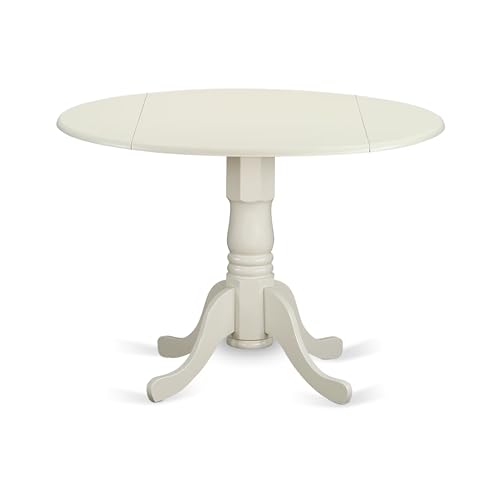
East West Furniture DLT-WHI-TP Dublin Modern Kitchen Table - a Round Dining Table Top with Dropleaf & Pedestal Base, 42x42 Inch, Linen White
Check price on Amazon
Merax Wooden Small 29"- 47" Extendable Dining Table with Drop Leaf,Brown | Farmhouse Folding Kitchen Table for 2- 4, Rounded Edges Dinner Table for Studio Apartment Breakfast Nook, Easy Assemble
Check price on AmazonCare and Maintenance for Long-Term Use
A drop leaf table takes more mechanical stress than a fixed table because the leaves move repeatedly. Basic care extends the life of the mechanism and finish:
- Dust the hinge area regularly; grit accelerates wear.
- Apply a wood conditioner or paste wax every few months on solid wood models.
- Tighten hinge screws periodically—this is the most common source of leaf sag.
- Avoid dragging the table when opening; lift and place rather than sliding.
- Use coasters and trivets to protect the finish from heat and moisture.
For deeper restoration, see our guide to scratch repair tips if the surface shows wear.
Frequently Asked Questions
What is a small drop leaf table?
A small drop leaf table is a compact table with hinged leaves on one or both sides that fold down when not in use. This design lets you expand the tabletop for meals and then collapse it to reclaim floor space in kitchens, apartments, and breakfast nooks.
How many people can a small drop leaf table seat?
Most small drop leaf tables seat two people with the leaves down or one side folded, and up to four people when both leaves are fully extended. Larger models with a wider frame can occasionally seat four comfortably with both leaves raised.
What materials are best for a drop leaf table in a small space?
Solid wood and wood veneer offer the best balance of durability and visual warmth for compact dining areas. Metal frames with wood tops are a strong option for heavy-duty use, while manufactured wood with a reinforced finish works well for starter-tier and mid-range models.
Can a small drop leaf table be used as a desk or extra counter space?
Yes. A drop leaf table is highly versatile. With the leaves folded, it works as a console, desk, or prep surface. With one leaf raised it becomes a compact work station, and with both leaves open it serves as a full dining table.
Final Buying Checklist
Before choosing, confirm five things: the folded footprint, the open footprint, the hinge and leaf-support type, the material and finish, and the chair clearance on each open side. If you want to explore adjacent compact categories, compare a small dining table with bench for a more social seating layout, or a small chair table set for a coordinated look. With the right drop leaf model, a small room can serve breakfast, work, and dinner without permanently sacrificing floor space.