
Small Kitchen Table with Drop Leaf and Chairs
Learn how a drop leaf table turns a compact kitchen into a flexible dining space. This guide covers dimensions, materials, chair pairing, stability, and the buying factors that matter most.
Why a Drop Leaf Table Works in Small Kitchens
A small kitchen table with drop leaf and chairs solves a very specific problem: you need a place to eat, but you cannot dedicate floor space to a full dining setup. Drop leaf tables use hinged panels that fold down against the frame, reducing the footprint to a narrow console when the table is not in use. When mealtime arrives, you lift the panels and lock them into place.
This design fits kitchens that double as walkways, laundry zones, or entry points. Unlike a fixed table, a drop leaf model lets you reclaim floor space during prep work or when the room needs to serve another purpose. For households of two, or for homes where the main dining room handles larger gatherings, this flexibility often matters more than raw surface area.
Best fit: A drop leaf table suits studios, apartments, galley kitchens, breakfast corners, and homes where the kitchen table is also the everyday work surface. If you regularly seat six or more people, a fixed rectangular dining table set is usually the more practical choice.
Everyday Scenarios
- Morning routine: One leaf up, two chairs, enough room for coffee and breakfast.
- Weeknight dinner: Both leaves up, seating for three or four.
- Prep work: Leaves down, table becomes a compact side surface.
- Small gatherings: Leaves up plus folding chairs or a bench tucked underneath.
If you are comparing compact formats, it helps to review small kitchen table sets side by side, since drop leaf models differ significantly in expanded size and chair clearance.
Key Dimensions and Space Planning
Measurements decide whether a drop leaf table feels convenient or cramped. The three numbers that matter are the folded footprint, the fully expanded surface, and the chair pull-out clearance. A table that looks fine in a showroom can block a doorway once chairs are occupied.
Typical Size Ranges
| Configuration | Typical Width | Typical Depth | Seating |
|---|---|---|---|
| Both leaves down | Narrow console width | Shallow, against wall | 0 to 2 (tucked stools) |
| One leaf up | Moderate width | Half expanded | 2 comfortably |
| Both leaves up | Full dining width | Full expanded depth | 2 to 4 |
Clearance Rules That Prevent Regret
- Chair pull-out: Allow roughly 30 inches of clear floor behind each occupied chair so people can sit and stand without scraping walls.
- Walkway: Keep at least 36 inches between the table edge and any counter or doorway used during meals.
- Wall clearance: If the table sits against a wall, confirm the leaf hinge side does not collide with a window sill or radiator.
- Under-table height: Check that chair seats fit beneath the apron when leaves are down, especially on models with thick frames.
For very tight corners, a small kitchen table for two may be more comfortable than a drop leaf model, because the fixed shape removes the need for hinge clearance. If you want chairs that slide fully under the table, review tables designed for underneath storage.
Materials and Build Quality Tiers
Drop leaf tables live in kitchens, which means heat, moisture, and frequent folding. Material choice affects how well the hinges hold, how the surface resists stains, and how the table ages. Instead of focusing on labels, compare construction tiers.
Entry-Level Tier
Entry-level drop leaf tables often use engineered wood with a laminated or veneered top. They are lightweight and easy to move, which suits renters. The trade-off is hinge rigidity: thinner panels can flex over time, and support brackets may be basic. These models work best for light use, such as breakfast or occasional meals.
Mid-Range Tier
Mid-range models typically upgrade to solid wood frames or thicker veneered panels with metal locking hinges. This tier usually offers smoother folding action, better weight distribution, and a more stable surface when both leaves are raised. For daily family use, this is often the sweet spot.
Premium and High-End Tiers
Premium drop leaf tables use solid hardwood, reinforced hinge plates, and precise joinery. They feel rigid with leaves up, resist wobble, and handle repeated folding without loosening. If the table doubles as a workspace, this tier is the more durable long-term investment. Solid wood options pair well with pressback chairs for a classic farmhouse look.
Surface Considerations
- Wood veneer: Warm appearance, needs coasters and prompt spill cleanup.
- Laminate: Easy to wipe, resistant to everyday stains, less forgiving of heat.
- Solid wood: Can be refinished, but requires periodic care and humidity control.
- Glass tops: Visually light in small rooms, but heavier and more prone to fingerprints. See how glass compares in tempered glass table tops.
Choosing the Right Chairs
Chairs make or break a compact drop leaf setup. The table may fold, but chairs do not, so their footprint and profile determine how much floor space you truly save. The goal is a chair that tucks in cleanly, feels comfortable for a full meal, and does not block movement when the table is closed.
Chair Types for Drop Leaf Tables
- Armless side chairs: The safest choice. They slide under the apron and stack more easily.
- Folding chairs: Ideal for occasional extra guests; store flat when not needed.
- Benches: A narrow bench on one side can seat two people and tuck completely under the table. Explore teak wood benches for a durable option.
- Stools: Counter-height stools only work if the table is counter height. Standard drop leaf tables need standard dining chairs.
Comfort and Proportion
A chair seat height of roughly 17 to 19 inches pairs with a standard 28 to 30 inch table height. Leave about 10 to 12 inches between the seat and the underside of the table for leg clearance. Slim backs and tapered legs reduce visual clutter in a small kitchen. Upholstered seats add comfort, but fabric choice matters in a food-prep zone; look at waterproof seat covers if spills are a concern.
If you prefer a cohesive look, browse small kitchen table and chairs sets where the chair height and table apron are already matched.
Stability, Hinges, and Daily Use
The hinge is the heart of a drop leaf table. A well-built hinge locks the leaf flat and carries weight without sagging. A weak hinge lets the leaf droop, which makes plates slide and chairs feel unstable. When evaluating a table, check three things: the hinge type, the support mechanism, and the leg placement.
Hinge Types
- Butler hinges: Traditional style that supports the leaf when raised; common on wooden tables.
- Gate-leg supports: A swinging leg assembly that props the leaf; very stable but takes more floor space.
- Locking metal hinges: Common on mid-range and premium models; the leaf clicks into a flat position.
- Folding brackets: Simple supports beneath the leaf; adequate for light use, less rigid under heavy loads.
Stability Checklist
- Push down on the raised leaf; it should not flex or dip.
- Check that all four legs touch the floor when leaves are up and down.
- Confirm the table does not tip when weight is placed on one leaf edge.
- Look for reinforced corner blocks or aprons on wooden models.
Stability matters more in households with children or frequent guests. If the table will see daily use, prioritize a model with locking hinges and a solid frame over a lighter entry-level design.
What to Check Before Buying
Before you commit, run through a short checklist that covers fit, function, and long-term use. This is the stage where most buyers discover a mismatch between the product photo and their actual kitchen.
Pre-Purchase Checklist
- Measure twice: Record the folded width, expanded width, and depth. Tape the outline on the floor to visualize the footprint.
- Confirm chair clearance: Test whether your chosen chairs fit under the apron with the leaves down.
- Check the hinge side: Decide whether the leaf should open toward the wall or into the room.
- Review the finish: Matte finishes hide scratches; glossy finishes show fingerprints in a kitchen environment.
- Plan storage: If you use folding chairs, confirm they store flat in a closet or behind a door.
- Read warranty and return terms: Hinge failures are the most common complaint, so understand the coverage before purchase.
Buyers who want a vintage or character-driven look often compare new drop leaf designs with restored pieces. If you are weighing that route, read about vintage kitchen tables to understand the condition and stability risks. Renters who want flexibility without long-term commitment can also explore furniture rental options.
Quick decision rule: If the table will be folded and unfolded more than once a day, choose a mid-range or premium model with locking hinges. If it stays open most of the time and folds only for occasional guests, an entry-level model can be sufficient.
Ready to Compare Drop Leaf Options?
Review the recommended models below to match your kitchen size, seating needs, and preferred build tier.
Explore OptionsRecommended Small Kitchen Tables with Drop Leaf and Chairs
⚠️ AFFILIATE DISCLOSURE: This website contains affiliate links. As an affiliate Associate, we earn from qualifying purchases. If you make a purchase through these links, we may receive a small commission at no additional cost to you. Read our full affiliate policy.
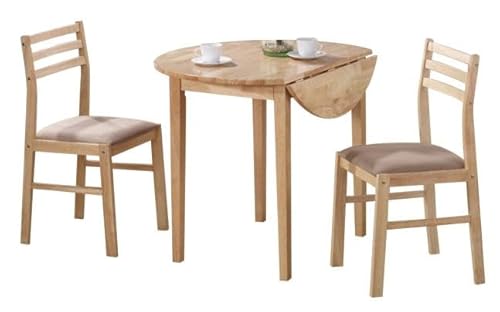
CARTESIAN 3-Piece Drop Leaf Dining Set, Natural Wood Table and 2 Chairs with Beige Cushions, Small Space Kitchen Furniture
Check price on Amazon
Farmhouse Wood Drop Leaf Dining Table Set with 2 X-Back Chairs, Walnut
Check price on Amazon
Merax Wooden 29"- 45" Extendable Rectangular Dining Table with Drop Leaf, Fits up to 4, Easy Assemble Espresso
Check price on Amazon
Harper & Bright Designs 3-Piece Wood Drop Leaf Dining Table Set with 2 X-Back Chairs, Space-Saving Breakfast Nook Dining Set, Brown
Check price on Amazon
Coaster Bucknell 3-Piece Round Drop Leaf Dining Table Set Natural 130006 | Round drop-leaf table and two ladder-back chairs in Natural, with beige padded seats; expands from 21 to 35 inches
Check price on Amazon
New Classic Furniture Gia 3-Piece Drop Leaf Dining Table Set with 2 Chairs, 42-Inch, Brown
Check price on Amazon
Merax Wooden Small 29"- 47" Extendable Dining Table with Drop Leaf,Brown | Farmhouse Folding Kitchen Table for 2- 4, Rounded Edges Dinner Table for Studio Apartment Breakfast Nook, Easy Assemble
Check price on Amazon
Merax Wood Dining Room Table Set for 2, Folding Table+ 2 Chairs, Brown | 3-Piece Farmhouse 45.6 inch Extendable Table with Drop Leaf , 2 Upholstered Chairs for Dining Room, Kitchen, Small Space
Check price on AmazonFrequently Asked Questions
What is a drop leaf kitchen table?
A drop leaf kitchen table has hinged side panels that fold down when not in use. This lets you shrink the table footprint for everyday storage and expand it when guests arrive.
How many chairs fit around a small drop leaf table?
Most small drop leaf tables seat two people with the leaves down and two to four with both leaves raised. Confirm the expanded dimensions and chair clearance before buying.
Are drop leaf tables stable enough for daily use?
Yes. Mid-range and premium drop leaf tables use sturdy hinges and support brackets. Entry-level models can feel less rigid, so check the locking mechanism and leg design before purchase.
Can I use a drop leaf table as a kitchen workspace?
Yes, with a caveat. The surface works for prep and light tasks, but the hinge line creates a seam. Use a cutting board and avoid placing hot pans directly on the leaf. Premium solid wood models handle this use best.
What is the difference between a drop leaf table and a folding table?
A folding table collapses entirely for storage. A drop leaf table keeps its frame in place and folds only the leaves. Drop leaf models look more like permanent furniture and suit kitchens better; folding tables are portable and better for temporary setups.
Should I choose a round or rectangular drop leaf table?
Round models soften tight corners and seat two to three people comfortably. Rectangular models offer more linear surface for prep work and pair neatly with a wall. If your kitchen has a narrow walkway, a round table is usually easier to navigate. For wider spaces, compare small rectangular tables.