
Solid Wood Extendable Table: The Complete Buying Guide
A solid wood extendable table gives you the best of both worlds — a compact everyday dining surface that grows to welcome guests. Learn how to choose the right wood, mechanism, size, and finish before you commit.
Explore Recommended TablesWhy this guide matters: If you are researching a solid wood extendable table, you already know you want real wood and flexibility. What most shoppers still need is clarity on which wood species suits their climate, which extension mechanism will hold up over years of use, and how to size the table for both everyday meals and holiday gatherings. This guide answers those questions in practical terms so you can move forward with confidence.
What Makes a Solid Wood Extendable Table Different
A solid wood extendable table is built from genuine timber rather than a veneer over engineered board. That distinction matters because solid wood can be sanded and refinished, develops character over time, and generally holds joinery more securely. The extension feature — whether a butterfly leaf that folds inside the table, a draw leaf that slides out from each end, or a removable panel stored separately — transforms a modest footprint into a gathering-size surface in seconds.
Compared with fixed tables, extendable designs solve a common dilemma: most households eat at a four-seat table day to day but need room for six, eight, or more during holidays and dinner parties. A well-built extendable table removes the need for a second table or a separate formal dining room. If you are weighing fixed versus flexible options, our broader solid wood dining table guide covers the fundamentals, while this page focuses specifically on extension systems and what to check before buying.
Wood Species: Matching Timber to Your Home
The wood species affects durability, weight, grain character, and how the table responds to humidity. Here is how the most common options compare for extendable designs, where the leaves must match the main top in both appearance and stability.
| Wood Species | Character | Best For | Tier Positioning |
|---|---|---|---|
| Oak | Hard, open grain, excellent stability; accepts stains well | Busy family dining, farmhouse and rustic styles | mid-range to premium |
| Walnut | Dense, dark, refined grain; resists dents | Formal dining, modern and mid-century interiors | premium to luxury |
| Maple | Hard, tight grain, light tone; takes a clean finish | Minimalist and contemporary spaces | mid-range to premium |
| Cherry | Medium hardness, warm tone that deepens with age | Traditional and transitional dining rooms | mid-range to premium |
| Pine & Rubberwood | Softer, lighter, more prone to dents; good paintability | Entry-level farmhouse and casual settings | entry-level to mid-range |
One consideration unique to extendable tables: the leaves should come from the same wood batch as the main top whenever possible. Mismatched grain or tone becomes obvious the moment the table is opened. Reputable makers cut leaves from adjacent boards and finish them together. If you are leaning toward a specific style, our solid oak dining table guide and solid wood dining table farmhouse overview explore how species choice shapes the final look.
Extension Mechanisms: How the Table Grows
The mechanism is the heart of any extendable table and the part most likely to fail first. Understanding the three main systems helps you evaluate build quality and match the table to how often you actually extend it.
Butterfly Leaf (Self-Storing)
The leaf is hinged in the middle and folds into a compartment beneath the tabletop. To extend, you pull the two halves apart, flip the leaf up, and push the halves back together. It requires no separate storage, which makes it ideal for apartments and small dining rooms. Entry-level butterfly tables sometimes use thin hardware; mid-range and premium models use reinforced steel hinges and locking latches that keep the leaf perfectly flush.
Draw Leaf (Pull-Out)
Leaves slide out from beneath each end of the table and then lift into place. Draw-leaf tables typically feel very sturdy because the leaves rest on the same frame rails as the main top. They work well in traditional and farmhouse settings. Check that the runners glide smoothly and that the leaves lock firmly — a well-specified draw leaf is among the most durable extension systems available.
Removable Panel Leaf
The simplest and often most robust design: the top separates and one or more loose leaves drop in. There is no folding hardware to wear out, and the leaves can be stored in a closet or a dedicated table pad. The trade-off is that you need somewhere to store the leaf when it is not in use. This system is common on heirloom-quality tables and on solid wood dining tables for 8 where large leaves are required.
Buying tip: Ask whether the extension hardware is rated for the leaf weight and how many extension cycles it is designed to withstand. A table that extends twice a year has very different requirements from one that opens every weekend. Look for metal-to-metal locking points rather than relying solely on wooden friction fits.
Sizing an Extendable Table for Your Room
The whole point of an extendable table is flexibility, but the extended footprint must still fit your room. Measure the closed length, the fully extended length, and the depth. Then calculate clearance: allow roughly 36 inches on each side for chairs to pull out and for people to walk behind them.
- Closed size: Should seat your household comfortably without feeling oversized for everyday meals.
- Extended size: Confirm the extra length will not block doorways, traffic paths, or heating vents.
- Seating math: Allow about 24 inches of table edge per person. A table that extends from 60 to 84 inches moves from four to six comfortable seats; extending to 96 inches or more typically supports eight.
- Storage: Butterfly leaves need none; draw leaves need none; removable panels need a closet or under-bed space.
For tighter rooms, pair an extendable top with space-saving chairs and consider a small rectangle dining table footprint or a space-saving dining table approach. If your dining area doubles as a living space, the sofa and dining table in same small room guide explains how to zone an open-plan layout around a table that changes size.
Build Quality Checks Before You Commit
Two solid wood extendable tables can look identical in photos yet differ enormously in construction. These are the details worth verifying through product specs, reviews, or a showroom visit.
- Joinery: Look for mortise-and-tenon or doweled joints at the apron and legs. Screws alone into end grain are a warning sign on any solid wood piece.
- Apron depth and cross-stretchers: A deeper apron and a center stretcher keep the two halves aligned when the table is open. Without them, extended tables can sag or rock.
- Hardware: Sliding rails, hinges, and latches should be steel or brass, not plastic. Ask whether replacement hardware is available.
- Leaf fit: The leaf should sit flush with the main top with no lip or gap. On butterfly tables, confirm the leaf locks level.
- Finish: A catalyzed lacquer or hard-wax oil finish protects against spills and heat better than a thin stain-only finish. Matte and satin finishes hide scratches better than high gloss.
- Leg room: Extension mechanisms reduce knee clearance. Sit at the table with it fully extended before buying if you can.
Style Directions That Suit an Extendable Table
Because the table must look intentional both closed and open, style consistency matters. Farmhouse designs with turned legs and a warm oak or pine finish pair naturally with draw-leaf and butterfly mechanisms; our solid wood extendable farmhouse dining table guide goes deeper on that combination. Modern and mid-century rooms favor cleaner aprons and walnut or maple tops with self-storing leaves. For round alternatives, see solid wood round dining table options, which can also be found in extendable versions.
Chair pairing is the next decision. Ladder-back and spindle designs suit farmhouse settings; upholstered dining chairs soften formal rooms. Our solid wood dining chairs guide covers proportions so the chairs tuck under the apron without clashing with the extension rails.
Care and Longevity for Extendable Tables
Solid wood moves slightly with seasonal humidity, and extendable tables have more moving parts than fixed ones. A few habits keep the table working smoothly for decades.
- Maintain humidity: Keep indoor relative humidity roughly between 35 and 55 percent. Extremes cause leaves to swell or shrink and can bind the mechanism.
- Extend periodically: Exercise the mechanism every few months even if you rarely use the leaf, so hinges and runners do not seize.
- Clean the runners: Wipe dust from sliding rails and apply a dry lubricant recommended by the manufacturer — never cooking oil, which attracts grit.
- Use coasters and trivets: Heat and moisture are the two fastest routes to finish damage. A table pad protects the top during holidays.
- Keep direct sun off the leaf: UV exposure can fade a stored leaf differently from the main top, making the tone mismatch visible when extended.
For a full routine, see our dining care and maintenance section. If you are starting from scratch on room planning, the buying guides hub collects checklists and measurement tools.
Solid Wood Extendable Table vs. Alternatives
It helps to see where a solid wood extendable table sits among the options shoppers commonly consider. The table below uses relative tier positioning rather than absolute figures, since specifications vary widely by maker.
| Option | Strengths | Trade-offs | Typical Tier |
|---|---|---|---|
| Solid wood extendable table | Refinishable, durable joinery, flexible seating, ages well | Heavier, needs humidity awareness, mechanism requires upkeep | mid-range to luxury |
| Veneer extendable table | More consistent grain appearance, lighter weight | Cannot be sanded and refinished; edges can chip | entry-level to mid-range |
| Glass extendable table | Visually light in small rooms, easy to wipe clean | Shows smudges, limited refinished options, cooler feel | entry-level to premium |
| Fixed solid wood table | Simplest construction, maximum rigidity | Cannot adapt to guest counts | mid-range to luxury |
If your room is genuinely compact, a small kitchen table or small kitchen tables collection may be a more natural starting point than a full dining table. For rooms that need to flex between everyday and hosting use, the extendable solid wood format is usually the most balanced long-term investment.
Recommended Solid Wood Extendable Tables
⚠️ AFFILIATE DISCLOSURE: This website contains affiliate links. As an affiliate Associate, we earn from qualifying purchases. If you make a purchase through these links, we may receive a small commission at no additional cost to you. Read our full affiliate policy.
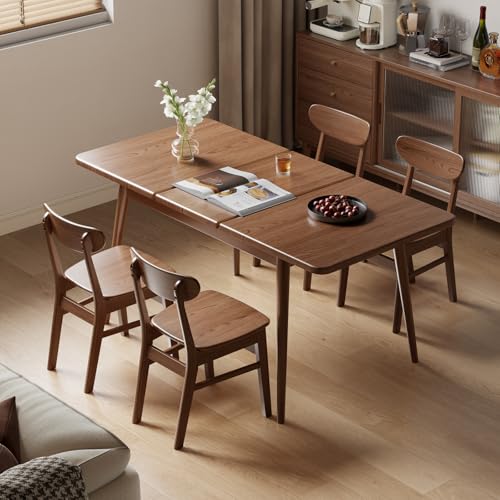
Muwuele 47"-63" Solid Wood Extendable Dining Tables for 4-8, Walnut | Compact Expandable Kitchen Table, Easy Assembly, Mid Century Modern, Dinner Table for Small Space, Dining Room, Apartment
Check price on Amazon
Muwuele 47"-63" Solid Wood Extendable Dining Tables for 4-8, Natural | Compact Expandable Kitchen Table, Easy Assembly, Mid Century Modern, Dinner Table for Small Space, Dining Room, Apartment
Check price on Amazon
71-87 Inch Extendable Dining Room Table, Rustic Wooden Kitchen Table 6-10 | STHOUYN Expandable Dining Table, Farmhouse Rustic Style, Rectangular Wooden Top, Seats 6-10, Brown Kitchen or Dining Room
Check price on Amazon
47.2"-70.8" Solid Wood Extendable Dining Table for 4-8 Walnut | 3-in-1 Design Expandable Table, Easy Assembly Extendable Dining Room Table, Ideal for Dining Room, Kitchen, Living Room
Check price on Amazon
Signature Design by Ashley Extendable Dining Table, Grayish Brown, Seats 8 | Wood, Acacia veneer, Engineered wood, Rectangular farmhouse style, 2 extension leaves, Moriville Series
Check price on Amazon
DM Furniture 55-71'' Extendable Dining Table for 4-8 People, Reclaimed Pine Wood Extending Dining Table w/Removable Leaves for Dining Room/Kitchen/Office, Space Saving, Brown
Check price on Amazon
43.7in-59in Solid Wood Frame Round Extendable Dining Table for 4-8, Modern Kitchen Oval Dining Table with Wooden Pedestal Base, Unique Wood Grain with Storage Shelf for Kitchen Living Room
Check price on Amazon
DM Furniture 47.5"-59" Reclaimed Solid Wood Extendable Dining Table, Walnut | FSC Certificated, Farmhouse Rectangular Expandable Table with Leaf Extension, Space-Saving for 4-6 | Apartment/Family Meal
Check price on AmazonFrequently Asked Questions
What is a solid wood extendable table?
A solid wood extendable table is a dining table built from genuine timber rather than veneer over engineered board, with a mechanism that increases the seating surface — usually butterfly leaves, draw leaves, or removable panels.
Which extension mechanism is most durable?
Draw-leaf and butterfly-leaf mechanisms with reinforced steel or brass hardware are generally the most durable. The quality of the sliding rails and locking hardware matters more than the leaf style itself.
How much space do I need around an extendable dining table?
Allow at least 36 inches of clearance on all sides for chair pull-out and walking space. When the table is fully extended, verify that the extra length does not block doorways, traffic paths, or heating vents.
Can a solid wood extendable table be used outdoors?
Most indoor solid wood extendable tables are not designed for outdoor use. Unless the manufacturer explicitly states weather-resistant construction, keep the table indoors or in a covered, climate-controlled area.
Next step: Once you have shortlisted a size and species, compare mechanism details side by side using the product cards above. If you are still refining your room layout, the small kitchen tables for small spaces guide and the measurement guide will help you lock in the right footprint before you decide.