
Upholstered Counter Stools: The Complete Buying Guide
Comfort, durability, and style for kitchen islands and breakfast bars. Learn how to choose the right height, upholstery, frame, and features before you buy.
Upholstered counter stools have become the default seating choice for modern kitchens, breakfast bars, and open-plan entertaining spaces. Unlike hard wooden or metal seats, a padded, fabric- or leather-covered stool invites people to linger over coffee, homework, or a casual dinner. But the category is broad: seat heights, frame materials, upholstery types, and back designs vary enormously, and the wrong combination can leave you with stools that are uncomfortable, unstable, or simply out of proportion with your counter. This guide walks through every decision point so you can buy with confidence.
What Makes a Stool an "Upholstered Counter Stool"?
An upholstered counter stool is defined by two attributes: a padded seat (and often a padded back) covered in fabric, leather, faux leather, or performance textile, and a seat height designed for counter-height surfaces of roughly 34 to 36 inches. This distinguishes it from bar-height stools, which are built for 40- to 42-inch bars and typically sit 28 to 30 inches high.
The upholstery is what separates these stools from their all-wood or all-metal cousins. Padding distributes body weight more evenly, reduces pressure on the legs during long meals, and softens the visual weight of the stool so it feels integrated into a living space rather than parked at it. Frames are usually solid wood, engineered wood, or metal, and the seat is either fixed or mounted on a swivel mechanism.
Getting the Height Right: The Single Most Important Measurement
Height mismatches are the most common reason people return counter stools. The rule of thumb is simple: the seat should sit 9 to 11 inches below the underside of the counter. That clearance leaves room for your thighs and allows you to slide in and out without clipping your knees.
| Counter Surface Height | Recommended Seat Height | Typical Use |
|---|---|---|
| 34–36 inches | 24–26 inches | Standard kitchen counter, most islands |
| 36–39 inches | 26–28 inches | Raised counter with a lower prep level |
| 40–42 inches | 28–30 inches | Bar-height counter (bar stools, not counter stools) |
Measure from the finished floor to the underside of the countertop, not to the top surface. If your counter has a thick overhang or a decorative edge, measure to the lowest point the stool must clear. Also account for the overhang depth: a 12-inch overhang gives knees room, while a shallow 6-inch overhang means you should favour backless or low-back designs so the stool can tuck under.
Upholstery Materials Compared
The covering you choose determines how the stool feels, how it ages, and how much maintenance it demands. There is no universally "best" option — only the best fit for your household.
Performance Fabric (Woven Polyester Blends)
Performance fabrics are engineered to resist stains, fading, and moisture. They are the most forgiving choice for families with children or pets because most spills bead up long enough to blot away. Modern performance weaves mimic linen and bouclé convincingly, so you don't sacrifice texture. Look for tight weaves over loose ones; tight weaves trap less debris and hold their shape longer. This is the balanced-tier default for most kitchens.
Genuine Leather
Leather is the premium-tier upholstery of choice for high-traffic kitchens. It wipes clean easily, develops a patina over time, and resists odours better than fabric. Full-grain and top-grain leathers are the most durable; bonded leather is a lower-tier option that can peel at the seams within a few years. Leather seats feel cool in summer and warm quickly to body temperature, making them comfortable across seasons.
Faux Leather / PU
Faux leather delivers much of the leather look and easy-clean convenience at an entry-level position in the market. The trade-off is longevity: lower-grade PU can crack where the seat flexes. Mid-range and high-end faux leathers use thicker polyurethane coatings and reinforced backing that hold up far better. If you choose faux leather, prioritise models with reinforced seams and a stated abrasion rating.
Velvet and Bouclé
These textured fabrics bring warmth and a designer look to breakfast nooks and open-plan living areas. They are less forgiving of grease and liquids, so they suit households that mostly use the stools for coffee and casual meals rather than messy prep work. Treat velvet and bouclé seats with a fabric protector at the outset and vacuum them weekly.
Frame Materials and Construction Quality
The frame is the skeleton of the stool and the main determinant of stability. Four constructions dominate the market:
- Solid hardwood frames — The most durable option. Look for kiln-dried hardwood (rubberwood, oak, beech) with corner blocks or doweled joints. These stools resist wobble for years and are the safest long-term investment.
- Engineered wood frames — Common in entry-level and mid-range stools. Adequate for light use, but check for reinforced joints and avoid models with visible staples or gaps at the seat base.
- Metal frames — Steel and iron frames are heavy-duty, easy to clean, and pair naturally with leather upholstery in industrial or modern schemes. Look for welded joints rather than bolted ones for maximum rigidity.
- Mixed-material frames — Wood legs with a metal footrest, or a metal base with a wood-trimmed seat, are popular in transitional designs. Inspect the connection points carefully, as these are the first areas to loosen.
Regardless of frame material, check the base for leveling glides. Slight floor unevenness is normal, and adjustable glides let you stabilise each stool individually. A four-leg base is the most stable configuration; pedestal and sled bases are more compact but can tip if the user leans.
Back Styles: Backless, Low-Back, and Full-Back
The back design affects comfort, visual footprint, and how neatly the stool tucks away.
Backless
The most compact option. Backless stools slide fully under the counter and disappear visually when unused. Best for tight islands and shallow overhangs, but offers no lumbar support for long sits.
Low-Back
A compromise that provides light lower-back support while keeping a low profile. Ideal for open-plan spaces where you want seating that doesn't block sightlines to the kitchen.
Full-Back
The most supportive and the most furniture-like. Full-back upholstered stools are comfortable for extended meals and read as dining chairs at the counter. They require deeper overhangs to tuck under.
Swivel Mechanisms and Adjustable Features
A swivel seat makes it far easier to get in and out of a counter stool, especially when the stools are packed tightly along an island. Smooth swivel mechanisms use ball bearings or heavy-duty nylon rings; entry-level models often use simple washers that can grind over time. If you choose a swivel, test the return motion — a good mechanism rotates silently and settles without wobble.
Adjustable-height stools use a gas lift or a threaded post. Gas lifts are convenient for multi-user households but have a finite lifespan; threaded posts are simpler and more durable. For fixed-height kitchens, a fixed-seat stool is the most stable and lowest-maintenance choice. Footrests are non-negotiable for comfort at counter height — without one, legs dangle and pressure builds behind the thighs. A padded or wide footrest is a worthwhile upgrade.
Buying Criteria at a Glance
| Criterion | What to Look For | Why It Matters |
|---|---|---|
| Seat height | 24–26 inches for standard counters | Prevents knee collisions and back strain |
| Upholstery | Performance fabric, leather, or high-grade faux leather | Determines cleaning effort and lifespan |
| Frame | Kiln-dried hardwood or welded metal | Stability and resistance to wobble |
| Weight capacity | Stated rating of 250 lbs or more | Safety and long-term durability |
| Back style | Match to overhang depth and room layout | Comfort vs. space efficiency |
| Footrest | Wide, padded, or integrated into frame | Comfort during longer meals |
Matching Upholstered Counter Stools to Your Space
Upholstered stools sit at the intersection of furniture and décor, so their style should echo the rest of the room. In farmhouse kitchens, linen-look fabric on turned wood legs feels natural. In modern minimalist spaces, a slim metal frame with a taut leather seat keeps the line clean. Industrial lofts suit distressed leather on blackened steel. For coastal and light-filled rooms, performance fabric in warm neutrals is the most versatile choice.
Colour strategy matters too. A neutral upholstery keeps the stool visually quiet and lets the counter and cabinetry lead. A bold or jewel-toned seat turns the stools into an accent — effective in open-plan rooms where the island doubles as a social hub. Whatever you choose, order a swatch first: fabric colours shift dramatically under kitchen lighting. If you are layering the stools with existing dining seating, review our upholstered dining benches with backs for a coordinated look.
How Many Stools Do You Need?
The standard allowance is 24 inches of counter width per stool for comfortable elbow room, narrowing to 21 inches when space is tight. For a 6-foot island (72 inches), that means three stools comfortably or four in a pinch. Backless and low-back designs can be packed slightly closer than full-back models.
Also consider the walking path behind the stools. Leave at least 36 inches between the stool and the nearest wall or appliance so people can pass while someone is seated. In narrow galley kitchens, backless stools that tuck under a shallow overhang are often the only workable solution.
Counter Stools Across Different Room Types
In a small apartment kitchen, two upholstered counter stools can replace a dining table entirely — a space-saving arrangement that keeps meals close to the prep zone. Pair them with a narrow island or peninsula and choose backless designs so the walkway stays clear.
In an open-plan kitchen-diner, full-back upholstered stools bridge the gap between kitchen and living area. They look like dining chairs from the sofa side and provide comfortable seating for casual meals. Coordinating their upholstery with the adjacent dining seating creates visual continuity.
In a breakfast nook, counter stools work alongside a high table or a tall kitchen table to create a casual secondary dining zone. Choose a uniform set for a clean look, or mix two upholstery tones for a collected, layered effect.
Care and Maintenance
Regular care extends the life of the upholstery and the frame. Vacuum fabric seats weekly with a soft brush attachment to lift crumbs and dust before they work into the weave. Blot — never rub — spills immediately with a clean, dry cloth. For set-in stains, use a fabric-safe upholstery cleaner and test it on a hidden area first.
Leather and faux leather need only a wipe with a damp cloth. Apply a leather conditioner two to three times a year to genuine leather to prevent drying and cracking. Tighten frame bolts and leg screws every few months, and check the footrest connection for loosening. Keep the stools out of direct sunlight where possible; prolonged UV exposure fades both fabric and leather.
For deeper guidance on protecting your furniture, see our general care resources, and if you want to extend the life of existing seating, explore sure-fit dining room chair covers with arms as an alternative refresh strategy.
Common Buying Mistakes to Avoid
- Buying bar height instead of counter height. The two are not interchangeable; a 30-inch stool at a 36-inch counter leaves your knees pinned.
- Ignoring the overhang. Full-back stools need deeper clearance than backless ones to tuck under cleanly.
- Overlooking the footrest. Without one, the stool is uncomfortable within fifteen minutes regardless of how plush the seat is.
- Skipping the weight rating. Cheap frames can flex and creak under heavier users; check the stated capacity.
- Buying fabric for a high-mess zone. If the stools sit next to the prep counter, performance fabric or leather will save you endless scrubbing.
Is an Upholstered Counter Stool Right for You?
Upholstered counter stools are the right choice if your counter doubles as an eating surface, if family members spend more than a few minutes seated there, or if the kitchen is visible from a living area and you want seating that reads as furniture. They are less suited to utility-focused kitchens where the stools are used briefly for prep tasks, or to outdoor counters where weather exposure would damage the upholstery.
If you entertain frequently, prioritise swivel seats, full backs, and easy-clean upholstery. If space is the constraint, choose backless or low-back designs with slim frames. Either way, measure twice and order a swatch before committing to a full set.
Recommended Upholstered Counter Stools
⚠️ AFFILIATE DISCLOSURE: This website contains affiliate links. As an affiliate Associate, we earn from qualifying purchases. If you make a purchase through these links, we may receive a small commission at no additional cost to you. Read our full affiliate policy.
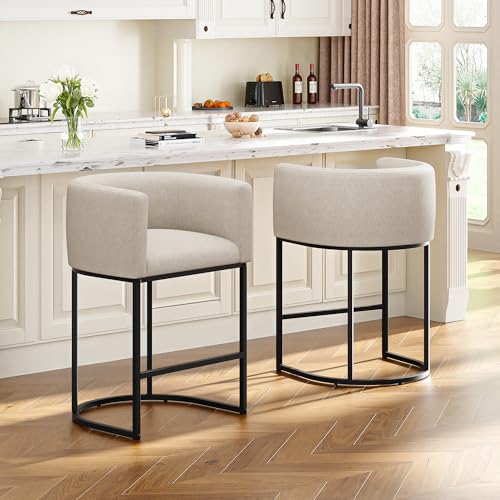
VATROS 26" H Counter Height Bar Stools Set of 2, Modern Barrel Counter Stools with Backrest and Arms, Linen Fabric Upholstered Accent Barstools for Kitchen Island,Support 450 LBS (Beige)
Check price on Amazon
VASAGLE Wooden Bar Stools Set of 2, Linen-Look Fabric, Cappuccino Beige | Mid Century Modern, Linen-Look Fabric, Solid Wood Legs, Ergonomic Backrest, Beige, MAZIO Collection ULBC125L101
Check price on Amazon
VKNOW Bar Stools Set of 2, 26" Fabric Counter Height Bar Stools, Green | Modern Upholstered Counter Stools with Rubberwood Legs for Kitchen Island Dining Room Bar
Check price on Amazon
VATROS Counter Height Bar Stools Set of 2, 360° Swivel Upholstered Barstools with Backs and Metal Legs, 26" H Seat Height, Linen Fabric in Beige
Check price on Amazon
Nalupatio Modern Bar Stools Set of 2, Adjustable Faux Leather Upholstered Swivel Bar Stools, Counter Height Bar Chairs with Back for Kitchen Island, Black
Check price on Amazon
UVV Bar Stools Set of 4, Upholstered Counter Height Bar Stools, Modern Counter Stools with Wood Legs for Kitchen Island Dining Room Bar, Green
Check price on Amazon
VATROS Counter Height Bar Stools Set of 3, FSC Certified Upholstered Faux Leather Barstools with Back, Metal Base, 27" Seat Height, Modern Upholstered Counter Stools for Kitchen Island,(Walnut Brown
Check price on AmazonFrequently Asked Questions
What height should upholstered counter stools be?
For standard 36-inch counter surfaces, choose stools with a seat height between 24 and 26 inches. This allows a comfortable 9 to 11 inches of clearance between the seat and the underside of the counter.
Is fabric or leather better for counter stools?
Leather and faux leather are easier to wipe clean and resist spills, making them ideal for busy kitchens. Woven fabrics offer more colour and texture variety but benefit from stain-resistant treatments, especially in households with children.
How much weight can upholstered counter stools support?
Most mid-range and premium upholstered counter stools are rated to support between 250 and 400 pounds. Heavy-duty and commercial-grade models often exceed 400 pounds, so always check the manufacturer's stated weight capacity before buying.
Do upholstered counter stools work in small kitchens?
Yes. Look for backless or low-back designs with slim legs and a footprint under 18 inches wide. Swivel models and stools that tuck fully under the counter overhang save additional floor space.
How do I keep upholstered counter stools clean?
Vacuum fabric seats weekly with a soft brush attachment, blot spills immediately with a clean cloth, and use a fabric-safe upholstery cleaner for set-in stains. Leather and faux leather need only a damp cloth and a conditioner applied a few times a year.
Can upholstered counter stools be used outdoors?
Standard indoor upholstered stools are not designed for outdoor exposure. Moisture, UV light, and temperature swings will degrade the fabric and frame. If you need outdoor counter seating, look specifically for outdoor-rated upholstery and weather-resistant frames.