
Wooden Dining Table and Bench: The Complete Guide to Choosing Your Set
Everything you need to know about selecting a wooden dining table and bench set — from wood species and size planning to style matching, seating comfort, and long-term care. Research first, decide with confidence.
Why a Wooden Dining Table and Bench Set Works
Bench seating has moved from rustic farmhouses into contemporary apartments and family homes for good reason. A bench tucks neatly under the table when not in use, seats multiple people along one side without the visual clutter of separate chair backs, and encourages a more sociable, side-by-side dining arrangement. Paired with a solid wood table, the result is a cohesive furniture piece that anchors the room.
Compared with a full chair set, a bench usually offers more seating capacity per linear foot of table edge. On a 72-inch table, a bench can comfortably seat three adults or four children, while the same span of chairs would typically seat three. This makes the table-and-bench format particularly efficient for families and for rooms where floor space is tight.
Wood itself brings practical benefits: it is repairable, ages gracefully, and can be refinished rather than replaced. A well-built hardwood set is a long-term investment that can adapt to changing decor over the years. If you are still comparing formats, our guide to the broader category of wood dining tables covers table-only options in more depth.
Choosing the Right Wood Species
The wood species determines hardness, grain character, colour, movement under humidity changes, and how the set will age. Below is a practical comparison of the most common species used for dining tables and benches.
| Wood Species | Character & Grain | Durability Tier | Best For |
|---|---|---|---|
| Oak | Prominent open grain, light to medium tone, takes stain well | High-end tier | Busy family dining rooms; traditional and farmhouse styles |
| Walnut | Rich dark brown, straight grain with occasional waves, smooth finish | Premium tier | Formal dining; mid-century and contemporary interiors |
| Maple | Fine uniform grain, pale creamy tone, very smooth surface | High-end tier | Modern minimalist spaces; painted or natural finishes |
| Pine | Knotty, soft, warm honey tone that deepens with age | Entry-level tier | Rustic cottages and casual breakfast areas |
| Acacia | High-contrast grain, varied tones, naturally moisture-resistant | Mid-range tier | Versatile everyday sets; occasional covered outdoor use |
| Teak | Golden brown, oily feel, exceptional weather resistance | Luxury tier | Indoor-outdoor dining; humid climates |
As a rule, denser hardwoods resist dents and scratches better than softwoods. If the table will see daily use with children, oak or maple is a sensible baseline. Walnut and teak sit at the premium and luxury end of the spectrum and reward careful maintenance with decades of service. Softwoods such as pine sit in the entry-level tier and suit lighter, more decorative use.
Solid Wood vs. Veneer and Engineered Construction
Not every "wooden" set is solid wood throughout. Understanding construction helps you judge what you are actually buying.
Solid wood
Made from planks of the same species throughout the tabletop, legs, and bench seat. Solid wood can be sanded and refinished multiple times, which extends its working life considerably. It does move slightly with seasonal humidity, so well-made pieces use joinery that allows for this movement. This is the professional-grade construction you should look for in a long-term investment.
Veneer over engineered core
A thin layer of real wood bonded to plywood or MDF. Veneered tops are more dimensionally stable and resist warping, and they can look identical to solid wood. However, they cannot be sanded aggressively, and edges are more vulnerable to chipping. These sit in the mid-tier range — often well-specified for the category, but not indefinitely refinishable.
Wood-look composites
Printed laminates over particleboard. These are the essential-tier option: stable, easy to clean, and consistent in appearance, but they do not offer the repairability of genuine timber. Check the edge banding quality carefully, as it is the first point of wear.
Sizing Your Table and Bench Correctly
Getting the dimensions right is the single most important decision. A set that is too large overwhelms the room; one that is too small leaves diners cramped. Start by measuring the available floor area and leaving at least 36 inches (90 cm) of clearance around the table for chair and bench pull-out.
| Table Length | Typical Seating | Recommended Bench Length | Best For |
|---|---|---|---|
| 48 inches (122 cm) | 4 people (2 per side) | 42–48 inches | Compact kitchens, two-person households |
| 60 inches (152 cm) | 6 people (3 per side) | 54–60 inches | Standard family dining rooms |
| 72 inches (183 cm) | 8 people (4 per side) | 66–72 inches | Larger families and entertaining |
| 84 inches (213 cm) | 10 people (5 per side) | 78–84 inches | Formal dining rooms, open-plan spaces |
Height and clearance
A standard dining table stands 28 to 30 inches tall. The matching bench seat should sit 17 to 19 inches from the floor, leaving 10 to 12 inches of clearance below the table apron. Counter-height sets (36 inches) require bench seats of roughly 24 to 26 inches — always confirm the pairing is designed together rather than mixing heights.
Depth and overhang
Most dining tables are 36 to 40 inches deep. Benches are typically 14 to 16 inches deep — narrower than chairs so they can slide fully under the table, which keeps walkways clear. If the bench has a backrest, allow extra depth and check that it still tucks in.
Bench Design Options to Consider
Bench construction varies far more than chair construction, and the right choice depends on how you use the space.
- Backless benches: The most versatile option. They slide completely under the table, free up visual space, and suit both dining and occasional extra seating elsewhere. This is the classic companion to a farmhouse-style table.
- Benches with backrests: More supportive for long meals and comfortable for elderly diners. They require more floor clearance behind and cannot tuck fully under the table.
- Storage benches: The seat lifts or slides to reveal storage for table linens, board games, or serving pieces. Excellent for small rooms where every cubic foot counts. See options in our white storage bench collection for a lighter finish.
- Upholstered-top benches: A padded seat improves comfort for long dinners and adds softness to the wood. Look for removable, washable covers if children are in the house.
- Trestle and A-frame benches: Open under-structure keeps sight lines clear and is easy to sweep beneath. Reinforced joinery at the trestle is a marker of solid build quality.
If you prefer the look of a bench paired with a specific table style, our range of wooden tables with benches shows how the pairing works in practice.
Matching the Set to Your Dining Room Style
Wood tone and silhouette should harmonise with the room's fixed elements — flooring, cabinetry, and window treatments — before you consider accessories.
Farmhouse and rustic
Distressed or lightly whitewashed finishes, chunky square legs, and visible knots. A backless bench is almost mandatory here. Warm honey-toned oak or pine works best against painted cabinetry and natural fibre rugs.
Mid-century modern
Tapered legs, rounded corners, and a clear walnut or teak finish. Pair the table with a slim bench with angled legs to keep the silhouette light. Avoid heavy aprons that visually weigh the piece down.
Contemporary and minimalist
Clean lines, uniform grain, and a matte or satin finish rather than high gloss. Maple or pale oak in a natural finish keeps the room bright. A bench with a simple slab seat and hidden joinery suits this look best.
Industrial
Mix wood with blackened steel legs or bench frames. Reclaimed-looking timber tops with visible grain contrast work well against exposed brick and concrete.
For a lighter, brighter treatment of the same concept, browse these white and wood dining table designs, which pair a painted base with a natural timber top.
Understanding Finishes and What They Mean for Daily Life
The finish determines how the set handles spills, heat, and sunlight — and how easy it will be to live with.
- Oil and wax finishes: Penetrate the wood and leave a natural, tactile surface. Easy to spot-repair, but require re-oiling every few months. Best for solid hardwood sets in low-traffic dining rooms.
- Lacquer and polyurethane: Form a protective film on the surface. More resistant to water and stains, but scratches are harder to repair invisibly. Mid-range to premium sets commonly use these.
- Water-based polyurethane: Lower odour and clearer film than solvent-based versions. A good choice for light-toned woods where you want to preserve the natural colour.
- Painted finishes: Hide grain and suit farmhouse and coastal schemes. Painted tables show chips at edges, so look for a factory-applied finish rather than a hand-painted one.
- Outdoor-rated finishes: Only relevant if the set will live on a covered porch. Look for marine-grade or spar urethane, and confirm the wood species is suited to the environment.
Whatever the finish, plan on using trivets and coasters from day one. Heat rings and water marks are the most common causes of premature refinishing.
Comfort and Ergonomics of Bench Seating
A common concern with benches is comfort during long meals. In practice, the bench format works well for most diners provided three conditions are met: the seat height matches the table, there is adequate knee clearance, and the seat surface is either slightly contoured or fitted with a cushion.
Backless benches encourage a more upright, mobile posture, which some diners prefer for casual meals but find tiring for multi-course dinners. If you regularly host formal meals, consider a bench on one side and wooden dining room chairs on the other — a hybrid arrangement that balances sociability with back support.
For households with elderly guests or anyone with mobility limitations, a bench with a backrest at the wall side is the most accommodating configuration. A simple bench cushion, 1.5 to 2 inches thick, meaningfully improves comfort without raising the seat height beyond ergonomic range.
Care and Maintenance for a Long-Lasting Set
Solid wood is forgiving but not indestructible. A simple routine keeps the finish intact and prevents the most common problems.
- Dust weekly with a soft microfibre cloth to remove grit that acts as an abrasive under plates and elbows.
- Wipe spills immediately with a slightly damp cloth and mild soap. Do not let liquid sit, particularly at joints and end grain where absorption is fastest.
- Re-oil oiled finishes every three to six months, or when the surface starts to look dry and matt. Use a furniture oil suited to the species and apply thinly.
- Control humidity. Wood expands and contracts with moisture. Keep the room between 40 and 60 percent relative humidity and avoid placing the set next to radiators or air-conditioning vents.
- Manage sunlight. Direct sun will fade and unevenly tone the wood over time. Rotate any removable cushions and consider blinds during peak afternoon sun. Our guide to window treatments covers light-control options for dining rooms.
- Tighten hardware and check joinery annually. A bench carries concentrated load along its seat, so check any bolts or brackets and re-tighten as needed.
- Refinish when needed. Solid wood tops can be sanded and re-finished, typically every five to ten years in a busy household. This is the main reason to favour solid construction over veneer.
What to Verify Before You Commit
Before choosing a set, run through this checklist. It will help you judge whether a listing is genuinely well-built or simply well-photographed.
- Construction details: Look for mortise-and-tenon or doweled joinery, corner blocks, and a kiln-dried specification. Screws alone at the joints are a warning sign on a load-bearing bench.
- Weight and stability: A substantial bench should feel planted, not skittish. Check the leg splay — a wider base at the floor resists rocking on uneven floors.
- Seat thickness: A bench seat should be at least 1.25 to 1.5 inches thick in solid wood, or 1 inch in high-grade engineered timber, to resist flex over time.
- Assembly and delivery: Confirm whether the set ships flat-packed and what tools are needed. Bench-to-table pairing is usually straightforward, but check that the bench length is designed for the specific table.
- Warranty: A structural warranty of one year or more suggests the maker stands behind the joinery. Compare terms across wood dining room sets if you are buying the full collection.
Recommended Wooden Dining Table and Bench Sets
⚠️ AFFILIATE DISCLOSURE: This website contains affiliate links. As an affiliate Associate, we earn from qualifying purchases. If you make a purchase through these links, we may receive a small commission at no additional cost to you. Read our full affiliate policy.
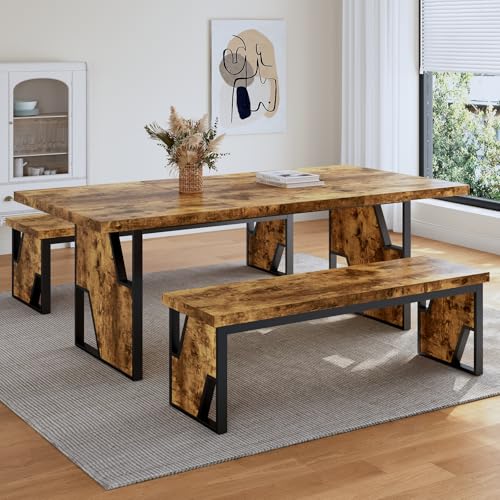
HIPIHOM 70.8" Wooden Dining Table with 2 Benches Kitchen Table and Chairs | Modern Table and Chairs set for 4-6 person, Thickened MDF Wooden Table with Dining Bench, for Living Dining Room, Office
Check price on Amazon
Feonase 5-Piece Dining Table Set for 4-8 People, 63" Extendable Kitchen Table with 2 Benches and 2 Square Stools, Mid-Century Modern Wooden Dining Room Table, Space-Saving, Walnut
Check price on Amazon
HUAHUU 63" Farmhouse Dining Table Set for 4-6, Kitchen Table with 2 Benches, Space Saving 3-Piece Rectangle Wooden Dinette Table Set for Dining Room, Breakfast Nook, Small Space, Brown & White
Check price on Amazon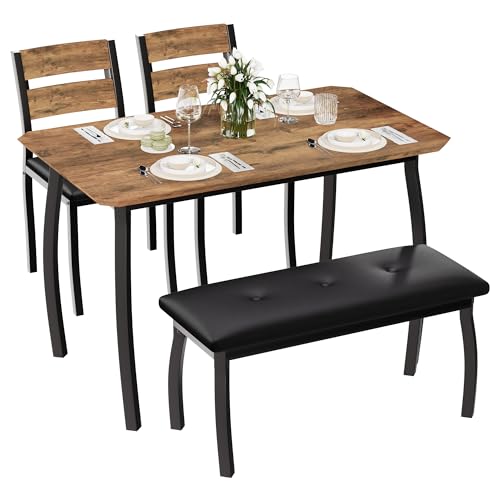
IDEALHOUSE 43'' Dining Table Set for 4, Wooden Kitchen Table with Upholstered Bench & 2 Cushion Chairs, Industrial Dinette Set for Studio, Kitchen, Dining Room, Apartment, Retro
Check price on Amazon
Signature Design by Ashley 1-Piece Wood Dining Bench, 48" 2-Tone Farmhouse | Sturdy solid wood frame with mango veneer and MDF substrate seat, Space-saving 48-inch profile, Wildenauer Series
Check price on Amazon
HOOBRO 39.3'' Bamboo Dining Bench, Farmhouse Kitchen Table Bench, Kitchen & Living Room Furniture, Easy to Assemble, Sturdy and Stable, Mocha MA03CD01G2
Check price on Amazon
NicBex 6 Piece Farmhouse Dining Table Set, Wooden Dinner Table Set for 6, 58.5" Rectangular Table, 4 Upholstered Linen Dining Chairs & Bench, Dark Walnut
Check price on Amazon
Zevemomo 6-Piece Solid Wood Dining Table Set, Wooden Legs Table Set, Brown | Including 1 Dining Table, 4 Upholstered Chairs and 1 Bench, Dining Table Sets for 6, Table Set for Dining Room, Kitchen
Check price on AmazonFrequently Asked Questions
What is the best wood type for a dining table and bench set?
How much seating space does each person need on a dining bench?
Can a wooden dining bench be used outdoors?
How do I maintain a solid wood dining table and bench?
What is the ideal table height for a dining bench?
Ready to Compare Sets?
Use the product recommendations above to compare specifications, construction details, and sizing for your dining room. For a wider view of the category, explore our full wooden dining table guide.
Explore Wood Table and Bench Options