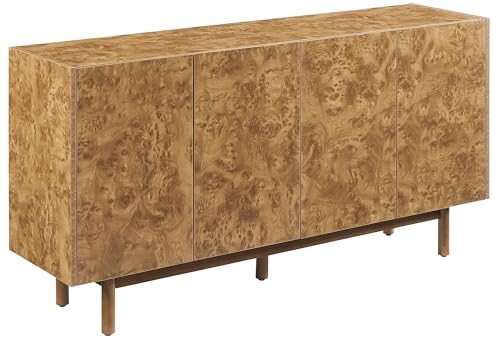
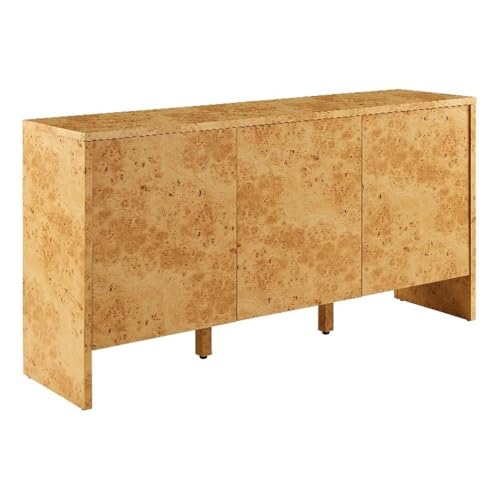
What Is a Burl Wood Sideboard?
A burl wood sideboard is a dining room storage cabinet finished in burl wood veneer or solid burl wood. The term "burl" refers to a growth on a tree — usually walnut, maple, elm, or oak — where the wood grain grows in irregular, swirling patterns rather than straight lines. When sliced and applied as veneer, burl wood produces a dramatic, almost painterly surface that ranges from tight clusters of "eyes" to broad, flowing swirls.
Functionally, a sideboard (also called a buffet or credenza) provides horizontal surface area for serving, plus closed storage for dinnerware, linens, and serving pieces. Combining that utility with burl wood's visual impact creates a piece that works as both furniture and art. If you are still deciding between storage styles, our guide to a sideboard cabinet with drawers explains how drawer configuration affects everyday usability.
Burl Veneer vs. Solid Burl Wood
Most burl wood sideboards use burl veneer over a solid wood or engineered substrate. This is not a compromise — it is standard practice even at the highest tiers of furniture making. Burl is scarce, and large solid burl panels are prone to movement and cracking. High-quality veneer allows makers to match and book-match panels for a symmetrical pattern that would be impossible with solid stock.
Solid burl construction exists, usually in smaller accent pieces or top-tier artisan furniture. Expect a heavier build, more visible natural variation, and a corresponding jump in market positioning. For most dining rooms, a well-made burl veneer sideboard offers the visual payoff with more stable long-term performance.
Why Burl Wood Stands Out in a Dining Room
- Visual uniqueness: No two burl panels are identical, so your sideboard is effectively one of a kind.
- Warmth and depth: The swirling grain catches light differently across the surface, adding dimension that flat-grain wood cannot match.
- Design flexibility: Burl works in modern minimalist, mid-century, and traditional interiors alike — the pattern is the statement, so the silhouette can stay clean.
- Conversation value: Guests notice burl. It reads as intentional and crafted, not mass-produced.
Burl Wood Grain Patterns: What to Look For
Grain pattern is the single biggest factor separating an ordinary burl piece from an exceptional one. When evaluating a sideboard, look at how the veneer is laid out across the doors and drawer fronts.
Common Burl Patterns
- Eye burl: Dense clusters of small knots or "eyes." Valued for tight, busy texture. Often seen in maple burl.
- Swirl burl: Broader, flowing waves of grain. Reads as more elegant and calm at a distance. Common in walnut burl.
- Cluster burl: A mix of eyes and swirls, often with dramatic contrast between light and dark zones.
- Book-matched panels: Two adjacent veneer leaves mirrored like an open book. This creates symmetry and is a hallmark of careful craftsmanship.
- Slip-matched panels: Consecutive leaves laid side by side without mirroring, producing a repeating but non-symmetrical pattern.
A premium burl sideboard will usually feature book-matched or slip-matched door fronts with consistent grain direction and minimal visible seams. Entry-level pieces may use random-match veneer, which can look patchy. When comparing options, ask how the veneer is matched — it is one of the clearest signals of build quality.
Color and Tone Considerations
Burl wood ranges from pale blond (maple, ash) to deep chocolate and reddish brown (walnut, elm). Lighter burl reads airy and contemporary; darker burl reads moody and traditional. Consider the surrounding palette: a dark walnut burl sideboard anchors a bright, airy dining room, while a blond maple burl piece keeps a modern minimalist space from feeling heavy.
Construction Quality: How to Judge a Burl Wood Sideboard
Burl veneer can hide inferior construction, so inspect the details beyond the surface. These are the checkpoints that matter most.
Substrate and Carcass
- Solid wood carcass: The most durable option. Look for dovetail or mortise-and-tenon joinery.
- Plywood carcass: A solid mid-range choice. High-grade plywood is stable and resists warping better than particleboard.
- Particleboard or MDF: Acceptable in entry-level pieces if well sealed, but less resistant to moisture and repeated loading.
Veneer Quality
Thick veneer (often called "thick-sliced" or "reconstructed") tolerates refinishing and resists sand-through. Paper-thin veneer is fragile and cannot be repaired easily. Check edges for lifting or bubbles, and look at how veneer wraps around door edges — tight, continuous wrapping signals care.
Doors, Drawers, and Hardware
- Drawer boxes: Dovetail joints outperform stapled or glued boxes. Metal side-mount or undermount glides should operate smoothly and quietly.
- Door alignment: Gaps should be even. Soft-close hinges are a plus in any tier.
- Hardware: Solid brass or heavy-duty metal hardware outlasts plated zinc. Consider whether pulls are replaceable if you want to restyle later.
Finish and Protection
Burl's swirling grain can trap moisture and show ring marks. A quality sideboard will have a catalyzed lacquer, conversion varnish, or hard-wax oil finish. Matte and satin finishes are more forgiving than high gloss. If you plan to place hot serving dishes directly on top, pair the sideboard with a protective pad — our formal place setting guide covers serving flow and surface protection in more detail.
Sizing Your Burl Wood Sideboard for the Dining Room
Sideboards are often bought too large or too small. Use these guidelines to get the proportion right.
Length
- A sideboard should generally be 50–75% of the length of the dining table it accompanies.
- In a standalone wall placement, leave at least 15–20 cm of breathing room on each side.
- For a round or oval table, a sideboard roughly two-thirds the table's diameter keeps visual balance.
Height and Depth
- Standard sideboard height is 75–90 cm, aligning with typical dining table height for serving convenience.
- Depth of 40–50 cm is practical for dinnerware; deeper units eat into walkway space.
- Leave 90–120 cm of clearance in front of the sideboard for comfortable opening of doors and drawers.
Proportion Check
A tall, narrow room benefits from a longer, lower sideboard that widens the visual base. A wide, low room can handle a taller cabinet. If you are working with a compact footprint, our small dining room layout guide pairs well with sideboard sizing advice, and the dining area furniture overview helps you plan the full room composition.
Burl Wood Sideboard Styles and Finishes
Silhouette and finish determine how a burl sideboard fits your interior. Here are the dominant directions.
Mid-Century Modern Burl
Clean lines, tapered legs, and minimal ornamentation let the burl grain lead. This style pairs naturally with mid-century modern dining chairs and tables. Look for flush doors, recessed pulls, and a low profile.
Modern Minimalist Burl
Handleless fronts, plinth bases, and restrained hardware. The burl pattern becomes the only decoration. This works especially well in modern minimalist dining rooms where restraint is the point.
Traditional and Transitional Burl
Molded edges, decorative hardware, and sometimes a contrasting frame. Traditional burl sideboards often feature book-matched door panels framed in solid wood. These suit formal dining rooms and pair with upholstered seating.
Finish Options
- Natural clear: Shows the true color of the burl; best for maple and light walnut.
- Toned or stained: Deepens contrast and unifies mismatched veneer panels.
- High gloss: Dramatic and reflective, but shows fingerprints and ring marks.
- Matte or satin: The most practical for daily use; softens the grain slightly but resists wear.
- Hard-wax oil: A natural, repairable finish that develops patina over time.
Burl Wood Sideboard Tier Comparison
Use this tier framework to set expectations for construction and finish quality. Tiers reflect relative market positioning, not absolute figures.
| Tier | Typical Construction | Veneer Quality | Best For |
|---|---|---|---|
| Entry-level | Engineered wood carcass, stapled or glued drawer boxes, basic metal glides | Thin veneer, random match | First apartments, low-traffic dining areas, renters |
| Mid-range | Plywood carcass, dovetail drawer boxes, soft-close hinges | Thicker veneer, slip-matched fronts | Family dining rooms with regular use |
| Premium | Solid wood carcass, mortise-and-tenon joinery, undermount glides | Thick-sliced veneer, book-matched panels | Design-forward dining rooms, long-term ownership |
| Luxury | Hand-built solid burl or artisan veneer work, custom hardware | Museum-grade book-matching, hand-finished surfaces | Statement interiors, collector-grade furniture |
Across tiers, the most noticeable jump is in veneer matching and drawer feel. A mid-range sideboard with book-matched doors often looks dramatically better than an entry-level piece, even when the carcass materials are similar.
Styling a Burl Wood Sideboard
A burl sideboard is visually busy, so styling should be restrained. Let the surface breathe.
Top Surface Rules
- Rule of three: Group objects in odd numbers — a lamp, a bowl, and a small sculpture, for example.
- Height variation: Mix tall and low pieces to avoid a flat line.
- Negative space: Leave at least a third of the surface clear. Burl grain needs room to read.
- Contrast materials: Matte ceramic, linen, and glass balance the wood's warmth.
Wall and Lighting Pairings
A simple framed artwork or a round mirror above the sideboard works well. Lighting matters: a pair of wall sconces or a small lamp creates a warm pool of light that highlights the burl grain. If you want to coordinate overhead lighting with the sideboard's finish, see our guide to a kitchen table chandelier for scale and placement principles.
Centerpiece Coordination
If the sideboard sits near the dining table, coordinate the surface decor to avoid visual competition. Our dining room centerpieces guide covers tabletop scale and seasonal swaps that pair with a burl sideboard's palette.
Seasonal and Everyday Styling
- Everyday: A ceramic bowl, a candle, and a stack of two books.
- Holiday: Swap in a garland, a tall vase, and metallic accents.
- Summer: Fresh flowers, woven elements, and light ceramics.
Placement and Room Integration
The sideboard's position affects both function and visual flow. These placement patterns work across most dining rooms.
Against a Solid Wall
The most common placement. Center it on the wall or align it with the table's centerline. Keep the top clear enough for serving during meals.
In an Open-Concept Space
A sideboard can act as a soft room divider between dining and living zones. Choose a finished back if the rear will be visible. Our open concept dining guide explains how to zone without walls.
Along a Window Wall
Burl veneer can fade under direct sun. If placing near a window, use UV-filtering treatments or rotate decor regularly. A dining room table and chairs set for 4 paired with a sideboard along a side wall keeps the window wall open.
With a Buffet-Style Serving Setup
If you host frequently, position the sideboard near the kitchen for efficient serving. Our buffet setup ideas guide covers flow, chafing dish placement, and plate stacking.
Care and Maintenance for Burl Wood
Burl's irregular grain requires slightly different care than straight-grain wood.
Routine Cleaning
- Dust weekly with a soft microfiber cloth, following the grain direction.
- Wipe spills immediately — burl's figure can trap moisture in the eyes and swirls.
- Use a damp cloth with mild soap for sticky residue, then dry immediately.
Protection
- Use coasters under drinks and trivets under hot dishes.
- Avoid silicone-based polishes, which can build up and dull the finish.
- Keep the sideboard away from radiators and direct sun to prevent veneer lifting.
- Maintain indoor humidity between 40–55% to reduce seasonal movement.
Long-Term Upkeep
Hard-wax oil finishes can be refreshed with a maintenance coat every year or two. Catalyzed lacquer and conversion varnish finishes generally only need cleaning. If the veneer lifts at an edge, address it early with a furniture restorer — small repairs are far easier than full re-veneering. For related furniture upkeep, see our chair repair guide and the dining care and maintenance hub.
Common Mistakes to Avoid
- Buying by photo alone: Burl varies dramatically between pieces. Request actual product photos or a video walkthrough.
- Ignoring veneer matching: Random-matched doors on a large sideboard can look patchwork. Prioritize book-matched or slip-matched fronts.
- Oversizing the piece: Measure the wall, walkway, and table length before ordering.
- Skipping the finish question: Matte and satin finishes are more forgiving than high gloss for daily dining use.
- Over-styling: Burl is already visually loud. Keep decor restrained.
- Forgetting the back panel: If the sideboard will float in an open-concept room, a finished back is essential.