
Dining Table with Bench and 4 Chairs: The Complete Buying Guide
Bench-and-chair dining sets combine relaxed family seating with structured comfort. This guide explains bench sizes, table materials, clearance rules, and layout planning so you can choose a set that fits your room, your household, and the way you actually eat.
Who this guide is for: You already know you want a dining table with bench and 4 chairs, and you are comparing specific configurations before ordering. Below you will find the practical specifications — bench-to-table height ratios, per-person seating width, clearance requirements, and material trade-offs — that determine whether a set works in daily life or becomes a return.
Why a Dining Table with Bench and 4 Chairs Works So Well
The bench-and-four-chairs layout is one of the most space-efficient six-seat configurations available. A bench removes the need for pull-out clearance on one side of the table, which means the same table can fit into a narrower room than a six-chair arrangement would allow. For households that eat together daily, that single change often decides whether a full-size table fits at all.
Practical advantages of bench seating
- Space efficiency: A bench slides flush under the table, freeing floor area on one side. This is particularly useful in apartments, breakfast nooks, and open-plan kitchens where traffic passes behind the table.
- Casual family dining: Benches let children climb in from the end and sit close together without armrests getting in the way. Families with young kids often find benches easier to manage than a row of separate chairs.
- Visual calm: A single bench reads as one clean horizontal line instead of four separate chair backs, which keeps a small dining area from feeling cluttered.
- Extra seating flexibility: A 60-inch bench can hold three slim adults or four children in a pinch, giving you occasional seating beyond the nominal six.
- Design cohesion: Bench-and-chair sets are usually sold as matched collections, so the wood tone, finish, and leg style already align — no mixing and matching required.
Where a bench is the weaker choice
Benches offer no back support and no individual adjustment. For long dinner parties, elderly guests, or anyone with mobility limitations, a chair with a supportive back and a comfortable seat cushion is meaningfully better. The best bench-and-chair sets solve this by pairing a solid bench with four well-padded chairs, so guests who need back support take the chairs and the bench serves the casual side.
If your household eats most meals at the table with people who need back support, a dining table with 6 chairs may serve you better. If you want the bench look but need more back support, consider a dining table with a bench that has a back.
Common 4-Chair + Bench Configurations
Bench-and-four-chair sets are sold in a handful of standard layouts. Knowing which one you are shopping for prevents ordering mistakes, especially around seating capacity and table shape.
Rectangular table with a long side bench
The most common configuration. A rectangular table, typically 60 to 72 inches long, has a bench along one long side and two chairs on the opposite long side plus one chair at each end. This seats six comfortably. It is the natural fit for narrow rooms because only the chair side needs full pull-out clearance.
Rectangular table with bench and four side chairs
Some sets place all four chairs on one long side and both ends, with the bench occupying the second long side. This works best when the bench side sits against or near a wall or window, and the chair side faces open floor. The bench and 4 chairs set category covers both variations, so check the product diagram before ordering.
Round or oval table with a curved bench
Less common but increasingly available. A curved bench follows the table edge and creates a conversational, café-style feel. These sets suit square rooms and breakfast areas. Measure carefully: a curved bench needs a specific table diameter to align properly and usually cannot be swapped onto a different table later.
Counter-height and bar-height variants
Counter-height bench sets place the table surface around 34 to 36 inches high with a correspondingly taller bench and chairs. They suit kitchens with island counters and can double as prep space. Note that counter-height benches are harder for small children to climb onto and less comfortable for long meals. If you are weighing this format, compare it against a counter-height dining table set before committing.
Comparison at a glance
| Configuration | Typical Seating | Best For | Watch Out For |
|---|---|---|---|
| Rectangular + one long bench + 4 chairs | 6 adults | Narrow rooms, family kitchens, everyday dining | Bench side needs wall or open-back clearance |
| Rectangular + bench + chairs on ends | 6 adults | Rooms with a window or wall behind the bench | End chairs need extra room at table corners |
| Round/oval + curved bench | 5–6 adults | Square rooms, breakfast areas, café styling | Bench must match table diameter; limited swap options |
| Counter-height bench set | 5–6 adults | Kitchen-adjacent dining, multi-use surfaces | Harder for children and elderly to access |
If your priority is a compact footprint rather than a full six-seat layout, a dinette set or a kitchen table and chairs set may be a more natural starting point.
Bench Types Compared
The bench is the differentiator in these sets, and the bench design matters more than most buyers expect. A bench that is too deep, too tall, or too hard will be the reason the set gets returned.
Standard wood bench
A simple plank or slat bench with four legs or a trestle base. This is the entry-level and mid-range standard for bench sets. It is durable, easy to clean, and pairs naturally with farmhouse and modern styles. Seat depth is typically 14 to 16 inches, which is comfortable for most adults. The main drawback is hardness — add a bench cushion if you plan to sit for more than 30 minutes.
Upholstered bench
A padded bench with fabric or faux-leather upholstery over foam. These are the most comfortable option and are usually positioned as mid-range to premium within a collection. They add warmth to the room and soften the visual weight of the bench. They require more care: spills need prompt attention, and the upholstery is the first component to show wear in a busy household.
Storage bench
A bench with a lift-up seat or drawers underneath. This is genuinely useful in small dining rooms where you need a home for table linens, napkins, or occasional serving pieces. Storage benches are heavier and slightly taller, and the seat mechanism is a wear point. If storage is your priority, verify the weight rating of the lid and whether it has a soft-close hinge.
Trestle and pedestal benches
A bench with a trestle base or a central pedestal frees legroom underneath. This matters on longer benches where people naturally shift sideways. Trestle benches usually have a more substantial visual presence and are common in solid wood dining sets with farmhouse styling.
Curved and corner benches
Curved benches match round tables; corner or L-shaped benches fit into a nook and can double as a banquette. These are the most space-specialized option and rarely interchangeable with a different table later. If you are designing a breakfast nook, a corner dining table with a matching bench is worth considering alongside a standard set.
Bench sizing rules that prevent returns
- Height: Bench seat height should be 16–18 inches for a standard 28–30 inch table. Counter-height tables need benches with a 24–26 inch seat.
- Length: Allow 24 inches of bench length per adult for comfortable seating, 20 inches at minimum. A 48-inch bench seats two; a 60-inch bench seats two to three.
- Depth: 14–16 inches is the standard comfortable seat depth. Deeper benches force people to slide forward, which reduces back support.
- Clearance: Leave at least 10 inches between the bench seat top and the table apron for legroom.
Table and Bench Materials
Material choice determines how the set ages, how much maintenance it needs, and how it responds to a busy household. The table and bench are usually built from the same material family, but the chairs sometimes introduce a second material such as upholstery or metal.
Solid wood
Solid hardwood — oak, acacia, rubberwood, maple, or pine — is the most repairable option. Scratches can be sanded and refinished, and the surface develops a natural patina over time. Rubberwood and acacia are common in mid-range sets; oak and maple sit in the premium tier. Solid wood moves slightly with humidity, so it performs best in a stable indoor environment. A solid wood farmhouse dining table paired with a matching bench is the classic choice for households that want a long-term set.
Engineered wood and veneer
MDF or particleboard cores with a wood veneer or laminate finish. These sets are typically entry-level to mid-range and offer consistent surfaces at a lower weight. They resist warping better than solid wood in fluctuating humidity, but they cannot be sanded or refinished, and water damage at seams is difficult to reverse. Use coasters and wipe spills immediately.
Marble and stone tops
A stone top on a wood or metal base creates a premium or luxury look with excellent heat and scratch resistance. Stone is heavy, cold to the touch, and requires periodic sealing depending on the type. It also needs a strong base and careful moving. Sets in this category are usually statement pieces rather than everyday workhorse tables.
Metal and mixed materials
Powder-coated steel or aluminum frames with wood or glass tops. These are durable, lighter, and often used in industrial and modern styling. Check the gauge of the steel and the quality of the powder coat — thin coatings chip at joints. Mixed-material sets pair well with modern dining sets and open-plan interiors.
Material comparison
| Material | Tier | Durability | Maintenance | Best For |
|---|---|---|---|---|
| Solid oak / maple | Premium | Excellent; refinishable | Occasional oil or wax | Long-term family dining |
| Rubberwood / acacia | Mid-range | Good; refinishable | Occasional polish | Everyday sets with character |
| MDF with veneer | Entry-level | Moderate; not refinishable | Wipe immediately; use coasters | Apartments, light use |
| Marble / stone top | Luxury | Very high; chip risk at edges | Seal periodically | Statement dining rooms |
| Powder-coated steel + wood | Mid-range | High; watch coating chips | Wipe; touch up chips | Modern and industrial rooms |
Comfort, Ergonomics, and Chair Pairing
A dining table with bench and 4 chairs is only as good as its weakest seating position. The four chairs carry the burden of back support, so their ergonomics matter more in this configuration than in an all-chair set.
Chair ergonomics to verify
- Seat height: 17–19 inches from floor to seat top for standard tables. The chair seat should sit roughly level with or slightly below the bench seat.
- Seat depth: 16–18 inches so the back of the knee clears the seat edge.
- Back height: A chair back that reaches at least mid-shoulder provides real support. Low-back chairs look elegant but fatigue guests at long meals.
- Weight capacity and joint construction: Check for corner blocks, mortise-and-tenon joints, or reinforced brackets. Chairs are the most-stressed component in any dining set.
For a deeper treatment of chair comfort and posture, see the guide to dining chair ergonomics. If you are pairing a la carte chairs with a bench, the reference on dining room chair height will help you match the seat height to the table.
Bench comfort upgrades
A bench cushion is the single highest-impact upgrade. A 2-inch high-density foam cushion changes a hard plank into comfortable seating and also protects the bench surface. Look for cushions with ties or a non-slip base so they stay put when people slide in and out. For long-term comfort, consider an upholstered bench in the same fabric family as your chair seats.
Mixing bench and chairs without visual clash
If you are assembling the set yourself rather than buying a matched collection, keep the bench and chairs within the same wood tone family and match the leg style. A chunky farmhouse bench with slim mid-century chairs reads as an accident; a trestle bench with spindle-back chairs reads as intentional.
Comfort strengths of this layout
- Chairs provide back support on the high-traffic side
- Bench lets children sit close together without armrest conflicts
- Bench cushions can be added or replaced over time
- Easy to slide in and out on the bench side
Comfort limitations to accept
- No back support on the bench side
- Seated people cannot easily reach items at the far end
- Bench users must coordinate when one person wants to leave
- Upholstered benches need prompt spill cleanup
Space Planning and Clearance Rules
Bench seating changes the clearance math in your favor, but only if you plan the room around it. The bench side of the table needs less depth than a chair side, and that saved space is the reason this configuration fits where a six-chair set does not.
Room size guidelines
- Minimum room: Roughly 10 by 12 feet for a standard 60-inch rectangular table with a bench and four chairs.
- Chair-side clearance: 36 inches from table edge to the nearest wall or furniture for comfortable pull-out and walk-behind space.
- Bench-side clearance: 24 inches is workable because the bench slides under the table; 18 inches is the absolute minimum if the bench backs onto a wall.
- End chair clearance: 30–36 inches at each end if chairs sit at the table ends; less if the ends are left open.
Table shape and room shape
Rectangular tables suit rectangular rooms and long walls. In a narrow room, run the table lengthwise and put the bench against the long wall side — this is the configuration that saves the most floor area. In a square room, a round table with a curved bench preserves walking paths around all sides. For tight footprints generally, the guidance on choosing a dining table for a small dining room is directly applicable.
Bench placement mistakes to avoid
- Pushing the bench flush against a wall with no gap — people cannot get in without moving the table.
- Placing the bench under a low window sill, which limits backrest cushions and leaning room.
- Forgetting radiator or HVAC vent clearance behind the bench.
- Assuming the bench can swap to the other side later — in many sets it cannot, because the table apron or leg placement blocks it.
If your room is genuinely tight
Consider a narrow dining table, a folding table, or a kitchen table and chairs for small spaces. If you love the bench look but have very little room, a small dining room table paired with a wall-side bench is often the most functional six-seat solution available.
Matching the Set to Your Household
Families with young children
Bench seating is a strong fit. Children can climb in from the end, sit side by side, and the bench surface is easy to wipe. Choose a wood or laminate bench over upholstery, and look for rounded table edges. A storage bench adds a practical home for napkins and art supplies. Pair with four chairs that have washable seat covers.
Couples who host occasionally
The bench-and-four-chair layout gives you a comfortable everyday two-seat table and a six-seat capacity for guests. An upholstered bench raises the comfort level for the occasions when the bench is fully occupied. This is also the configuration that best fits open-plan apartments, where the bench side can face a wall.
Multigenerational households
Prioritize the chairs. Older guests should always have the option of a chair with a supportive back and a comfortable seat height. A set with four well-built chairs and a solid bench lets you assign seating by need. Avoid counter-height sets in this context — the extra step up is a fall risk.
Small-space renters
Choose a set that can be disassembled and moved, and favor engineered wood or metal-and-wood construction for lighter weight. A bench that stores under the table is a real advantage in a studio or one-bedroom. If you expect to move frequently, verify that the bench legs are bolt-on rather than glued.
Recommended Dining Table with Bench and 4 Chairs Sets
⚠️ AFFILIATE DISCLOSURE: This website contains affiliate links. As an affiliate Associate, we earn from qualifying purchases. If you make a purchase through these links, we may receive a small commission at no additional cost to you. Read our full affiliate policy.

Morden Fort Dining Table Set for 6, Farmhouse Wooden Table & Upholstered Bench & 4 Dining Chairs, Kitchen Dining Set with Nailhead Accents, Rectangular Table Sets for 6 for Kitchen/Dining Room
Check price on Amazon
NicBex 6 Piece Farmhouse Dining Table Set, Wooden Dinner Table Set for 6, 58.5" Rectangular Table, 4 Upholstered Linen Dining Chairs & Bench, Dark Walnut
Check price on Amazon
AMERLIFE 6 Piece Farmhouse Dining Table Set with 60" Solid Wood Table | 60" Solid Wood Table, 4 Upholstered Chairs, Bench Included, Seating for 6 to 7, Rustic White Finish
Check price on Amazon
Karl home Dining Table Set for 6 w/Bench and 4 Chairs, Solidwood, Nature | Farmhouse dining table with bench & 4 chairs, padded seats&backrests,compact design,for kitchen/small apartment/dining room
Check price on Amazon
LUMISOL Dining Table Set for 6, Farmhouse Kitchen Table Set with Extendable Dining Table, Upholstered Bench and 4 Chairs for Kitchen, Dining Room, Small Space, Gray
Check price on Amazon
Merax 6-Piece Wooden Kitchen Dining Table Set with 4 Fabric Chairs and Bench, Family Furniture, Natural Cherry
Check price on Amazon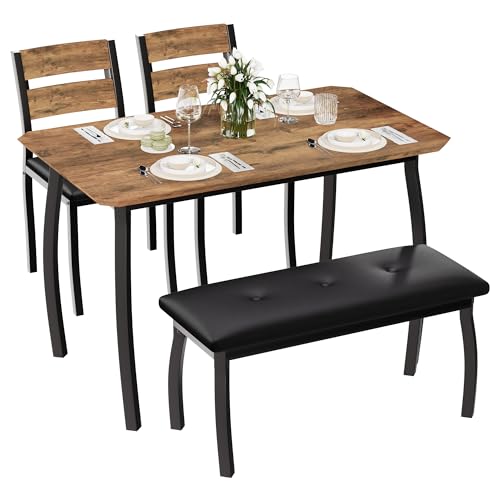
IDEALHOUSE 43'' Dining Table Set for 4, Wooden Kitchen Table with Upholstered Bench & 2 Cushion Chairs, Industrial Dinette Set for Studio, Kitchen, Dining Room, Apartment, Retro
Check price on Amazon
Fkhouse 43.3" Dining Room Table Set for 4, Drawer, 2 Chairs & Bench, Walnut | Kitchen Table and Chairs, Space-Saving Tuck-Under Chairs and Bench, Pull-Out Storage Drawer, Upholstered Seats, Bench Shelf
Check price on AmazonPre-Purchase Checklist
Run through this list before you order. Each item corresponds to a return reason that shows up repeatedly in bench-and-chair set reviews.
- Measure the room twice: Note the chair-side clearance, bench-side clearance, and the walking path behind the chair side.
- Confirm the bench side: Check the product diagram to see which long side the bench occupies, and confirm it matches your wall or window placement.
- Verify bench height against table height: 16–18 inch seat with a 28–30 inch table. Ask the seller if the specification is not listed.
- Check per-person bench length: At least 20 inches per adult, ideally 24. Measure the bench length against your usual household size.
- Review chair construction: Corner blocks, joint type, and weight capacity. Chairs fail before tables do.
- Decide on upholstery: If the bench or chairs are upholstered, confirm the fabric is cleanable and the cushion is replaceable.
- Check delivery and assembly: Confirm the box dimensions fit your entryway and whether assembly tools are included.
- Read the warranty: Note what is covered — frame, finish, upholstery, and hardware are often covered differently.
- Plan for floor protection: Felt pads for bench and chair legs protect both flooring and the furniture joints.
For a broader set of buying criteria that applies across all dining furniture, see the main dining buying guides section.
Frequently Asked Questions
How many people can a dining table with bench and 4 chairs seat?
A standard set typically seats six adults comfortably. The bench accommodates two to three people on one side, while the four chairs seat the opposite side and the ends. A 60-inch bench can hold three slim adults or four children in occasional use; a 48-inch bench comfortably seats two.
What is the ideal bench height for a standard dining table?
The bench seat should sit 16 to 18 inches from the floor when paired with a 28 to 30 inch dining table. This leaves roughly 10 to 12 inches between the bench seat and the table apron, which is the ergonomic range for comfortable legroom. Counter-height tables require a 24 to 26 inch bench seat.
Is a bench more comfortable than dining chairs?
Not for long meals. Benches have no back support and are best for casual, shorter sittings and for children. Upholstered dining chairs offer better back support and are preferable for long dinners or elderly guests. The bench-and-four-chair layout works because the chairs cover the support need while the bench delivers space efficiency.
Can a dining bench be used outdoors?
Only if it is built from weather-resistant materials such as teak, acacia, powder-coated aluminum, or HDPE. Indoor benches made from MDF, veneer, or untreated pine will warp, crack, or delaminate with moisture and UV exposure. If you need outdoor seating, choose a dedicated outdoor set.
How much space do I need for a dining table with bench and 4 chairs?
Plan for a room of roughly 10 by 12 feet for a standard 60-inch rectangular table. You need about 36 inches of clearance on the chair side for pull-out and walking, and 18 to 24 inches on the bench side because the bench slides under the table. End chairs need 30 to 36 inches at each end if used.
Should I choose an upholstered or solid wood bench?
Choose upholstered if comfort during longer meals matters most and your household is careful with spills. Choose solid wood if durability and easy cleaning matter most, especially with young children or pets. Many buyers choose a solid wood bench and add a removable cushion, which combines both advantages.
Can I add two more chairs later to make it an eight-seat set?
Only if the table is long enough and has open legroom at the ends. A 60-inch table with a bench on one long side and chairs on the other can usually take one chair at each end if the leg or trestle design allows it. Check the manufacturer's stated seating capacity and the base construction before assuming you can expand.