
Mid-Century Modern Upholstered Dining Chairs
Everything you need to know before choosing sculpted, upholstered seating for your dining room — from frame construction and fabric performance to comfort, proportion, and pairing with the right table.
Explore the Buying GuideWhat Defines a Mid-Century Modern Upholstered Dining Chair?
Mid-century modern upholstered dining chairs are a study in restraint and sculptural form. They emerged from the design philosophies of the 1940s through the 1960s, when designers began pairing new materials with organic shapes and a renewed focus on function. Today, the style remains one of the most versatile choices for dining rooms because it blends clean geometry with genuine comfort.
Several visual cues make these chairs instantly recognizable. The most common is a tapered, splayed leg — often angled outward and finished in walnut, teak, or another warm hardwood. The seat and backrest are usually sculpted, with a gentle curve that supports the body without the bulk of traditional upholstery. Upholstery itself is typically tight and tailored rather than loose and cushioned, preserving the streamlined silhouette that defines the era.
Clean, Organic Lines
Curved backrests and softened seat edges replace heavy carving with a light, architectural profile.
Splayed & Tapered Legs
Angled wooden legs lift the chair visually and create the signature floating stance of the style.
Tailored Upholstery
Tight, smooth fabric wraps emphasize form over ornament, keeping the chair visually quiet.
Low, Supportive Backrest
A gently contoured back supports the lumbar region without blocking sightlines across the table.
If you are building a cohesive dining space, it helps to understand how these chairs relate to the table they surround. A mid-century modern table pairs naturally with upholstered seating of the same era, but the chairs also work well alongside more contemporary tables. For a broader look at the seating category, our upholstered dining chairs overview covers alternative silhouettes and configurations.
Why Choose Upholstered Mid-Century Dining Chairs?
Dining chairs are used more than almost any other piece of furniture in the home, so comfort and durability matter as much as appearance. Upholstered mid-century modern chairs offer a rare combination: a refined visual presence and the cushioning needed for long dinners, work-from-home lunches, and holiday gatherings.
- Comfort for extended seating: Foam padding and a contoured backrest reduce pressure during multi-course meals.
- Design flexibility: The restrained silhouette suits modern, transitional, and even farmhouse interiors.
- Acoustic softness: Fabric surfaces absorb sound, which helps in open-plan dining areas.
- Material warmth: Wood frames and textile upholstery soften the hard surfaces common in dining rooms.
- Long-term relevance: The style has remained in production for decades, so replacement and expansion pieces are widely available.
Design note: If your dining room already features a strong statement table — such as a marble-top dining table — upholstered mid-century chairs in a neutral fabric keep the composition balanced rather than busy.
Frame Materials and Construction
The frame determines how a chair ages. A well-built frame keeps its geometry for years, while a weak frame will loosen, squeak, or wobble regardless of how good the upholstery looks on day one. When evaluating mid-century modern upholstered dining chairs, look closely at the wood species, joinery, and the way the seat platform is reinforced.
Common Frame Woods
- Walnut: The classic mid-century choice, prized for its rich, dark grain and dimensional stability. Walnut frames often signal a premium or high-end tier chair.
- Teak: Dense and naturally oil-rich, teak is durable and warm in tone. It is common in Scandinavian-influenced pieces.
- Oak and ash: Hard, resilient, and widely available. These woods often appear in mid-range models and take stains well.
- Rubberwood and engineered woods: Frequently used in entry-level and starter-tier chairs. Quality varies significantly, so check for reinforced joinery.
Joinery and Reinforcement
Look for mortise-and-tenon or doweled joints at the leg-to-seat connection, corner blocks, and a solid seat platform. Screwed-and-glued construction is acceptable at the mid-range level, but staples alone are a warning sign. A heavy-duty chair will typically include a reinforced apron beneath the seat to prevent flex.
Metal accents are another consideration. Some designs use metal dining table legs or metal chair frames to complement wooden pieces, and mixed-material chairs can be a smart bridge between mid-century and industrial interiors.
Upholstery Fabric Options
Fabric choice affects comfort, maintenance, and how the chair reads in the room. Mid-century modern upholstered dining chairs are available in a wide range of textiles, and the right selection depends on household traffic, presence of children or pets, and the amount of natural light the room receives.
| Fabric Type | Best For | Durability Notes |
|---|---|---|
| Performance polyester blends | High-traffic family dining rooms | Stain-resistant, easy to wipe, resists fading |
| Leather and faux leather | Formal or minimalist interiors | Wipes clean easily; develops patina over time |
| Microfiber | Households with pets and children | Dense weave resists scratches and light spills |
| Bouclé | Soft, textural design statements | Comfortable but requires gentle cleaning |
| Velvet | Luxury and formal dining rooms | Rich appearance; needs regular brushing and care |
| Wool blends | Natural, breathable comfort | Durable and temperature-regulating; spot clean only |
For a deeper look at textile selection, our guide to upholstery fabric for chairs explains weave types, rub counts, and how to test a swatch at home. If you plan to refresh an older set rather than buy new, our article on upholstering a chair walks through the re-covering process.
Comfort and Ergonomics
A dining chair should support the body for at least an hour of seated conversation. The best mid-century modern upholstered dining chairs balance a firm, supportive seat with a backrest that follows the natural curve of the spine. Foam density is the single most important comfort variable: low-density foam compresses quickly, while high-density foam retains its shape over years of use.
- Seat height: Standard dining chairs sit around 18 inches from floor to seat top; confirm this matches your table apron height.
- Seat depth: A depth of roughly 16 to 18 inches supports the thighs without pressing behind the knees.
- Backrest angle: A slight recline of 5 to 10 degrees improves long-meal comfort compared with a fully upright back.
- Arm options: Armless chairs tuck under the table more easily, while armchairs suit the head of the table.
If you are outfitting a full set, pairing four side chairs with two armchairs is a common arrangement. Sets such as upholstered dining chairs set of 4 and upholstered dining room chairs set of 6 are convenient ways to furnish a room consistently, though buying individual chairs allows more flexibility in mix-and-match layouts.
Proportion and Table Pairing
Scale is where many dining rooms go wrong. A visually heavy chair beside a delicate table can make the room feel unbalanced, and an oversized table with small chairs can look under-furnished. Mid-century modern upholstered dining chairs tend to be visually light, so they pair well with both round and rectangular tables.
Measure the table first. As a rule, allow about 24 inches of table edge per person, and leave at least 12 inches between the seat back and the wall for comfortable movement. For round tables, a round dining table for 4 with chairs is a natural fit for four upholstered mid-century chairs, while larger households may prefer a rectangular dining table set configuration.
Pairing tip: Match the chair frame wood to the table base rather than the tabletop. A walnut chair frame beside a walnut table base creates a subtle visual link even when the tabletop is glass or stone.
If you prefer a softer, more eclectic look, mixing upholstered chairs with a wooden bench is a popular approach. A teak wood bench on one side of the table and two or three upholstered chairs on the other adds texture without losing cohesion.
Quality Tiers Explained
Mid-century modern upholstered dining chairs are available across a wide spectrum of construction quality. Rather than focusing on numeric figures, it helps to understand what each tier typically delivers in materials, joinery, and comfort.
| Tier | Typical Construction | Best For |
|---|---|---|
| Entry-level / starter tier | Engineered wood frames, lower-density foam, basic woven fabric, stapled or partially doweled joinery | Occasional use, first apartments, staging |
| Mid-range / balanced tier | Solid hardwood frames in oak or ash, medium-density foam, performance fabric, screwed-and-doweled joints | Everyday family dining and regular entertaining |
| Premium / high-end tier | Walnut or teak frames, high-density foam, tailored upholstery, reinforced corner blocks, mortise-and-tenon joinery | Long-term daily use and design-forward interiors |
| Luxury / flagship tier | Hand-finished hardwood, custom textiles, hand-stitched upholstery, artisan joinery | Formal dining rooms and collector-level interiors |
Mid-range models usually offer the best balance of durability and design fidelity: they retain the silhouette and comfort of premium chairs while using materials that hold up well under daily use. Premium and luxury tiers make sense when the chairs will be used every day for many years and the room's design is a long-term commitment.
Care and Maintenance
Upholstered chairs need modest but consistent care to stay looking their best. Vacuum fabric seats every few weeks with a brush attachment to lift dust and crumbs from the weave. Blot spills immediately with a clean, dry cloth rather than rubbing, and use a mild upholstery cleaner only after testing it on a hidden area.
- Rotate chairs periodically so wear is distributed evenly across the set.
- Keep chairs out of direct, prolonged sunlight to prevent fabric fading and wood bleaching.
- Re-tighten leg bolts every few months; loose legs stress the joinery.
- Use felt pads under wooden legs to protect hard floors from scratches.
- Treat wood frames with a suitable polish once or twice a year to preserve the finish.
For households with pets or young children, consider removable waterproof seat covers for dining room chairs as a protective layer during messy meals. More detailed maintenance routines are covered in our broader dining care and maintenance section.
Recommended Mid-Century Modern Upholstered Dining Chairs
⚠️ AFFILIATE DISCLOSURE: This website contains affiliate links. As an affiliate Associate, we earn from qualifying purchases. If you make a purchase through these links, we may receive a small commission at no additional cost to you. Read our full affiliate policy.

HNY Barrel Dining Chairs Set of 6, Mid Century Modern Upholstered Dining Chairs with Arms, Linen Kitchen & Dining Room Chairs, Solid Wood Frame Accent Chairs for Kitchen, Apartment, Beige
Check price on Amazon
smartue Wooden Dining Chairs Set of 4, Upholstered Kitchen Chairs with Solid Wood Legs, Mid Century Dining Room Chair with Ergonomic Curved Backrest for Kitchen Dining Vanity, Green
Check price on Amazon
HNY Mid Century Modern Dining Chairs Set of 6, Upholstered Linen Kitchen & Dining Room Chairs with Ergonomic Curved Backrest, Solid Wood Legs, Farmhouse Accent Chair for Home, Apartment, Beige
Check price on Amazon
CHUN YI Dining Chairs Set of 4, Upholstered Solid Wood Dining Room Chairs, Mid Century Modern Farmhouse Kitchen Chair with Ergonomic Curved Backrest, Warm Beige(Only Chairs)
Check price on Amazon
VKNOW Wooden Dining Chairs Set of 4 with Walnut Wood Legs and Curved Back | Mid Century Modern Upholstered Dining Room Chairs with Faux Mohair Fabric, Kitchen Chairs for Farmhouse, Dining Room, Green
Check price on Amazon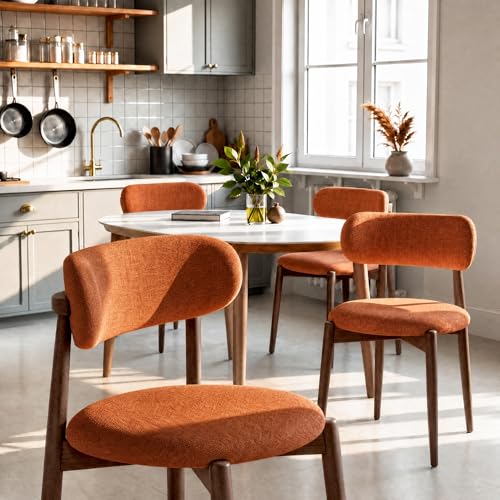
Fabulcozy Wooden Dining Chairs Set of 4, Mid Century Modern Upholstered Kitchen Chairs with Solid Wood Legs, 350lb Heavy Duty Padded Side Chairs for Dining Room & Vanity, Orange
Check price on Amazon
Homixis Mid-Century Modern Upholstered Dining Chairs Set of 4, Camel | Features contoured ergonomic backrest & sturdy solid wood legs. Ideal upholstered chairs for kitchen, dining room & vanity.
Check price on AmazonFrequently Asked Questions
What defines a mid-century modern upholstered dining chair?
A mid-century modern upholstered dining chair typically features clean lines, tapered or splayed legs, a sculpted seat, and upholstery that balances comfort with a streamlined silhouette. Natural wood frames, gentle curves, and a low-profile backrest are common hallmarks.
Which upholstery fabrics work best for dining chairs?
Performance fabrics, tight-weave polyester blends, leather, and microfiber are practical choices for dining chairs because they resist spills and daily wear. Bouclé and velvet offer a more luxurious look but require gentler care and more frequent maintenance.
How do I mix mid-century modern chairs with an existing dining table?
Match the wood tone of the chair frame to the table base or top for visual cohesion. If the table is a strong statement piece, choose chairs with simpler silhouettes. Mixing two upholstery colors or pairing a bench with chairs can add a curated, collected feel.
Are upholstered dining chairs comfortable for long meals?
Yes, provided the seat has adequate foam density and a supportive backrest. Mid-range and premium models usually use higher-density foam and reinforced frames, which improve comfort during long dinners compared with entry-level options.
Choosing With Confidence
Mid-century modern upholstered dining chairs reward careful selection. Focus on the frame first, then the fabric, then the comfort details — in that order. A well-constructed chair in a performance textile will serve a household for years and continue to look intentional as surrounding decor evolves. Explore our full range of upholstered mid-century modern dining chairs for more silhouettes, and browse our dining chairs category to compare styles across eras and materials.
Whether you are furnishing a first dining room or refreshing a long-loved space, the right chairs should feel comfortable from the first meal and still look right a decade later. Use this guide as a checklist, measure your table carefully, and choose the tier that matches how often the room is used.