
Upholstered Mid Century Modern Dining Chairs: The Complete Buying Guide
Master the art of choosing upholstered mid century modern dining chairs — from frame construction and fabric selection to comfort, proportions, and long-term care. Everything you need to decide with confidence.
Upholstered mid century modern dining chairs sit at the intersection of form and function. They carry the clean lines, tapered profiles, and organic warmth that define mid-century design, while adding the softness and comfort that modern households expect from a seat used every day. For anyone researching this category before a purchase, the challenge is rarely finding something that looks good — it is understanding which construction details, upholstery choices, and proportions will actually hold up in daily use.
This guide walks through the decisions that matter most: how the frame is built, which upholstery materials suit different households, how seat geometry affects comfort over a long dinner, and how to coordinate these chairs with the rest of your dining room. By the end, you will have a clear framework for evaluating any upholstered mid century modern dining chair set you encounter, whether you are shopping for a full set of six or a single accent seat.
What Defines an Upholstered Mid Century Modern Dining Chair
Mid-century modern design emerged from a philosophy of purposeful simplicity: honest materials, functional forms, and the removal of unnecessary ornamentation. Applied to dining chairs, that philosophy produces a recognizable silhouette — a gently curved backrest, often a splayed or tapered leg, a seat that floats slightly above the frame, and a slim profile that keeps sightlines open around the table.
Upholstery changes the character of that silhouette in useful ways. A fully upholstered back and seat softens the visual weight of the chair, adds acoustic dampening in open-plan spaces, and provides the cushioning that makes long meals comfortable. The most successful designs balance that softness with restraint — upholstery that follows the frame rather than obscuring it, so the mid-century geometry remains legible.
Key Design Signals
- Tapered or splayed legs: Often in solid wood or walnut finish, angled outward for stability and visual lightness.
- Curved or scoop backrest: Ergonomically shaped to support the spine without a bulky frame.
- Floating seat: A small gap between the upholstered seat and the frame, a hallmark of the era's construction.
- Minimal hardware: Joints are typically exposed or hidden cleanly, with little visible metalwork.
- Restrained proportions: Slim arms (or armless), medium back height, and a footprint that fits under most tables.
Frame Construction: The Foundation You Cannot See
The frame determines how long the chair stays tight and stable. Upholstery hides it, so you need to rely on specification details and a few physical checks. Solid hardwood frames — particularly kiln-dried beech, oak, or walnut — resist warping and hold joinery fasteners far better than softwood or particle-board composites. Look for corner blocks, doweled or mortise-and-tenon joints, and reinforced seat aprons as signs of durable construction.
Metal frames are another credible option in this style. Powder-coated steel or tubular metal frames can be lighter and very stable, and they pair naturally with the chrome-and-wood vocabulary of mid-century design. If you are comparing a wood frame against a metal frame, our guide to metal dining table legs and frame compatibility is a useful companion read when you are matching chairs to an existing table.
What to Check on the Frame
- Wood species and drying: Kiln-dried hardwood is the benchmark for stability in humid or heated homes.
- Joint type: Mortise-and-tenon and doweled joints outperform stapled or glued-only assemblies.
- Leg attachment: Look for reinforced corner blocks or metal brackets where legs meet the seat apron.
- Weight and wobble: A well-built chair feels solid with no side-to-side play when you press the backrest.
Upholstery Materials: Matching Fabric to Your Household
Upholstery choice has the largest effect on how the chairs feel, how they age, and how much maintenance they demand. There is no universally best fabric — the right choice depends on who uses the chairs and how often. The table below compares the main options across the criteria that matter most to buyers.
| Upholstery Type | Best For | Durability Profile | Maintenance |
|---|---|---|---|
| Woven performance fabric (polyester blend) | Families, daily use, high-traffic dining rooms | High abrasion resistance, stain-resistant finish | Spot-clean with mild soap; very forgiving |
| Linen and linen blends | Formal dining, adult households, textured looks | Moderate; softens with age and can crease | Professional cleaning recommended for stains |
| Velvet (cotton or synthetic) | Statement seating, luxury and glam interiors | Good when densely woven; crushes in high-use spots | Vacuum regularly; avoid water-based cleaning |
| Bouclé and textured weaves | Warm, tactile mid-century interiors | Moderate; loops can snag with pets or jewelry | Gentle vacuum; spot-clean carefully |
| Faux leather / polyurethane | Easy-clean households, kids' dining areas | High wipe-clean practicality; check seam quality | Wipe with damp cloth; avoid harsh solvents |
| Top-grain leather | Long-term investment seating | Very durable; develops patina over time | Condition periodically; easy to wipe |
For households with young children or pets, performance weaves and faux leather are the pragmatic starting point. For formal or adult-only dining rooms, linen blends and velvet deliver the tactile richness that defines premium mid-century interiors. If you plan to reupholster later, choose a chair with a removable seat cushion and a simple frame — our guide to upholstery fabric for chairs explains how fabric weight and backing affect that decision.
Comfort Engineering: Seat Height, Depth, and Cushioning
Comfort in a dining chair is largely a matter of geometry. The seat height should allow your feet to rest flat on the floor while your thighs are roughly parallel to the ground — typically around 18 to 19 inches for standard dining tables. Seat depth matters just as much: too deep, and the backrest pushes you forward; too shallow, and the seat edge digs into the thighs. A depth that leaves two to three inches between the back of your knee and the seat edge is the sweet spot for most adults.
Cushioning is where upholstered mid-century chairs distinguish themselves. High-density foam holds its shape and resists bottoming out; lower-density foam feels plush at first but compresses quickly. Many well-specified chairs combine a firm foam core with a softer top layer, which gives immediate comfort without sacrificing long-term support. Backrest angle and lumbar curvature also matter — a slight recline and a gently scooped back are far more comfortable over a two-hour meal than a rigid upright back.
Comfort Checklist
- Seat height: Confirm it matches your table height; counter-height and bar-height sets need different chair geometry.
- Seat depth: Aim for 2–3 inches of clearance behind the knee.
- Foam density: High-density foam with a softer top layer is the balanced choice.
- Back support: Look for a slight recline and lumbar curvature.
- Arm clearance: If the chairs have arms, verify they fit under your table apron.
How Many Chairs? Set Configurations and Spacing
Upholstered mid-century dining chairs are commonly sold in sets of two, four, or six. The right count depends on your table and room. As a rule of thumb, allow about 24 inches of table edge per person for comfortable elbow room, and keep at least 36 inches between the table edge and any wall or sideboard to allow chairs to pull out. If your table is extendable, buying a set that can grow with it — or adding matching single chairs later — is often the most flexible approach.
For larger rooms, a set of six upholstered chairs around a rectangular table creates a cohesive, formal look. For apartments and small dining nooks, a set of four or even two chairs paired with a bench can keep the space open. If you are still deciding on the table itself, our guides to the mid-century modern table and the rectangular dining table set cover proportion and pairing considerations in more depth.
Style Pairing: Making the Chairs Work With Your Room
Upholstered mid-century dining chairs are versatile, but they pair best when the room shares some of their design logic. A walnut or teak table with tapered legs is the natural partner. Warm neutral upholstery — oatmeal, camel, olive, or soft charcoal — keeps the palette flexible and lets the wood grain lead. If you want a more dramatic room, a single accent upholstery color across all chairs is more cohesive than mixing multiple hues.
Consider the surrounding storage and decor as well. A walnut sideboard or a vintage mid-century credenza reinforces the era's vocabulary without feeling themed. Lighting with a slim profile — a globe pendant or a sputnik-style chandelier — echoes the chairs' geometry. And because upholstered chairs add visual softness, they balance rooms with harder surfaces such as marble-top dining tables or glass tops.
Room-Matching Tips
- Match wood tones: Keep chair legs within one or two shades of the table's wood finish.
- Limit upholstery colors: One primary upholstery color across the set reads more intentional than a mix.
- Repeat shapes: Curved backs pair well with round or oval tables; tapered legs pair well with splayed table legs.
- Balance visual weight: Heavier upholstery suits larger rooms; lighter weaves suit small spaces.
Quality Tiers: What Changes as You Move Up the Market
Because upholstered mid-century dining chairs vary widely in construction, it helps to think in terms of quality tiers rather than specific brands. The descriptors below are relative positions in the market, not absolute judgments — a well-made entry-level chair can serve a household perfectly for years.
| Tier | Typical Construction | Best For |
|---|---|---|
| Entry-level tier | Engineered wood or softwood frame, stapled joints, standard foam, polyester upholstery | Occasional use, starter apartments, secondary dining areas |
| Mid-range tier | Solid hardwood frame, doweled joints, high-density foam, performance or blended fabric | Daily family use, primary dining rooms |
| Premium tier | Kiln-dried hardwood, mortise-and-tenon joinery, layered foam, linen blends or top-grain leather | Long-term investment seating, formal dining rooms |
| Luxury tier | Hand-finished hardwood, traditional joinery, premium leather or designer textiles, reinforced frames | Design-led interiors, collector-grade furniture |
In practice, the jump from entry-level to mid-range is the most meaningful for most buyers: it is where frames become solid hardwood and foam density becomes reliable. The jump from premium to luxury is largely about finish quality, textile provenance, and joinery refinement. Understanding where a chair sits on this scale helps you compare options fairly without relying on transient market figures.
Care and Longevity: Protecting Your Investment
Upholstered chairs reward a small amount of routine care. Vacuum fabric seats and backs every few weeks with a soft brush attachment to lift dust and crumbs before they work into the weave. Rotate the chairs around the table periodically so wear is distributed evenly. Blot spills immediately rather than rubbing, and follow the fabric manufacturer's cleaning code — many performance fabrics tolerate mild soap and water, while velvet and linen often require solvent-based or professional cleaning.
For wood frames, dust with a soft cloth and apply a furniture conditioner a few times a year to prevent drying and cracking. Keep chairs out of direct sunlight where possible, since UV exposure fades both wood finishes and upholstery dyes. If you want a deeper treatment, our guide to sustainable wood care covers conditioning routines that protect solid wood frames over the long term. For households with pets, consider waterproof seat covers for dining room chairs as a practical layer of protection on high-use seats.
Maintenance Rhythm
- Weekly: Vacuum fabric surfaces; wipe down leather or faux leather with a dry cloth.
- Monthly: Check leg tightness and tighten hardware if needed; rotate chairs.
- Seasonally: Condition wood frames; deep-clean upholstery per the fabric care code.
- Annually: Inspect joints and upholstery seams for early signs of wear.
Common Buying Mistakes to Avoid
The most common mistake is buying for looks alone and discovering later that the seat depth or height does not suit the table. Measure your table height, your available floor space, and your typical guest count before choosing a set. The second most common mistake is underestimating upholstery maintenance: a fabric that looks beautiful in a showroom may not suit a household with toddlers or shedding pets. Third, many buyers overlook arm clearance — chairs with arms that do not slide under the table apron end up pushed awkwardly into the room.
Finally, resist the urge to mix too many styles at once. Upholstered mid-century chairs are most effective when the room shares their restraint. A single era-appropriate anchor piece — the table, a sideboard, or a lighting fixture — is enough to tie the space together without making it feel like a period set.
Frequently Asked Questions
Are upholstered mid century modern dining chairs comfortable for long meals?
Yes, when the geometry is right. High-density foam, a slightly reclined backrest, and a seat depth that leaves two to three inches behind the knee make these chairs comfortable for multi-hour dinners. Avoid chairs with very thin cushions or rigid upright backs if long meals are common in your home.
What upholstery is best for families with young children?
Performance woven fabrics and faux leather are the most practical choices. They resist stains, wipe clean easily, and tolerate frequent spot-cleaning. If you prefer natural fibers, choose a tight-weave linen blend with a stain-resistant finish and keep a protective cover on hand for messy meals.
How do I match upholstered chairs to a wood dining table?
Keep the chair legs within one or two shades of the table's wood finish, and choose an upholstery color that either echoes the wood's warmth or provides a soft neutral contrast. Walnut and teak tables pair especially well with oatmeal, camel, olive, and charcoal upholstery.
Should I buy a set of four, six, or individual chairs?
Allow roughly 24 inches of table edge per person and at least 36 inches of clearance between the table and walls. A set of four suits small dining nooks and apartments; a set of six suits larger rectangular tables. Individual chairs are useful for extending a set later or adding an accent seat.
Can upholstered dining chairs be reupholstered later?
Yes, if the frame is solid and the seat cushion is removable. Chairs with simple frames and detachable seats are the easiest to reupholster, which makes them a strong long-term choice if you expect your style preferences to change.
Ready to compare options? Browse curated upholstered mid century modern dining chairs in sets and singles, with construction details and upholstery specs laid out clearly.
Explore Upholstered Dining ChairsRecommended Upholstered Mid Century Modern Dining Chairs
⚠️ AFFILIATE DISCLOSURE: This website contains affiliate links. As an affiliate Associate, we earn from qualifying purchases. If you make a purchase through these links, we may receive a small commission at no additional cost to you. Read our full affiliate policy.

Dining Chairs Set of 2, Upholstered Mid Century Modern Dining Chair with Solid Wood Legs, Comfortable Fabric Kitchen Dining Room Chairs with Ergonomic Curved Backrest (2, Walnut + Beige)
Check price on Amazon
CHUN YI Dining Chairs Set of 4, Upholstered Solid Wood Dining Room Chairs, Mid Century Modern Farmhouse Kitchen Chair with Ergonomic Curved Backrest, Warm Beige(Only Chairs)
Check price on Amazon
smudyizi Upholstered Dining Chairs Set of 4, Mid Century Modern Side Chairs | Farmhouse Style Fabric Upholstered Dining Room Chairs, Comfortable Kitchen Side Chairs for Dining Room & Kitchen
Check price on Amazon
smartue Wooden Dining Chairs Set of 4, Upholstered Kitchen Chairs with Solid Wood Legs, Mid Century Dining Room Chair with Ergonomic Curved Backrest for Kitchen Dining Vanity, Green
Check price on Amazon
DUMOS Dining Chairs Set of 2, Mid Century Modern Chair Round Upholstered Curved Backrest, Kitchen Vanity Living Room Chairs with Black Metal Legs, Green
Check price on Amazon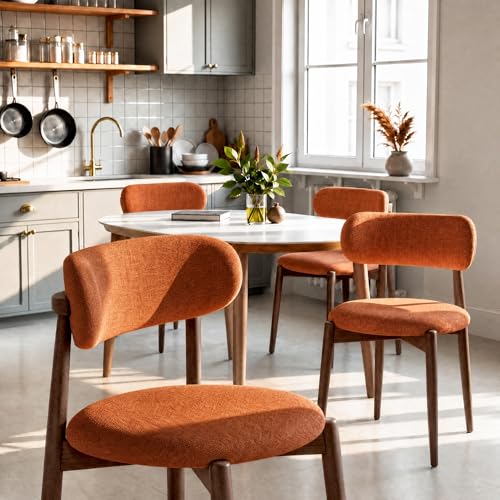
Fabulcozy Wooden Dining Chairs Set of 4, Mid Century Modern Upholstered Kitchen Chairs with Solid Wood Legs, 350lb Heavy Duty Padded Side Chairs for Dining Room & Vanity, Orange
Check price on Amazon
COLAMY Upholstered Dining Chairs Set of 4, Mid Century Modern Kitchen Chairs with Back, Farmhouse Fabric Side Dining Room Chairs with Wood Legs for Dining Room Restaurant, Beige
Check price on AmazonFinal note: always confirm the chair's dimensions, fabric care code, and assembly requirements against your table and room measurements before ordering. A five-minute measurement check prevents most returns in this category.