

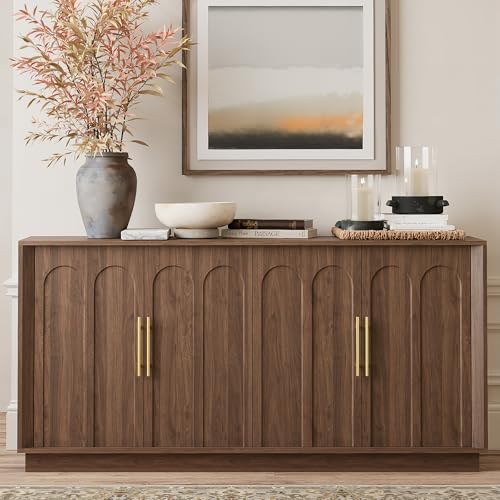


What Is a Tall Sideboard Cabinet?
A tall sideboard cabinet is a vertical storage piece designed for dining rooms, kitchens, and open-plan living areas. Unlike a standard sideboard that typically sits at dining-table height, a tall sideboard extends upward — often reaching between 120 cm and 180 cm — to create a taller silhouette with additional shelving and closed storage. The form combines the serving function of a traditional buffet with the display and storage capacity of a cabinet.
In practice, a tall sideboard cabinet usually features a mix of doors, drawers, and open shelving. The upper section may include glass doors for displaying china, glassware, or decorative pieces, while the lower section holds heavier items such as platters, table linens, and serving trays. This layered layout is what makes the tall sideboard so effective in a dining room: it organizes frequently used items at arm's reach and reserves the top surface for lamps, vases, or a seasonal centerpiece.
If you are still comparing storage formats, our guide to tall buffet cabinets explains how that category overlaps with the tall sideboard, and our overview of thin buffet cabinets is useful if depth is your main constraint.
Tall Sideboard vs Standard Sideboard: Key Differences
Understanding the distinction helps you choose the right piece for your room. A standard sideboard aligns with the dining table surface, which makes it convenient for buffet-style serving. A tall sideboard cabinet prioritizes vertical storage and visual presence. The table below summarizes the practical differences.
| Feature | Standard Sideboard | Tall Sideboard Cabinet |
|---|---|---|
| Typical height | 80–90 cm | 120–180 cm |
| Footprint | Wider, often deeper | Compact, vertical |
| Primary role | Serving surface and closed storage | Vertical storage plus display |
| Best for | Rooms with generous floor area | Rooms with limited floor space and tall walls |
| Top surface use | Buffet service, platters | Display, lighting, decorative accents |
| Anchor to wall | Recommended | Essential |
The right choice comes down to how you use your dining room. If you host frequent buffet meals, a standard height may be more practical for serving. If you need to store a full dinnerware collection and your floor plan is tight, a tall sideboard cabinet earns its place against the wall.
How to Choose the Right Height and Width
Height is the defining feature of a tall sideboard, so measure carefully before you commit. Start with the ceiling height and subtract any crown molding or pendant lighting clearance. As a rule of thumb, leave at least 30 to 40 cm of open space above the cabinet so the room does not feel compressed. Cabinets in the 140–160 cm range are the most versatile for typical residential dining rooms, while models approaching 180 cm work best in rooms with high ceilings.
Width should relate to the wall you are filling. A useful guideline is that the cabinet should occupy roughly 50 to 75 percent of the available wall width. This leaves breathing room on either side and avoids a cramped look. If your wall is narrow, a compact model in the 80–100 cm width range can still deliver meaningful vertical storage.
- Measure ceiling height and note any light fixtures that hang into the cabinet's zone.
- Confirm the wall width and plan for 15–30 cm of clearance on each side.
- Check door swing clearance — both cabinet doors and nearby room doors.
- Verify that the top surface is reachable for dusting and styling.
- Account for baseboards when measuring depth against the wall.
Depth, Clearance, and Traffic Flow
Depth is where tall sideboard cabinets differ most from traditional buffets. A deep cabinet eats into walkway space, which matters in dining rooms where chairs are pulled out during meals. Most tall sideboards are designed with a depth between 35 cm and 50 cm. Narrower depths suit hallways and compact dining areas, while deeper models accommodate large platters and serving trays.
Plan for at least 90 cm of clearance between the front of the cabinet and any dining chair or doorway when the room is in use. If the cabinet sits on the main path between the kitchen and the table, increase that clearance so the cabinet does not become an obstacle. For rooms with tight layouts, browse our tables for small spaces collection alongside this guide to coordinate furniture proportions.
Materials and Construction Quality
Material choice affects durability, maintenance, and the visual weight of the cabinet. Solid wood — oak, walnut, teak, and maple — remains the benchmark for longevity and repairability. Engineered wood with a quality veneer is a solid mid-range option and is widely used for tall cabinets because it resists warping in stable indoor climates. Metal frames paired with wood or glass give an industrial character. If you are considering wood construction, our guide to sustainable wood explains sourcing and care considerations.
| Material | Tier | Best For |
|---|---|---|
| Solid hardwood (oak, walnut, teak) | Premium to luxury tier | Long-term investment pieces with repairable surfaces |
| Engineered wood with quality veneer | Mid-range tier | Balanced construction with consistent finishes |
| Metal frame with wood or glass panels | Mid-tier to high-end tier | Industrial and contemporary dining rooms |
| Lacquered or painted MDF | Entry-level tier | Statement color schemes and lighter budgets within the category |
When evaluating construction, check drawer runners, hinge quality, and shelf adjustability. Dovetail or doweled drawer joints signal a more robust build than stapled construction. Adjustable shelves give you flexibility as your collection changes. A well-specified cabinet in the mid-range tier often delivers smoother hardware and more precise alignment than the entry level, which matters for daily use.
Storage Layout: Doors, Drawers, and Open Shelving
The interior layout of a tall sideboard cabinet determines how usable it will be day to day. A practical configuration combines closed storage for less-presentable items with display areas for pieces you want to show. Common layouts include:
- Two tall doors with adjustable shelves — the most flexible layout for dinnerware and serving pieces.
- Upper glass doors and lower solid doors — a classic dining room arrangement that blends display and concealment.
- Center drawers with flanking doors — useful for cutlery, linens, and small accessories.
- Open shelving section — good for cookbooks, decor, or a beverage station, though it demands regular styling.
Think about what you will store. Dinner plates stack efficiently on deep shelves; stemware needs taller clearance; serving platters often need full-width spans. Measure your largest items before choosing. If you entertain often, prioritize easy access to the pieces you reach for most, and consider a layout with a lower open shelf for quick grab items.
Styles That Suit a Tall Sideboard Cabinet
The tall silhouette works across many interior styles, but the detailing should match the rest of the room. In a modern minimalist dining room, flat-front doors, integrated handles, and a matte finish keep the cabinet visually quiet. Farmhouse and rustic settings suit beadboard panels, exposed hinges, and a distressed or natural wood finish. Industrial lofts often pair a blackened metal frame with reclaimed wood shelves. For a more polished dining room, fluted or reeded doors and brass hardware add texture without overwhelming the space.
If you are still defining the overall look of your dining room, our guides to unique sideboards and buffets and traditional formal dining room decorating ideas provide styling direction that pairs well with a tall cabinet.
Placement and Room Proportion
A tall sideboard cabinet acts as a visual anchor, so placement matters as much as size. The most common position is centered on the longest available wall, opposite or adjacent to the dining table. Centering the cabinet gives the room a sense of balance and provides a natural backdrop for a lamp, mirror, or artwork above.
Consider sightlines from the room's entry point. A tall cabinet placed on the first wall you see will read as a focal point; placed on a secondary wall, it can recede and support the table as the main event. Avoid blocking windows or radiators, and keep at least 90 cm of clearance from heat sources. If the cabinet sits in an open-plan space, align its top line with nearby shelving or kitchen cabinetry for a cohesive look.
- Center the cabinet on the wall for visual balance.
- Leave 30–40 cm above the cabinet for breathing room.
- Keep 90 cm of clearance in walkways and chair zones.
- Coordinate the top line with adjacent storage where possible.
- Light the top surface with a small lamp or picture light for depth.
Safety: Anchoring a Tall Cabinet
Tall furniture carries a higher center of gravity, so anchoring is not optional. Always use the anti-tip strap or wall anchor included with the cabinet, and fix it into a wall stud or a suitable masonry anchor. If the cabinet did not include hardware, a furniture safety strap is inexpensive and straightforward to install. This is especially important in homes with children or pets, and in areas where the cabinet may be leaned against or used to steady someone standing up from the table.
Also check the cabinet's load rating for shelves and the top surface. Distribute heavy items — stacks of plates, large platters — on lower shelves and keep the upper shelves for lighter pieces. This keeps the center of gravity low and reduces strain on the cabinet structure over time.
Styling the Top Surface
The top of a tall sideboard cabinet is a display stage at eye level, which makes it one of the most impactful styling surfaces in the dining room. Keep the arrangement simple: a lamp for warm ambient light, a vase or bowl for seasonal color, and one or two decorative objects with varying heights. Avoid crowding, since the cabinet is already visually substantial.
For tabletop styling that complements the cabinet, explore our ideas for table runners and table place settings. If you rotate decor seasonally, our summer table ideas show how to shift the palette without replacing core pieces.
Care and Maintenance
Maintenance needs depend on the material. Solid wood benefits from a gentle polish a few times a year and should be kept away from direct sunlight to prevent uneven fading. Painted and lacquered finishes wipe clean with a soft damp cloth. Glass doors need a streak-free cleaner. Metal frames should be dried promptly to prevent spotting.
- Dust the top surface and open shelves weekly.
- Use coasters and trivets under hot or wet items on the top surface.
- Avoid placing the cabinet against a radiator or in direct afternoon sun.
- Check hinges and drawer runners annually and tighten as needed.
- Reapply wood conditioner according to the manufacturer's guidance.
For a broader maintenance routine, our guide to dining furniture care covers wood, glass, and upholstery across the dining room.
Common Mistakes to Avoid
- Buying before measuring. Confirm height, width, depth, and door swing clearance against your actual wall.
- Skipping the wall anchor. Tall cabinets must be secured, especially in family homes.
- Ignoring interior dimensions. Check shelf spacing against your largest platters and stemware.
- Overcrowding the top surface. A tall cabinet needs visual breathing room to avoid feeling heavy.
- Mismatching the style. Coordinate detailing and finish with the dining table and chairs.
- Blocking walkways. Keep at least 90 cm of clearance in active traffic zones.
Frequently Asked Questions
How tall should a tall sideboard cabinet be?
A tall sideboard cabinet typically stands between 120 cm and 180 cm high. Cabinets in the 140–160 cm range are the most versatile for residential dining rooms. Leave 30–40 cm of open space above the cabinet so the room does not feel compressed.
What is the difference between a tall sideboard and a standard sideboard?
A standard sideboard is usually 80–90 cm high and aligns with the dining table surface for buffet serving. A tall sideboard cabinet extends upward to add vertical storage and display space, making it better suited to rooms with limited floor space and taller walls.
Can a tall sideboard cabinet work in a small dining room?
Yes. A tall cabinet uses vertical space rather than floor space, which is a major advantage in small rooms. Choose a narrower depth — typically 35–45 cm — and lighter finishes to keep the room feeling open. Confirm walkway clearance before purchasing.
What materials are best for a tall sideboard cabinet?
Solid wood such as oak, walnut, and teak offers the greatest durability and repairability. Engineered wood with quality veneer is a solid mid-range option. Metal frames with wood or glass suit industrial and contemporary interiors. Match the material to your room's humidity and sunlight exposure.
How do I secure a tall sideboard cabinet to the wall?
Use the anti-tip strap or wall anchor supplied with the cabinet and fix it into a stud or suitable masonry anchor. If hardware was not included, a furniture safety strap is easy to install. Anchoring is essential in households with children or pets.
What should I store in a tall sideboard cabinet?
Use lower shelves for heavier items such as stacks of plates, platters, and serving trays. Reserve upper shelves and glass-front sections for lighter pieces, stemware, and display items. Keep frequently used pieces at arm's reach and seasonal items higher up.
Related Dining Room Guides
Ready to Choose Your Tall Sideboard Cabinet?
Use the product recommendations above to compare models, then match the cabinet to your room's dimensions and your storage needs. A well-chosen tall sideboard can anchor your dining room for years.
View Recommended Cabinets