
Expandable Kitchen Table: The Complete Buying Guide
Everything you need to know before choosing an expandable kitchen table — mechanisms, materials, sizing, and design considerations for flexible dining spaces.
START EXPLORINGWhy an expandable kitchen table? An expandable kitchen table gives you the best of both worlds: a compact surface for everyday meals and extra seating when guests arrive. This guide walks you through the key decisions — from expansion mechanisms and material choices to sizing and styling — so you can choose with confidence.
What Is an Expandable Kitchen Table?
An expandable kitchen table is a dining table engineered to change size on demand. Unlike a fixed table, it incorporates a mechanism — hinged leaves, sliding panels, or removable extension boards — that increases the usable surface area. When the extra space is not needed, the table returns to a smaller footprint that fits comfortably in a kitchen, breakfast nook, or compact apartment.
This category overlaps with several related designs. If you are exploring the broader category, our expandable dining table guide covers full-size options, while this page focuses on models sized for kitchens and everyday family meals. For tables that combine seating and storage, see the expandable kitchen tables collection.
The appeal is straightforward: one table serves two roles. During the week it functions as a practical prep-and-dine surface; on weekends or holidays it becomes a gathering place. That dual-purpose design makes an expandable kitchen table one of the most versatile pieces of furniture in a home.
Expansion Mechanisms Explained
The mechanism is the heart of any expandable table. It determines how easy the table is to extend, how much storage the extra leaves require, and how stable the table feels when fully opened. Here are the main types:
- Butterfly leaf (self-storing): A leaf is hinged beneath the tabletop and folds out and up into place. No separate storage is needed, and extension takes seconds. Ideal for everyday flexibility.
- Separate extension leaves: One or more boards are inserted into the center or ends of the table. This design often provides the largest expansion but requires a closet or storage space for the leaves when not in use.
- Drop-leaf: Hinged panels on one or both sides fold down when not needed. Excellent for very small kitchens where the table sits against a wall. See our drop-leaf kitchen table guide for a deeper comparison.
- Sliding / telescoping panels: The tabletop splits and slides apart on tracks to reveal a stored leaf. Smooth operation and no loose parts, but the hardware quality matters a great deal.
- Gate-leg: A traditional design where swinging legs support folded-down leaves. Charming in farmhouse and cottage settings, though the leg mechanism needs periodic checking.
In practice, butterfly and self-storing designs are the most convenient for daily use, while separate-leaf tables suit households that host large groups regularly. If you want the convenience of built-in storage, our guide to expandable tables with self-storing leaves explains the trade-offs in detail.
How to Choose the Right Size
Sizing is where most buyers make mistakes. An expandable table only solves a space problem if both its collapsed and expanded dimensions fit your room. Follow these steps:
- Measure the collapsed footprint. This is the table as it will sit every day. Leave at least 30 inches (76 cm) of clearance on all sides for chair pull-out and walking space.
- Measure the expanded footprint. Consider how far the table extends when fully open and whether that blocks doorways, walkways, or cabinetry.
- Plan seating by width. Allow roughly 24 inches (61 cm) of table width per person. A table that expands to 60 inches comfortably seats six; a 72-inch surface seats eight.
- Check height compatibility. Standard dining height is 30 inches (76 cm). Counter-height and bar-height expandable tables exist but require matching stool heights.
For kitchens with tight layouts, models that expand lengthwise rather than widthwise usually work best. If your room is genuinely small, our extendable tables for small spaces guide offers layout diagrams and additional sizing advice.
Materials and Construction Quality
The tabletop material affects durability, maintenance, and visual warmth. The frame and hardware determine how well the expansion mechanism holds up over years of use.
- Solid wood: The most durable and repairable option. Oak, maple, walnut, and pine are common. Solid wood tables can be sanded and refinished if scratched, making them a long-term investment.
- Engineered wood with veneer: Stable and consistent, often found in entry-level and mid-range models. Resists warping but cannot be refinished as readily.
- Laminate and melamine surfaces: Easy to clean and resistant to stains, well suited to busy family kitchens. Look for sealed edges to prevent moisture ingress.
- Glass tops: Visually light and easy to wipe down, but heavier and more prone to chipping at edges. Pair with a sturdy metal or wood frame.
- Stone and faux-marble: Premium and luxury tier tables use stone or composite tops for a statement look. These are heavy and require reinforced frames.
Pay close attention to the expansion hardware. High-grade steel hinges, reinforced corner blocks, and smooth-glide tracks are hallmarks of well-built tables. Entry-level models often use lighter hardware that is fine for occasional use but less suited to daily opening and closing. For a comparison of table categories by construction tier, see our broader expandable table overview.
Style Options for Every Kitchen
An expandable kitchen table should harmonize with the surrounding cabinetry, flooring, and lighting. The most popular styles fall into a few recognizable families:
- Farmhouse and rustic: Chunky legs, distressed finishes, and warm wood tones. Often paired with bench seating. Explore our farmhouse kitchen table guide for coordinating ideas.
- Modern and minimalist: Clean lines, slim profiles, and neutral finishes. Often feature concealed expansion mechanisms and metal accents.
- Mid-century modern: Tapered legs, rounded edges, and walnut or teak finishes. Works beautifully in open-plan kitchens.
- Industrial: Mixed wood and metal construction with visible hardware. Durable and forgiving in busy households.
- Coastal and light: Painted finishes, pale wood, and airy silhouettes. Ideal for bright, compact kitchens.
If your kitchen leans traditional, a gate-leg or butterfly-leaf table in solid wood will feel natural. For contemporary spaces, a sliding-panel table with a matte finish keeps the look streamlined. Our extendable wood dining table guide covers finish and grain selection in more depth.
Tier Comparison: Matching the Table to Your Needs
Expandable kitchen tables fall into recognizable quality tiers. Rather than focusing on figures, use this classification to match construction quality and features to how intensively you plan to use the table.
| Tier | Typical Construction | Best For |
|---|---|---|
| Entry-level | Engineered wood, laminate surfaces, basic hinges | First apartments, light daily use, occasional hosting |
| Mid-range | Wood veneer over engineered core, smoother mechanisms, reinforced joints | Family kitchens with regular daily use and weekly gatherings |
| Premium | Solid wood tops and frames, high-grade steel hardware, self-storing leaves | Heavy daily use, frequent hosting, long-term ownership |
| Luxury | Hardwood or stone tops, precision mechanisms, hand-finished details | Design-focused kitchens, statement pieces, multi-generational homes |
A mid-range model typically offers noticeably smoother operation and better joint stability than an entry-level table, while premium and luxury tiers focus on materials that age gracefully and mechanisms rated for years of repeated use. Matching the tier to your usage pattern is the single most reliable way to avoid disappointment.
Recommended Expandable Kitchen Tables & Space-Saving Dining Solutions
⚠️ AFFILIATE DISCLOSURE: This website contains affiliate links. As an affiliate Associate, we earn from qualifying purchases. If you make a purchase through these links, we may receive a small commission at no additional cost to you. Read our full affiliate policy.

41 in-78 in Extendable Dining Room Table for 4-8, Round Expandable Kitchen Table with Fluted Base, Modern Farmhouse Oval Dinner Tables for Dining Room Kitchen Living Room (Walnut)
Check price on Amazon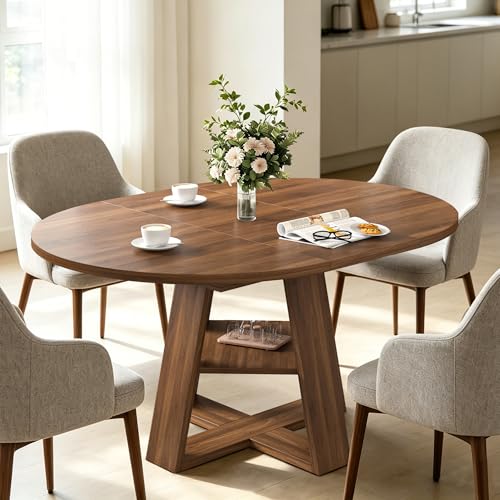
43.3"-59" Extendable Round Oval Dining Table for 4-8 with Storage Shelf | Modern Kitchen Oval Dining Table with Removable Leaves,Space Saving Extendable Table Wood Base for Kitchen Living Room Walnut
Check price on Amazon
41 in-78 in Extendable Dining Room Table for 4-8, Round Expandable Kitchen Table with Fluted Base, Modern Farmhouse Oval Dinner Tables for Dining Room Kitchen Living Room (Natural)
Check price on Amazon
71-87 Inch Extendable Dining Room Table, Rustic Wooden Kitchen Table 6-10 | STHOUYN Expandable Dining Table, Farmhouse Rustic Style, Rectangular Wooden Top, Seats 6-10, Brown Kitchen or Dining Room
Check price on Amazon
ONBRILL 41-78 Inch Extendable Dining Table for 4-8, Storage Shelf, Walnut | Expandable Kitchen Table with Fluted Base, Mid Century Modern Oval Dinner Tables for Dining Room, Kitchen, Living Room
Check price on Amazon
DONGMUWUJEE Solid Wood Small Dining Table for 2-6, 23.6"L-47.2"L Expandable Kitchen Table, Designed for Small Spaces, Easy Assembly, Suitable for Kitchen, Dining Room, Living Room, Apartment (Walnut)
Check price on Amazon
GarveeHome 63-83" Extendable Dining Table, Industrial Rectangular Dining Room Table for 6-8 People, Expandable Kitchen Table with Heavy Duty Metal Frame for Dining Room, Kitchen & Parties, Brown
Check price on AmazonDesign Tips for Expandable Kitchen Tables
Once the table is in place, a few design choices make the space feel intentional rather than improvised:
- Keep the expansion path clear. Avoid placing the table where an open leaf will block a doorway or trap a chair. Mark the expanded footprint on the floor with tape before you commit.
- Choose chairs that tuck fully under. Armless chairs and benches slide in completely, preserving walkway space. Benches are especially efficient for expandable tables because they scale with the table length.
- Anchor the table with lighting. A pendant or linear fixture centered over the table defines the dining zone in an open-plan kitchen. Lower the fixture to roughly 30–36 inches above the tabletop.
- Use a protective pad if leaves are stored. Felt pads and a fitted table pad protect the surface when leaves are swapped in and out.
- Coordinate with surrounding storage. A slim sideboard or wall shelf keeps serving pieces nearby without crowding the table. Our buffets and sideboards guide covers storage options that pair well with expandable tables.
For kitchens that open directly into a dining area, define the zones with a rug or a change in flooring. This helps a compact expandable table read as a deliberate dining space rather than an afterthought. If you are planning a larger dining room as well, the dining tables buying guide covers fixed and expandable options side by side.
Care and Maintenance Essentials
Expandable tables have moving parts, so maintenance focuses on both the surface and the mechanism:
- Wipe spills promptly, especially on veneer and laminate surfaces, to prevent moisture from reaching seams.
- Dust and lubricate sliding tracks and hinges periodically with a dry silicone spray or paraffin wax. Avoid oily lubricants that attract dust.
- Check screws and bolts on the frame and leg assemblies every few months; expansion mechanisms put stress on joints over time.
- Store separate leaves flat in a dry location, ideally in a protective sleeve, to prevent warping.
- Use coasters and trivets to protect wood and veneer finishes from heat and condensation.
For a fuller routine, our care and maintenance section covers wood polishing, upholstery cleaning, and hardware upkeep for dining furniture.
Frequently Asked Questions
What is an expandable kitchen table?
It is a dining table designed with a mechanism that increases the surface area when needed — typically through hinged leaves, sliding panels, or removable extension boards. It stays compact for everyday meals and extends for guests.
What types of expansion mechanisms are available?
Common mechanisms include self-storing butterfly leaves, separate extension leaves, drop-leaf designs, sliding telescoping panels, and traditional gate-leg supports. Each differs in convenience, storage needs, and stability.
How do I choose the right size expandable kitchen table?
Measure both the collapsed and expanded footprints, allow at least 30 inches of clearance around the table for chairs, and plan roughly 24 inches of table width per seated diner. Check that the expanded size does not block walkways or doors.
Are expandable kitchen tables durable?
Durability depends on construction. Premium and luxury tier models with solid wood frames and high-grade steel hardware hold up to years of repeated extension. Entry-level models suit lighter, occasional use.
Can an expandable kitchen table work in a small space?
Yes — this is their primary strength. Drop-leaf and butterfly-leaf designs keep a small footprint during daily use and extend only when needed, making them ideal for apartments and compact kitchens.
Ready to Choose Your Expandable Kitchen Table?
Review the recommended options above, compare mechanisms and construction tiers, and match the table to your space and hosting habits.
EXPLORE OPTIONS