
Mid Century Sideboard: The Complete Buying Guide & Design Tips
Everything you need to know before choosing a mid century sideboard for your dining room — from materials and sizing to storage features, styling, and long-term care.
START THE GUIDEWhat You Will Learn on This Page
- What Makes a Sideboard Mid Century?
- Why a Mid Century Sideboard Belongs in Your Dining Room
- Materials and Construction: What to Look For
- Sizing and Proportions for Your Space
- Storage Layouts: Doors, Drawers, and Open Shelving
- Understanding Quality Tiers
- Styling Your Mid Century Sideboard
- Care and Maintenance Essentials
- Quick Buying Checklist
- Frequently Asked Questions
What Makes a Sideboard Mid Century?
The mid century modern movement, which flourished from the mid-1940s through the late 1960s, reshaped furniture design with a philosophy that favored clean lines, functional forms, and honest materials. The sideboard — also called a credenza — became one of its signature pieces. A true mid century sideboard is recognizable by several design hallmarks:
- Tapered and splayed legs: Legs that narrow toward the floor and angle outward, often in wood or brass-tipped finishes.
- Clean, uninterrupted surfaces: Minimal carving or ornamentation, letting the wood grain and silhouette speak.
- Sliding doors and recessed pulls: Hardware is discreet, often integrated into the door edge rather than protruding.
- Asymmetrical balance: Many designs mix drawers and cabinet doors in an offset arrangement.
- Warm wood tones: Walnut, teak, rosewood, and oak with a natural or oiled finish are the classic choices.
If you are exploring the broader aesthetic, our guide to mid century design principles covers the movement's history and how it translates to modern dining spaces. The sideboard sits naturally alongside other iconic pieces such as the mid century modern table and mid century modern upholstered dining chairs.
Why a Mid Century Sideboard Belongs in Your Dining Room
A sideboard is more than storage. In a dining room, it acts as a serving station, a display surface, and a visual anchor. The mid century interpretation adds a distinct advantage: its low, horizontal profile makes rooms feel wider and more open, while the elevated legs allow light to pass underneath.
Practical benefits include:
- Serving surface: A dedicated spot for platters, carafes, and dessert before guests sit down.
- Tableware storage: Keeps dinnerware, linens, and serveware within arm's reach of the table.
- Decluttering: Drawers and closed cabinets hide everyday items that would otherwise crowd the tabletop.
- Style continuity: Ties together other mid century pieces, from the mid century style dining table to midcentury dining chairs.
Materials and Construction: What to Look For
The material story is central to mid century design. Understanding what you are looking at will help you judge whether a piece is built to last.
Solid Wood vs. Veneer
Authentic mid century sideboards were often built from solid walnut or teak, or from high-quality veneers over plywood — a technique that was considered premium at the time, not a shortcut. Modern reproductions range widely:
- Solid hardwood: The most durable option. Walnut and oak are common. Expect visible grain variation and the ability to refinish.
- High-quality veneer over engineered wood: Can mimic the look faithfully and resist warping. Check that edges are banded and seams are tight.
- Thin laminate over particle board: Typically an entry-level construction. Fine for light use but less forgiving over time.
Joinery and Hardware
Look for dovetail or mortise-and-tenon joints in drawers and frames. Soft-close hinges and full-extension drawer glides are signs of thoughtful construction. Solid brass or powder-coated steel hardware resists tarnishing better than thin plated alternatives.
Finish
Oiled finishes feel warm and can be spot-repaired; lacquered finishes offer more surface protection but are harder to touch up. For dining rooms where spills are possible, a satin lacquer or conversion varnish is a practical choice.
Sizing and Proportions for Your Space
Scale is the most common mistake buyers make. A sideboard that is too large crowds the room; one that is too small looks lost. Use these guidelines:
| Consideration | Guideline | Best For |
|---|---|---|
| Length relative to table | Roughly two-thirds the length of the dining table | Visual balance |
| Walkway clearance | At least 24–36 inches around the front | Comfortable movement |
| Standard depth | 15–18 inches | Most dining rooms |
| Narrow depth | 12–14 inches | Compact or hallway-adjacent spaces |
| Height | 28–32 inches at the top surface | Serving comfort and sightlines |
If your room is tight, a narrow sideboard or a narrow buffet cabinet preserves floor space while still providing storage. For a broader comparison of storage-driven dining furniture, see our guide to modern buffet cabinets.
Storage Layouts: Doors, Drawers, and Open Shelving
The internal configuration matters as much as the exterior. Think about what you plan to store:
- Sliding doors: Space-efficient and quintessentially mid century. Best for larger items like platters and stacked plates.
- Drawers: Ideal for flatware, napkins, placemats, and small serving tools. Look for felt-lined or divided options.
- Open shelving: Displays favorite ceramics and glassware but demands tidiness. Often combined with closed sections in an asymmetrical layout.
- Adjustable shelves: A practical feature that lets you reconfigure for tall vases or stacked bowls.
A common mid century layout pairs a central bank of drawers with flanking cabinet doors. If you entertain often, prioritize a wide, uninterrupted top surface for buffet service.
Understanding Quality Tiers
Mid century sideboards span a wide range of construction quality. Rather than focusing on numbers, it helps to understand the tiers of the market and what each typically delivers:
Entry-Level Tier
Engineered wood with laminate or thin veneer, basic hardware, and simple assembly. Suitable for light use and renters. Well-specified for the category, but expect fewer adjustable shelves and simpler joinery.
Mid-Range Tier
Quality veneers over engineered wood or mixed solid-wood frames, soft-close hardware, and better internal organization. A balanced tier that offers durable construction for everyday dining room use.
Premium Tier
Solid hardwood construction, dovetail drawers, premium materials, and refined finishes. Often produced in smaller batches or by established furniture makers. A long-term investment piece.
Luxury Tier
Hand-finished solid walnut or teak, custom hardware, and exacting joinery. These pieces are typically made to order and designed to be passed down. Commercial-grade durability in a residential form.
Styling Your Mid Century Sideboard
The sideboard top is a styling opportunity, but restraint is the mid century way. A few principles:
- Work in odd numbers: Group three objects of varying heights rather than pairing things symmetrically.
- Leave negative space: Empty surface area lets the wood grain and silhouette breathe.
- Mix textures: Combine ceramic, glass, and a natural element such as a small plant or dried branches. Our guide to mixed materials explains how to balance contrasting surfaces.
- Anchor with art: Hang a single large piece or a small gallery arrangement above, keeping the bottom edge 8–12 inches above the sideboard.
- Use a tray: Corrals small items like candlesticks and a bowl, making cleanup easy.
For tabletop accents, consider modern table runners or a modern dining table centerpiece that echoes the sideboard's palette. If you are building a cohesive mid century dining room, pair the sideboard with a mid century table and modern mid century table option for a unified look.
Care and Maintenance Essentials
A well-cared-for sideboard will outlast most other furniture in the room. Basic habits make the difference:
- Dust regularly with a soft, slightly damp cloth. Avoid abrasive cleaners on wood surfaces.
- Use coasters and trivets for hot dishes and drinks to prevent ring marks and heat damage.
- Control humidity: Solid wood expands and contracts. Keep the room between 35–55% relative humidity where possible.
- Avoid direct sunlight, which can fade and dry the finish over time. Use curtains or blinds during peak hours.
- Re-oil oiled finishes every 6–12 months with a furniture-grade oil to maintain the surface.
- Check hardware periodically and tighten screws on hinges and pulls.
For deeper guidance, see our care and maintenance section, which covers wood polish, scratch repair, and humidity control in detail.
Quick Buying Checklist
Before you commit, run through this list:
- Measure twice: Confirm wall length, walkway clearance, and door swing.
- Check the back: If the sideboard will be visible from behind, confirm it has a finished back panel.
- Test the doors and drawers: They should glide smoothly and close flush.
- Inspect the joinery: Look for dovetails, dowels, or mortise-and-tenon joints rather than staples alone.
- Confirm shelf adjustability: Especially if you store tall items.
- Verify the finish: Ask whether it is oiled, lacquered, or veneered, and how to maintain it.
- Plan delivery: Check door widths and stair turns for large pieces.
- Consider the tier: Match construction quality to your intended use and how long you plan to keep the piece.
Ready to Choose Your Mid Century Sideboard?
Browse curated options that match the construction, sizing, and style principles covered in this guide.
EXPLORE RECOMMENDED OPTIONSRecommended Mid Century Sideboards & Credenzas
⚠️ AFFILIATE DISCLOSURE: This website contains affiliate links. As an affiliate Associate, we earn from qualifying purchases. If you make a purchase through these links, we may receive a small commission at no additional cost to you. Read our full affiliate policy.

Bme Sideboard Georgina Solid Wood 2 Doors & 3 Drawers, 61'' Mid Century Modern Cabinet with Geometric Pattern for Kitchen, Dining, Living Room
Check price on Amazon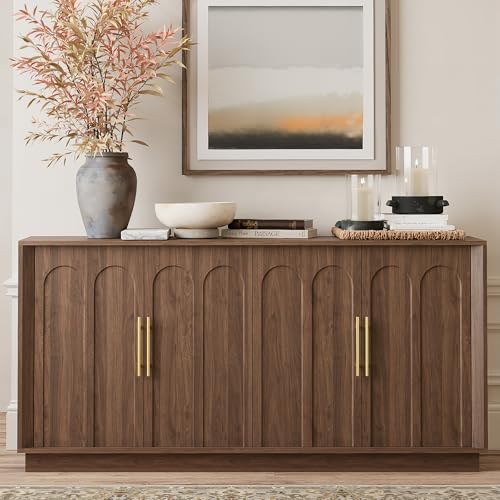
FORTUNETEC 67" Sideboard Buffet Cabinet with Storage, Arched Doors, Walnut | Mid Century Modern Accent Cabinet with Wood Gain, Modular Media Console, Credenza for Living Dining Room Kitchen Entryway
Check price on Amazon
Bme Georgina Sideboard 2 Doors & 3 Drawers, Mid Century, Teak Brown, 61" | Solid Acacia Wood - Geometric Pattern - Mid Century Modern Cabinet - Adjustable & Removable Shelves
Check price on Amazon
VASAGLE Storage Cabinet, Sideboard with Adjustable Shelves | Mid-Century Modern Buffet Cabinet, 55.1 x 15.7 x 29.5 Inch, for Living Room, Walnut, MIRIANA Collection ULSC631KX01
Check price on Amazon
LKTART 47" Real Wood Veneer Sideboard Buffet Cabinet with Storage Drawers | Mid Century Modern Sideboard Buffet Cabinet with Solid Wood Frame&Legs,Accent Storage Cabinet with 2 Doors and 3 Drawers
Check price on Amazon
Nasonet 55" Sideboard Buffet Cabinet, Retro Storage Cabinet, Walnut | Mid-Century Style, Rounded Corners, Solid Wood Legs, 4-Door Credenza Sideboard Buffet for Dining Room Living Room Entryway
Check price on Amazon
Walker Edison Mid-Century Modern Wood Kitchen Buffet Sideboard Entryway Serving Storage Cabinet Doors Dining Room Console, 70 Inch, Walnut
Check price on Amazon
OneBlis 63" Fluted Sideboard Buffet Cabinet with Sliding Door, Mid-Century Modern Wood Sideboard, Adjustable Shelf, Coffee Bar Cabinet with Storage for Kitchen, Walnut
Check price on AmazonFrequently Asked Questions
What defines a mid century sideboard?
A mid century sideboard is characterized by clean lines, tapered legs, splayed angles, minimal ornamentation, and a balance between form and function. It typically features sliding doors, drawers, or open shelving, and is crafted from materials like walnut, teak, or oak with a natural finish.
How do I choose the right size sideboard for my dining room?
Measure the available wall space and aim for a sideboard that leaves at least 24 to 36 inches of clearance around it for walkways. As a general guideline, a sideboard should be roughly two-thirds the length of your dining table for visual balance. Consider depth: standard sideboards are 15 to 18 inches deep, while narrower options suit compact spaces.
What materials are best for a mid century sideboard?
Solid walnut and teak are the most authentic mid century materials, prized for their warm grain and durability. Oak offers a more accessible entry point. Veneered engineered wood can be a good value within its tier if the construction is solid. Avoid particle board with thin laminate if you want longevity.
How can I style a mid century sideboard?
Keep the top surface uncluttered. Use a mix of heights: a low bowl or tray, a tall vase or lamp, and one or two decorative objects. Hang artwork or a mirror above it, and leave negative space so the sideboard's lines remain visible. Inside, use drawer dividers and shelf risers to keep tableware organized.
Is a mid century sideboard the same as a credenza?
In modern usage the terms are largely interchangeable. Historically, a credenza referred to a sideboard with doors used in dining rooms, while a sideboard could have a mix of drawers and doors. Both describe the same low, horizontal storage piece in a mid century context.