
Modern Buffet Cabinet: The Complete Buying & Styling Guide
Everything you need to know about choosing a modern buffet cabinet — from materials and storage configurations to proportion rules and styling techniques that elevate your dining room.
START EXPLORINGWhat Is a Modern Buffet Cabinet?
A modern buffet cabinet — also called a modern sideboard or contemporary buffet — is a low, wide storage and serving piece designed for the dining room. Unlike traditional buffets with ornate carvings, decorative moldings, and heavy hardware, the modern iteration embraces clean geometry, flat or subtly textured surfaces, and a disciplined approach to ornamentation.
The modern buffet cabinet serves three functions simultaneously: it stores dinnerware, linens, and serving pieces; it provides a surface for buffet-style serving during gatherings; and it acts as a visual anchor that grounds the dining room composition. The best modern buffets balance generous storage with an uncluttered silhouette that feels intentional rather than merely empty.
Contemporary designs often blur the line between buffet and sideboard, and the terms are used interchangeably in most furniture catalogs. What matters is the function: closed storage below, a serving surface above, and a form that complements modern dining tables and chairs. If you are still selecting your dining table, our guide to the modern dining room table can help you establish proportions before you commit to a buffet.
Key distinction: A traditional buffet typically features raised-panel doors, carved legs, and decorative hardware. A modern buffet cabinet uses flush or slab doors, minimal or integrated pulls, and legs that are either straight and tapered or fully recessed for a floating look.
Why a Modern Buffet Cabinet Belongs in Your Dining Room
The dining room is one of the few spaces in a home that must perform both daily and occasionally. A modern buffet cabinet bridges that gap by keeping everyday items accessible while providing a staging area for entertaining. Consider what a well-chosen buffet actually solves:
- Dedicated storage: Dinnerware, glassware, flatware, table linens, and serving platters all need a home that is not the kitchen pantry. A buffet keeps these items in the room where they are used.
- Serving surface: During dinner parties, the buffet top becomes a secondary staging area for dishes, drinks, and desserts, keeping the dining table clear for seated guests.
- Visual balance: A dining room with only a table and chairs can feel incomplete. A buffet adds visual weight and anchors the room's composition.
- Style statement: A well-designed modern buffet contributes to the overall aesthetic more than almost any other dining room piece, second only to the table itself.
For smaller dining rooms where a full buffet feels excessive, a narrow buffet cabinet offers the same functional benefits in a more compact footprint. And if your dining area doubles as a workspace or homework station, a buffet with closed storage helps conceal the clutter that accumulates on open shelving.
Modern Buffet Styles: Finding Your Aesthetic
Modern is a broad term. Within the modern buffet category, several distinct stylistic directions exist, each with its own material palette, detailing, and visual temperament. Identifying which direction suits your dining room is the first real decision in the buying process.
Minimalist Modern
Minimalist buffets are defined by what they omit. Slab doors with no visible hardware, recessed plinths instead of legs, and a single material or a restrained two-tone palette. The form is geometric and the surface is smooth. These pieces work best in rooms that already have strong architectural lines or a disciplined color palette. If this sounds like your aesthetic, our guide to the modern minimalist dining room explores the broader design context.
Mid-Century Modern
Mid-century buffets feature tapered legs, warm wood tones (especially walnut and teak), and often a mix of door and drawer configurations with subtle asymmetry. The silhouette is lower and longer than other modern styles. For a cohesive dining room, pair a mid-century buffet with a mid-century modern table and upholstered dining chairs. If you are exploring this style further, the mid-century sideboard guide covers the specific characteristics of this category.
Modern Farmhouse
This style softens the hard edges of modern design with warmer textures and a slightly more relaxed feel. Expect wood-grain finishes, subtle shaker-style door frames, and hardware in matte black or antique brass. A modern farmhouse buffet pairs naturally with a modern farmhouse dining table and can be styled with a modern table runner for casual gatherings.
Glam & Luxe Modern
High-gloss lacquer finishes, mirrored fronts, metallic accents, and stone or glass tops define the glam modern buffet. These pieces are designed to catch light and serve as a focal point. They work best in dining rooms with generous space and a deliberate lighting plan — perhaps anchored by a modern chandelier for the dining room.
Industrial Modern
Exposed metal frames, riveted details, reclaimed wood surfaces, and open shelving define this style. Industrial modern buffets are often heavier in appearance and work well in loft-style or open-concept dining rooms. They pair comfortably with mixed-material dining sets; our guide to mixed materials in dining furniture explores this approach in depth.
Materials & Finishes: What to Look For
The material of your modern buffet cabinet affects its durability, maintenance requirements, and visual weight in the room. Use the table below to compare the most common options available across entry-level, mid-range, and premium tiers.
| Material | Characteristics | Best For | Tier Availability |
|---|---|---|---|
| Solid Walnut | Rich grain, warm tone, repairable surface | Mid-century and minimalist rooms | Premium to luxury |
| Solid Oak | Strong grain, light-to-medium tone, very durable | Farmhouse and industrial rooms | Mid-range to premium |
| Lacquered MDF | Smooth uniform finish, available in any color | Minimalist and glam rooms | Entry-level to mid-range |
| Wood Veneer | Real wood surface over engineered core, stable | Most modern styles | Entry-level to premium |
| Tempered Glass | Reflective, visually light, easy to clean | Small rooms and glam styles | Mid-range to premium |
| Stone or Sintered Top | Scratch and heat resistant, heavy, distinctive | Luxury and formal dining rooms | Premium to luxury |
| Powder-Coated Metal | Frames, legs, and hardware; durable finish | Industrial and minimalist rooms | All tiers |
A few practical notes on material selection:
- Solid wood can be refinished if scratched, making it a long-term investment. Veneers cannot be sanded aggressively but are more stable in humid climates.
- Lacquered finishes in high-gloss are striking but show fingerprints and require gentle cleaning. Matte lacquer is more forgiving.
- Glass tops visually shrink the piece, which helps in small rooms, but require regular polishing to avoid smudges.
- Metal hardware should be solid and smoothly operating. A mid-range buffet with well-made hinges will outlast an entry-level piece with thin hardware.
Storage Configurations: Matching the Cabinet to Your Collection
The interior layout of a modern buffet cabinet matters as much as its exterior. Before choosing, inventory what you actually need to store and how often you need to access it.
Door Configurations
- Two-door: The most common configuration. Suitable for dinnerware sets, linens, and medium-sized serving pieces. Look for adjustable interior shelves.
- Three-door: Offers a wider storage area, often with a central section for taller items. Good for households with large platters or stemware.
- Four-door: Maximizes capacity and suits long walls. Works best in dining rooms with sufficient clearance.
- Sliding doors: Save clearance space in front of the cabinet, making them useful in narrow dining rooms.
Drawer Configurations
Drawers are ideal for flatware, napkins, placemats, and smaller accessories. A buffet with a mix of drawers and doors offers the most flexible storage. Soft-close drawer glides are a hallmark of mid-range and premium construction; entry-level models may use standard glides that operate less smoothly.
Open Shelving and Display
Some modern buffets incorporate open sections for displaying decorative objects, cookbooks, or a few select pieces of dinnerware. Open shelving reduces concealed storage but adds visual interest and lightens the piece. If you prefer an uncluttered look, choose a buffet with predominantly closed storage and use the top surface for display instead.
Interior Features to Look For
- Adjustable shelves (essential for accommodating different heights)
- Felt-lined drawers (protects flatware and glassware)
- Wine storage inserts or racks (if you entertain frequently)
- Cable management cutouts (if the buffet will host small appliances or a bar setup)
- Ventilation gaps (for electronics or humidity-sensitive items)
Sizing & Proportion: Getting the Dimensions Right
A modern buffet cabinet that is too large will crowd the dining room; one that is too small will look lost. Use the following guidelines as a starting point, then adjust for your specific room.
Width Relative to the Dining Table
The most reliable proportional rule is to choose a buffet that is approximately two-thirds the width of your dining table. If your table seats six and measures around 72 inches, a buffet in the 45–50 inch range provides visual balance. A buffet significantly wider than the table can overwhelm the room; a much narrower one may look incidental.
Height
Most modern buffets stand between 30 and 36 inches high. This range aligns with standard dining table height (30 inches) and allows comfortable serving. Taller buffets (36–40 inches) can work as a visual counterpoint to a low dining table, but they may feel heavy in small rooms. For reference, compare the buffet height to your modern dining chairs — the buffet surface should sit at or slightly below the chair back height.
Depth
A depth of 15–20 inches is standard. Deeper buffets (20–24 inches) provide more usable surface but consume more floor space. Shallow buffets (12–15 inches) are ideal for hallways or narrow dining rooms but may not accommodate large platters.
Clearance
Allow at least 36 inches of clearance in front of the buffet for opening doors and drawers and for people to stand while serving. In tighter rooms, 30 inches is workable if the buffet has sliding doors or if drawers open only partway.
| Dining Table Seats | Typical Table Width | Suggested Buffet Width | Suggested Buffet Height |
|---|---|---|---|
| 4 | 48–54 inches | 32–40 inches | 30–32 inches |
| 6 | 60–72 inches | 40–50 inches | 30–34 inches |
| 8 | 72–84 inches | 50–60 inches | 32–36 inches |
| 10+ | 84–96+ inches | 60–72 inches | 32–36 inches |
These are starting points, not rules. Room shape, window placement, and circulation paths all influence the final decision. If your dining room is narrow, a narrow sideboard may be a better fit than a full-width buffet.
Placement & Layout: Where the Buffet Belongs
The most common placement for a modern buffet cabinet is against the longest uninterrupted wall in the dining room, opposite or perpendicular to the dining table. This creates a balanced composition and keeps the serving surface accessible without disrupting circulation.
Common Layouts
- Opposite the table: The classic arrangement. The buffet faces the dining table, creating a symmetrical focal point. Works best when the wall is long enough to accommodate the buffet plus some breathing room on either side.
- Perpendicular to the table: Useful in square rooms or when a window occupies the far wall. The buffet becomes a side element rather than a focal point.
- Floating: In open-concept spaces, a freestanding buffet can act as a room divider between the dining area and living space. This requires a finished back panel — check before buying.
- In a niche or alcove: A buffet that fits precisely into an architectural niche looks custom and saves floor space.
What to Avoid
- Placing the buffet where it blocks a doorway or primary circulation path.
- Positioning it directly under a window if the buffet is tall enough to obscure the view or interfere with curtains.
- Placing it too close to a heat source (fireplace, radiator) — this can damage wood and finishes over time.
- Blocking electrical outlets you may need for lighting or small appliances.
If your dining room is part of an open plan, consider how the buffet relates to adjacent furniture. A buffet that is too tall or visually heavy can disrupt the flow between the dining area and the modern kitchen island with seating and storage.
Styling Your Modern Buffet Cabinet
A modern buffet is a serving surface, a display area, and a visual anchor. Styling it well requires restraint and a clear eye for proportion. The goal is composition, not clutter.
The Three-Object Rule
Group objects in threes of varying heights and widths. A tall vase, a medium bowl, and a low tray create a triangle of visual interest that feels balanced. Repeat this grouping at the other end of the buffet for symmetry, or use a single larger arrangement in the center for a more minimalist look.
What to Display
- A table lamp or pair of lamps: Adds warmth and layers light. Choose a scale appropriate to the buffet width.
- A mirror or artwork above: A mirror doubles the visual space and reflects light; artwork adds color and personality. Keep the bottom edge of the frame at least 6–8 inches above the buffet top.
- A bowl or tray: Useful for corralling keys, mail, or serving pieces. A modern dining table centerpiece style can be adapted for the buffet surface.
- Candlesticks or a small sculpture: Adds vertical interest without weight.
- Seasonal accents: Rotate a few pieces to keep the display fresh.
What to Avoid
- Covering the entire surface — leave at least one-third clear for actual serving use.
- Displaying too many small objects, which reads as clutter rather than collection.
- Hanging artwork too high above the buffet; it should feel connected to the piece below.
- Using objects that are all the same height or all the same material.
Lighting the Buffet
Buffets benefit from layered lighting: a pair of table lamps for ambient light, a picture light or wall sconce above for accent, and possibly a small task light if the buffet doubles as a bar or coffee station. If your dining room has a modern chandelier, ensure the buffet lighting complements rather than competes with it.
Care & Maintenance
A modern buffet cabinet is an investment in your dining room. Protect it with a few simple habits.
Wood and Veneer
- Dust regularly with a soft, dry cloth. Avoid silicone-based polishes that can build up.
- Wipe spills promptly with a damp cloth and dry immediately.
- Use coasters and trivets under hot or wet items.
- Keep the buffet out of direct sunlight to prevent fading and uneven aging.
- Maintain indoor humidity between 35% and 55% to prevent wood from cracking or warping.
Lacquer and Gloss Finishes
- Clean with a soft cloth dampened with mild soapy water. Avoid abrasive cleaners.
- Dry immediately with a lint-free cloth to prevent water spots.
- Use felt pads under objects placed on the surface.
Glass and Stone Tops
- Use a glass cleaner or a stone-specific cleaner as appropriate.
- Avoid placing hot items directly on glass or stone; use trivets.
- Clean stone surfaces with a pH-neutral cleaner to avoid etching.
Metal Hardware
- Wipe with a soft damp cloth. Dry immediately.
- Avoid abrasive pads that can scratch the finish.
- Check hinges and drawer glides periodically; tighten screws as needed.
Frequently Asked Questions
What is a modern buffet cabinet?
A modern buffet cabinet is a streamlined storage and serving piece for the dining room, defined by clean lines, minimal ornamentation, and functional design. It typically features flat-panel doors, integrated handles, and a mix of closed storage and open display space.
How do I choose the right size buffet cabinet for my dining room?
Measure the available wall space and leave at least 36 inches of clearance in front for opening doors and drawers. A general guideline is to choose a buffet that is roughly two-thirds the width of your dining table for visual balance. If space is tight, a narrow or tall slim model may be more appropriate.
What materials are best for a modern buffet cabinet?
Popular modern materials include solid walnut or oak, lacquered MDF, high-grade veneers, tempered glass, and brushed or matte metal. The best choice depends on your desired aesthetic, durability needs, and maintenance preferences. Solid wood is the most repairable over time; veneers and lacquer are more stable in fluctuating humidity.
Can a modern buffet cabinet work in a small dining room?
Yes. Choose a narrow or wall-mounted model with vertical storage, lighter finishes, and minimal hardware. A narrow buffet cabinet or a tall, slim sideboard can provide substantial storage without overwhelming a compact space. Sliding doors also reduce the clearance needed in front of the cabinet.
Should the buffet match the dining table?
Not necessarily. In a modern dining room, a buffet can harmonize with the table through shared wood tone, complementary material, or consistent scale without matching exactly. A mixed-material approach often looks more current than a matched set. What matters most is that the buffet feels proportional to the table and intentional within the room's design.
What is the difference between a buffet and a sideboard?
In modern furniture, the terms are largely interchangeable. Historically, a buffet was taller and used for serving, while a sideboard was slightly lower and used for storage. Today, modern buffet cabinets often combine both functions. Focus on dimensions and storage configuration rather than the label.
Ready to Choose Your Modern Buffet Cabinet?
Explore our recommended modern buffet cabinets and sideboards from trusted retailers. Each piece is selected for design integrity, material quality, and functional storage.
Explore OptionsRecommended Modern Buffet Cabinets & Sideboards
⚠️ AFFILIATE DISCLOSURE: This website contains affiliate links. As an affiliate Associate, we earn from qualifying purchases. If you make a purchase through these links, we may receive a small commission at no additional cost to you. Read our full affiliate policy.

VASAGLE Storage Cabinet, Sideboard with Adjustable Shelves | Mid-Century Modern Buffet Cabinet, 55.1 x 15.7 x 29.5 Inch, for Living Room, Walnut, MIRIANA Collection ULSC631KX01
Check price on Amazon
VASAGLE Storage Cabinet, Sideboard with Adjustable Shelves | Mid-Century Modern Buffet Cabinet, 55.1 x 15.7 x 29.5 Inch, for Living Room, Black, MIRIANA Collection ULSC631BE01
Check price on Amazon
FORTUNETEC 67" Sideboard Buffet Cabinet with Storage, Arched Doors, Black | Modern Minimalist Accent Cabinet with Wood Gain, Modular Media Console, Credenza for Living Dining Room Kitchen Entryway
Check price on Amazon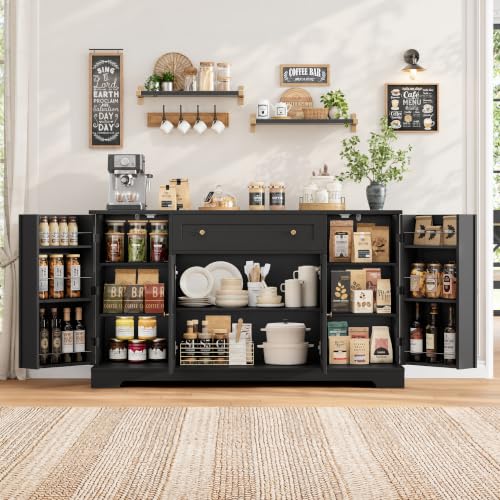
HITHOS 54" W Kitchen Buffet Cabinet with Storage, Coffee Bar Cabinet, Black | Dual Swing-Out Door Racks, Drawer & Adjustable Shelves, Modern Sideboard Storage Cabinet for Kitchen Living Room
Check price on Amazon
usikey 55" Buffet Cabinet with Storage and Drawers, Large Sideboard Buffet Cabinet with Adjustable Shelves and Doors, Modern Coffee Bar for Kitchen, Living Room, White
Check price on Amazon
63" Buffet Cabinet with Faux Marble Top, Curved Sides, 4 Doors, Walnut | Mid Century Modern Sideboard Cabinet, Adjustable Shelves, Large Storage Credenza for Dining Room, Living Room, Entryway
Check price on Amazon