
Sideboard Storage Cabinet: The Complete Buying Guide
Learn how to choose a sideboard storage cabinet that combines generous storage, durable construction, and refined dining room style — with expert guidance on doors, drawers, materials, and sizing.
Why a sideboard storage cabinet matters: A well-chosen sideboard does more than hold dishes. It anchors the dining room, keeps serving pieces within reach, and reduces clutter during meals and gatherings. This guide walks you through every decision — from door style to drawer configuration — so you can buy with confidence.
What a Sideboard Storage Cabinet Does for Your Dining Room
A sideboard storage cabinet is a low, wide piece of dining room furniture designed to hold dinnerware, linens, serveware, and glassware while providing a flat top surface for serving food or displaying decor. Unlike a simple buffet, a true storage cabinet typically features a combination of closed doors, open drawers, and sometimes glass-front sections that let you showcase your collection.
The best sideboards solve three problems at once. First, they keep everyday dining items organized and within easy reach. Second, they add a visual anchor to the dining room wall, balancing the table and seating arrangement. Third, they extend your serving area during holidays and dinner parties, reducing trips to the kitchen.
If you are still exploring the broader category, our guide to sideboards and dining room storage pieces covers the full range of options, while the comparison of sideboard and buffet cabinets explains how the two formats differ in function and layout.
Key Configurations: Doors, Drawers, and Open Shelves
The internal layout of a sideboard storage cabinet is the single biggest factor in how useful it will be day to day. Before comparing finishes or styles, decide which configuration matches the way you live and entertain.
Solid Door Cabinets
Best for concealing clutter and protecting contents from light. Solid doors are ideal for busy family dining rooms where the cabinet holds everyday plates, serving bowls, and table linens. Many buyers pair solid doors with interior adjustable shelves for flexible storage.
Glass Door Cabinets
Designed for display. Glass-front sections let you show off china, stemware, or decorative pieces while keeping them dust-free. Consider a sideboard cabinet with glass doors if display is a priority in your dining room.
Drawer-Focused Layouts
Drawers are ideal for flatware, napkins, placemats, and small accessories. A sideboard cabinet with drawers offers quicker access than shelves and keeps small items tidy and organized.
Combination Cabinets
The most versatile choice: drawers in the center for flatware and linens, cabinets on either side for larger pieces, and sometimes an open shelf or wine rack. A sideboard buffet layout often uses this hybrid approach.
For a refined look in lighter interiors, a white sideboard cabinet brightens the room and pairs well with warm wood tables. For farmhouse or cottage interiors, a rustic sideboard adds texture and character. If you prefer a sculptural silhouette, explore a curved sideboard that softens hard lines in modern dining rooms.
Sizing and Placement: Getting the Proportions Right
Proportion is critical. A sideboard that is too small will look lost against a large wall; one that is too large can crowd the dining table and block circulation. Use these guidelines as a starting point:
- Height: Most sideboard cabinets stand 30 to 36 inches high, roughly level with the dining table. Taller cabinet-style sideboards reach 40 inches or more for additional vertical storage.
- Depth: Typical depths range from 15 to 20 inches. Deeper cabinets hold platters and large serving pieces more easily; shallower cabinets suit narrow dining rooms and hallways.
- Width: A common rule is that the sideboard should be roughly two-thirds the width of the dining table, though wall space often dictates the final choice.
- Clearance: Leave at least 36 inches of walking space between the sideboard and the table so chairs can pull out comfortably.
If your dining room is compact, a narrow sideboard table can provide storage and a serving surface without overwhelming the space. For a full room layout, pair your cabinet with a table chosen from our small dining room solutions, where space-saving proportions are covered in detail.
Materials and Build Quality: What to Look For
Build quality determines how a sideboard storage cabinet ages. Look beyond the surface finish and examine the structure, hardware, and joinery:
- Solid wood: Durable and repairable. Solid hardwood frames and door fronts resist wear and can be refinished over time. Expect heavier weight and a long-term investment.
- Engineered wood: Stable and consistent, often used for cabinet bodies with solid wood or veneer fronts. Quality engineered wood with reinforced joinery performs well in mid-range and premium pieces.
- Veneers: A thin layer of real wood over a stable core. High-grade veneers offer the look of solid wood with greater dimensional stability.
- Hardware: Soft-close hinges, full-extension drawer slides, and solid metal pulls are hallmarks of well-specified cabinets. Heavy-duty hardware matters in households that open drawers daily.
- Back panels and shelf supports: A reinforced back panel reduces wobble, and adjustable shelf supports let you reconfigure storage as your collection changes.
When comparing options, our guide to sideboards with drawers highlights how drawer construction and glide quality affect everyday usability.
Comparing Sideboard Storage Cabinets by Tier
To compare options fairly without focusing on numeric figures, use market tier descriptors. The table below summarizes what each tier typically delivers in a sideboard storage cabinet.
| Tier | Typical Construction | Best For | Key Trade-Offs |
|---|---|---|---|
| Entry-Level | Engineered wood with laminate or paper veneer, basic hinges, standard drawer slides | First apartments, guest rooms, occasional-use dining spaces | Lighter build; limited adjustability; simpler hardware |
| Mid-Range | Engineered wood with real wood veneer, soft-close hinges, partial-extension drawers | Everyday family dining rooms, balanced storage needs | Better hardware and finishes; fewer solid wood components |
| Premium | Solid wood frames with veneered panels, full-extension soft-close drawers, adjustable shelving | Frequent entertaining, long-term dining room investment | Heavier piece; requires more careful placement and care |
| Luxury | Solid hardwood construction, dovetail joinery, premium hardware, hand-finished surfaces | Formal dining rooms, design-led interiors, heirloom-quality purchases | Highest investment; specialized care may be needed |
In practice, a mid-range cabinet often offers the best balance for most households: soft-close hardware and real wood veneers deliver a refined feel without the weight and upkeep of full solid hardwood. Premium and luxury tiers make sense when the sideboard is a focal point and you plan to keep it for many years. Our buying guides section covers additional strategies for comparing furniture tiers.
Sideboard Storage Cabinet Buying Checklist
- Measure the wall, doorway, and walking clearance before choosing a width.
- Confirm door configuration: solid, glass, or a combination.
- Check that drawers use full-extension or soft-close slides if used daily.
- Verify adjustable shelving so the interior adapts to platters and tall items.
- Inspect hardware quality — hinges, pulls, and leveling feet.
- Choose a finish that suits your dining room palette and cleaning routine.
- Plan the top surface: serving, display, or both.
- Consider cable access if you plan to place a lamp or charging station on top.
Recommended Sideboard Storage Cabinets
⚠️ AFFILIATE DISCLOSURE: This website contains affiliate links. As an affiliate Associate, we earn from qualifying purchases. If you make a purchase through these links, we may receive a small commission at no additional cost to you. Read our full affiliate policy.

usikey 55" Buffet Cabinet with Storage and Drawers, Large Sideboard Buffet Cabinet with Adjustable Shelves and Doors, Modern Coffee Bar for Kitchen, Living Room, White
Check price on Amazon
HOSTACK Kitchen Buffet Cabinet with Storage, Sideboard Coffee Bar, White | Farmhouse Kitchen Storage Cabinet with 3 Drawers & Adjustable Shelf & Doors, 42.5"W Buffet Table for Dining Living Room
Check price on Amazon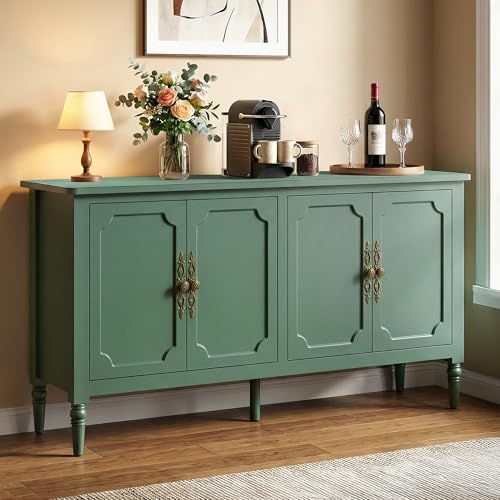
RoyalCraft Buffet Cabinet with Storage, 59" Painted Sideboard Coffee Bar | Vintage Kitchen Storage Cabinet with Adjustable Shelves, Mid Century Modern Credenza for Dining& Living Room, Entryway, Green
Check price on Amazon
IFGET 92.63" W Modern Arched Sideboard Buffet Cabinet with Storage, Natural | Fluted Arch Sideboard Cabinet w/Adjustable Shelves, Wooden Modular Kitchen Cabinet for Dining& Living Room, Entryway
Check price on Amazon
Homhedy Coffee Bar Storage Cabinet with Drawers, Kitchen Buffet Cabinet | Sideboard Cabinet with Doors, Farmhouse Buffet Cabinet, Adjustable Shelves, for Kitchen / Dining / Living Room, White
Check price on Amazon
Joaxswe Sideboard Buffet Cabinet with Storage, 46" Arc-Shaped Credenza | 3 Doors & Adjustable Shelves, Stable Leg, Mid Century Modern Coffee Bar Cabinet for Kitchen, Living Room, Entryway, Dark Wood
Check price on Amazon
VASAGLE Storage Cabinet, Sideboard with Adjustable Shelves | Mid-Century Modern Buffet Cabinet, 55.1 x 15.7 x 29.5 Inch, for Living Room, Walnut, MIRIANA Collection ULSC631KX01
Check price on Amazon
HOSTACK 60" W Sideboard Buffet Cabinet with Storage, Kitchen Cabinet, White | 36 Tall Kitchen Buffet Storage Cabinet with 4 Drawer, Large Coffee Bar Cabinet, Modern Buffet Table for Dining Living Room
Check price on AmazonStyling the Top Surface of Your Sideboard
The top of a sideboard storage cabinet is prime real estate. Treat it as a functional display zone rather than a catch-all surface. A common approach is to create a focal point in the center — a vase, a bowl, or a pair of candle holders — and keep the edges relatively clear for serving.
For serving occasions, leave roughly half the surface open for platters and beverages. A tray corrals small items and makes it easy to clear the surface quickly. For everyday display, layer heights: a taller vase or lamp behind, a low bowl in front. This creates depth without clutter.
Complement the cabinet with table styling pieces from our table setting guide, and consider a serveware collection that can move from cabinet to table during meals. If you like a centered decorative arrangement, a simple centerpiece works well on both the sideboard and the dining table.
Care and Maintenance for Long-Term Performance
A sideboard storage cabinet sits in a high-traffic area, so a little routine care goes a long way:
- Dust weekly with a soft, dry cloth. Avoid abrasive pads on veneered surfaces.
- Control humidity in the dining room to prevent wood movement and veneer lifting.
- Use coasters and trivets on the top surface for hot dishes and wet glasses.
- Keep away from direct sunlight to reduce fading and uneven finish wear.
- Address scratches promptly — see our scratch repair tips for safe methods on wood and veneer.
- Check hardware annually and tighten hinges or pulls as needed.
With consistent care, a quality sideboard storage cabinet can serve as the organizational and visual centerpiece of the dining room for many years.
Frequently Asked Questions
What is the difference between a sideboard and a buffet?
The terms are often used interchangeably. Traditionally, a buffet is a larger serving piece with a wider top for holding dishes during meals, while a sideboard is a storage-focused cabinet with doors and drawers. Modern sideboard storage cabinets blend both functions, offering ample storage plus a serving surface.
How tall should a sideboard storage cabinet be?
Most sideboard cabinets stand between 30 and 36 inches high, which aligns closely with standard dining table height and makes the top surface comfortable to use for serving. Taller cabinet-style sideboards can reach 40 inches or more for added vertical storage.
Should I choose glass doors or solid doors?
Glass doors are ideal for displaying dinnerware, glassware, and collectibles while keeping them dust-free. Solid doors conceal clutter and protect contents from light, making them a better choice for everyday storage and busy family dining rooms. Many premium sideboards combine both door types.
How do I care for a wooden sideboard cabinet?
Dust regularly with a soft cloth, keep the cabinet away from direct sunlight and heat sources, and use coasters or trivets under hot or wet items. Apply a wood conditioner a few times a year for solid wood pieces, and address scratches promptly with proven repair techniques.
Final thought: A sideboard storage cabinet is one of the most practical investments you can make in a dining room. Prioritize the door and drawer configuration you will actually use, confirm the proportions fit your wall and walking space, and choose a tier that matches your long-term plans. With those three decisions settled, the rest — finish, style, and styling details — falls into place naturally.