
Table with Leaf: The Complete Guide to Extendable Dining Tables
Everything you need to know about tables with leaf extensions — the mechanisms, the leaf types, the sizing logic, and how to choose a design that fits both everyday meals and special occasions.
Start ExploringWhy a table with leaf matters: A dining table with a leaf gives you two tables in one. It stays compact for daily use, then extends to welcome extra guests when you host. Understanding how leaves work helps you pick a design that feels effortless rather than fiddly.
What Is a Table with Leaf?
A table with leaf is a dining table built with one or more extension panels — called leaves — that expand the usable surface when needed. In everyday mode the table sits at its base size. When guests arrive, you deploy the leaf to gain seating and serving space. The concept is simple, but the execution varies widely across designs, and that variation is where most buying decisions are won or lost.
Extendable dining tables have become a staple of modern homes because they solve a real problem: most households do not host a crowd every night, but nearly every household hosts a crowd sometimes. Rather than committing floor space to a table large enough for the biggest gathering of the year, a leaf table adapts to the occasion. If your dining area is on the compact side, you may also want to browse ideas for tables for small spaces and compare them against extendable options before deciding.
The term "leaf" covers several distinct designs. Some leaves fold and hide inside the table itself. Others hinge down at the sides. Others are separate panels stored in a closet or a dedicated compartment. Each approach has a different footprint, a different level of convenience, and a different impact on how the table looks and feels in the room.
Why Homeowners Choose a Leaf Table
The appeal of a table with leaf comes down to three practical benefits that recur across nearly every buying conversation:
- Adaptability without a second table. One piece of furniture covers both intimate weeknight dinners and holiday gatherings. No need for a folding table stashed in the garage.
- Better use of floor space. A compact base footprint keeps traffic lanes clear, which matters in open-plan homes and apartments where the dining zone shares space with the kitchen or living area.
- Long-term flexibility. Households change. A leaf table can accommodate a growing family or a rotating cast of dinner guests without requiring a furniture replacement.
The trade-off is mechanical complexity. A fixed table is a slab and four legs. A leaf table adds hinges, slides, latches, or folding mechanisms, all of which need to operate smoothly and hold up over years of use. That is why the quality of the mechanism deserves as much attention as the tabletop material.
The Main Types of Table Leaves
Three leaf designs dominate the market. Each is a genuinely different product experience, so it helps to understand the mechanics before comparing specific models.
Butterfly Leaf (Self-Storing)
A butterfly leaf is a two-panel leaf that folds in half and stores inside the table body, usually beneath the top or within a central cavity. When you need the extension, you pull the table halves apart and the folded leaf unfolds into place. When you are done, it folds back and disappears.
This is the most convenient design for households that extend and retract frequently, because there is no separate panel to store and no risk of losing it. The trade-off is that the internal storage cavity adds some bulk to the table body, and the folding hardware needs to be well engineered to avoid rattles or stiffness over time. In the mid-range and premium tiers, butterfly mechanisms are typically smoother and more precisely aligned than in entry-level models.
Drop Leaf (Hinged Sides)
A drop leaf hinges at the table edge and folds down vertically when not in use. With both leaves down, the table can be surprisingly narrow — narrow enough to function as a console or a compact breakfast spot. Fold one leaf up and you have a modest dining surface. Fold both up and the table is fully extended.
Drop leaf designs are the classic solution for very tight rooms, and they pair naturally with wall placement. The trade-off is that the folded-down leaves occupy vertical space at the table's sides, which can interfere with chair placement when partially deployed. Many drop leaf tables also require support legs or brackets for the raised leaves, which affects knee clearance. If compact dining is your priority, the broader category of tables for 2 offers additional shapes and layouts worth comparing.
Separate Extension Leaf
A separate extension leaf is a standalone panel inserted into the center of the table after the two halves are pulled apart. It usually lives in a closet, a storage bag, or a dedicated drawer. This design is common on traditional and formal tables, where the leaf is expected to be deployed for holiday meals and stored away for the rest of the year.
The advantage is simplicity: fewer moving parts in the table itself, and a cleaner look when the leaf is out. The disadvantage is handling. A separate leaf can be heavy, awkward to maneuver alone, and easy to damage if stored carelessly. It also requires storage space, which not every home has. For formal settings, though, this design often delivers the most polished appearance. You can see how it fits into a broader traditional aesthetic by exploring traditional dining tables.
At a Glance: Leaf Type Comparison
| Leaf Type | Storage | Best For | Consideration |
|---|---|---|---|
| Butterfly leaf | Self-storing inside table | Frequent extending and retracting | Relies on quality folding hardware |
| Drop leaf | Folds down at the sides | Very tight rooms and dual-use surfaces | Folded leaves limit chair clearance |
| Separate extension leaf | Stored externally | Occasional formal entertaining | Handling and storage space required |
Sizing a Table with Leaf Correctly
The most common mistake with extendable tables is sizing only the extended configuration, or only the compact one. Both states matter, because the table will live in both states. A leaf table that is perfect for the holidays but awkward every other day of the year is not a good fit.
Measure the Base Footprint First
Start with the dimensions the table will occupy in its everyday, unextended state. Then add clearance for chairs pulled out, for walking behind seated guests, and for any nearby furniture or doorways. A useful rule is to allow roughly 36 inches between the table edge and the nearest wall or obstruction when chairs are occupied. If your room cannot accommodate that clearance at base size, the table is too large regardless of how well the leaf works.
Then Measure the Extended Footprint
Next, map out the fully extended footprint and check it against the room's limits. Pay particular attention to doorways, traffic paths, and any fixed elements like a kitchen island. In many homes, the extended configuration is used only occasionally and can encroach on circulation space temporarily — but it should still be physically possible to seat people comfortably. A table that extends into a wall is not usable.
Seating Capacity and Leaf Depth
Seating capacity depends on both table width and leaf depth. A typical leaf adds enough surface to seat two additional guests, one at each end of a rectangular table. Deeper leaves can sometimes seat two per side in the extension zone, but this depends on the table's width and the spacing between place settings. As a general guide, each seated guest needs about 24 inches of table edge width for comfortable dining.
For smaller rooms, the sizing challenge is tighter, and it is worth reviewing small-space table strategies alongside leaf-table measurements. For narrow layouts, a two-person table with a drop leaf can often outperform a larger fixed table on both comfort and floor-space efficiency.
Recommended Table with Leaf Products
⚠️ AFFILIATE DISCLOSURE: This website contains affiliate links. As an affiliate Associate, we earn from qualifying purchases. If you make a purchase through these links, we may receive a small commission at no additional cost to you. Read our full affiliate policy.

41 in-78 in Extendable Dining Room Table for 4-8, Round Expandable Kitchen Table with Fluted Base, Modern Farmhouse Oval Dinner Tables for Dining Room Kitchen Living Room (Walnut)
Check price on Amazon
MECHYIN 55"-71" Extendable Dining Table for 4-8 with Built-in Flip Leaf | Space‑Saving Modern Rectangle Dining Table, Built‑in Flip Leaf, Sturdy Metal Legs, for Kitchen & Dining Room,Small Apartments
Check price on Amazon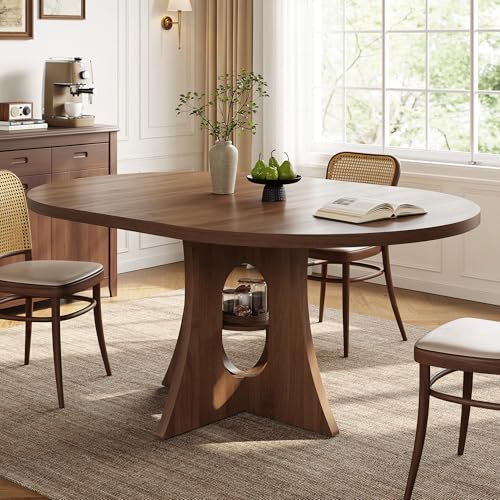
Sanyz 43.3"-59" Extendable Round-to-Oval Dining Table with Leaf & Storage | Oval Table, Round Kitchen Table, Seats 4-8, Modern Farmhouse, Space-Saving, Walnut Finish, Circle Table, Oval Dining Table
Check price on Amazon
IDEALHOUSE FoldingTable, Drop Leaf Dining Table with 6 Wheels and 2-Layer Storage Shelf, Space Saving Table for Small Spaces (Dark Walnut, 50.1" D x 31.4" W x 29.5" H)
Check price on Amazon
ONBRILL 42"-106" Extendable Dining Table for 2-10 with Storage Legs, Walnut | Mid-Century Modern Oval Extendable Dining Table with 4 Removable Leaves, Round Dinner Table for Dining Room, Kitchen
Check price on Amazon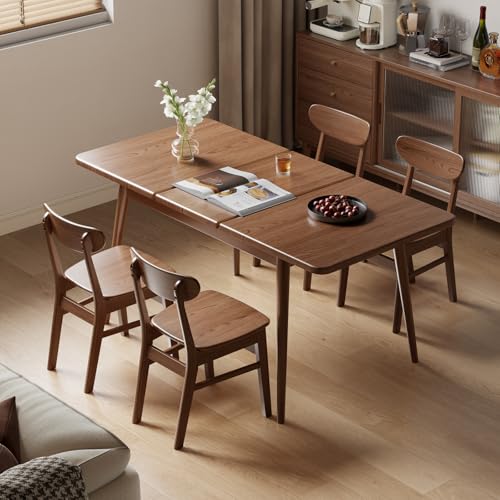
Muwuele 47"-63" Solid Wood Extendable Dining Tables for 4-8, Walnut | Compact Expandable Kitchen Table, Easy Assembly, Mid Century Modern, Dinner Table for Small Space, Dining Room, Apartment
Check price on Amazon
COMUHOME Drop Leaf Folding Dining Table with Storage, Wheels, Space Saving | Foldable Design, 18mm Thick Plywood, 300 lbs Capacity, Locking Wheels, Farmhouse Style, for Living Room Kitchen Small Spaces
Check price on AmazonMaterials and Construction to Look For
Leaf tables endure repeated movement, so construction quality matters more than it does on a fixed table. A few details separate designs that age gracefully from those that develop rattles, sticking slides, or misaligned surfaces.
Tabletop Materials
Solid wood remains the benchmark for leaf tables because it tolerates the repeated movement of hinges and slides without delaminating. Hardwoods such as oak, maple, and walnut are common in the mid-range and premium tiers. Engineered wood tops with quality veneers are also viable, particularly in the entry-level tier, provided the core is dense and the veneer is properly bonded.
Glass and stone tops change the equation. A tempered glass dining table can be elegant, but the leaf mechanism must be designed specifically for glass, and glass leaves are heavy and require careful handling. Stone tops, including marble-top tables, are visually striking but add weight that stresses the extension hardware. If you are drawn to a natural wood look, it is worth reading about sustainable wood sourcing before you commit, since leaf tables are long-lived purchases.
Mechanism Quality
The mechanism is where a leaf table earns or loses its keep. Look for smooth-gliding steel or aluminum slides, positive latches that lock the table in both positions, and tight tolerances that keep the tabletop surfaces flush when the leaf is deployed. Entry-level tables often use simpler friction-based slides, while mid-range and top-tier designs tend to use geared or ball-bearing slides that operate with less effort.
Wooden slides can work well in traditional designs but demand more maintenance. Metal-to-metal slides with proper lubrication are generally more consistent over time. Whichever you choose, test the mechanism in person if possible, or read reviews that specifically mention long-term operation.
Leg and Frame Construction
Extension tables concentrate stress at the frame joins. Reinforced corner blocks, sturdy aprons, and legs that are firmly attached with both glue and mechanical fasteners are signs of a solid build. On drop leaf tables, pay attention to the support brackets or gate legs — these carry the load of the raised leaf and should feel substantial rather than flimsy.
If the design uses a trestle or pedestal base, check how the base interacts with the extension mechanism. Trestle bases can be very stable and visually elegant; the trestle dining table category includes several leaf-equipped designs. Turned-leg tables offer a more traditional silhouette, and turned-leg dining tables are worth exploring if classic styling is your preference.
Matching a Leaf Table to Your Dining Room
A leaf table has to work in two visual states, which is a design consideration in its own right. The compact configuration should look intentional, not like a table waiting to be fixed. The extended configuration should feel proportionate to the room rather than crowding it.
Shape and Proportion
Rectangular tables are the most common leaf designs because the extension axis is straightforward. Round and oval tables can also incorporate leaves, though the mechanics are more complex and the resulting shape may shift between circular and oval depending on leaf deployment. A tall circle table or a tulip table demonstrates how shape choices interact with room layout, even when those specific designs are not leaf-equipped.
In open-plan homes, the table is often visible from the kitchen or living area. A table that looks elegant at base size is a stronger choice than one that reads as a folded-up compromise. Drop leaf designs tend to look best against a wall, while butterfly and separate-leaf tables usually sit centered in the dining zone.
Style Direction
The leaf mechanism is largely invisible in use, but the overall style should match the room. Farmhouse settings suit painted or distressed wood finishes. Modern minimalist rooms favor clean-lined tables with hidden mechanisms. Traditional rooms gravitate toward formal wood tones and separate leaves. If you are leaning toward a specific aesthetic, browsing dining room styles can help you see how different table silhouettes sit within a complete room.
Pairing with Seating
Seating needs to accommodate both table states. Chairs that tuck neatly under the base table may crowd each other when the leaf is deployed, so check chair spacing in both modes. Upholstered chairs add comfort for longer dinners and can soften a hard-edged extension table. The upholstered chair category covers a wide range of compatible seating. Benches are another option — a bench can slide along one side and adapt well to changing table lengths, and the table and bench seat pairing is especially practical for casual family dining.
Which Households Benefit Most from a Leaf Table?
Leaf tables are not the right answer for every home, but they excel in several common situations.
Small Dining Rooms
In a compact dining room, a table with leaf lets you maintain a usable everyday footprint while retaining the ability to host. This is the classic use case, and it remains the strongest argument for the category. Drop leaf designs are particularly effective here because the table can be pushed against a wall with the leaves down. If your space is genuinely tight, the strategies in small dining room guides can help you place the table, chairs, and storage without crowding.
Households That Host Occasionally
Families who host holidays, birthdays, or periodic dinner parties benefit from the ability to scale up without dedicating permanent floor space to a large table. A butterfly leaf is usually the most convenient choice in this scenario, since there is no separate panel to store.
Open-Plan Homes
In open-plan layouts, the dining table is on display much of the time. A leaf table that looks refined in its compact state keeps the visual footprint modest while preserving entertaining capacity. Pairing the table with a cohesive seating arrangement — perhaps an upholstered bench with back on one side — keeps the open-plan dining zone looking purposeful.
Multi-Generational and Flexible Households
Homes where the number of people at the table changes regularly — adult children visiting, grandparents joining for Sunday dinner, remote workers using the table as a desk during the week — get outsized value from an extendable design. The table adapts to the week's rhythm rather than forcing a compromise.
Restaurant and Commercial Settings
Commercial dining spaces also use leaf tables to reconfigure quickly for different party sizes. Heavy-duty mechanisms and commercial-grade construction matter more in this context. If you are equipping a hospitality space, the considerations in table and chairs for restaurant guides are relevant even though the home market is the primary focus here.
A Practical Buying Checklist
Before committing to a specific table with leaf, run through the following checks. Each one addresses a failure mode that buyers commonly discover only after the table is in the home.
- Measure both states. Confirm that the base footprint fits everyday life and the extended footprint fits the largest gathering you realistically expect.
- Test the mechanism in person. If buying online, look for reviews that describe long-term mechanism performance, not just the first week.
- Confirm storage. Self-storing leaves need no storage; separate leaves do. Decide whether you have a safe place to keep a panel.
- Check surface alignment. A well-made leaf table holds its surfaces flush. Misalignment causes wobbling plates and annoys guests.
- Assess chair clearance. Make sure chairs tuck in and pull out comfortably in both configurations, and that the extended table does not trap anyone against a wall.
- Match the material to your lifestyle. Solid wood handles repeated movement best; glass and stone require more care with the mechanism.
- Plan the seating. Decide whether you will use chairs, a bench, or a mix, and confirm the counts work in both table states.
- Review the warranty and parts availability. Hinges and slides are the parts most likely to need service over time, so parts availability matters.
If your decision is between several leaf designs, it can help to compare them with adjacent categories. A traditional dining table with a separate leaf, a teak dining table with a butterfly mechanism, and a trestle dining table with a drop leaf each occupy different positions on the convenience-versus-formality spectrum.
Caring for a Table with Leaf
Maintenance for a leaf table is mostly about the mechanism and the surfaces at the seams. A few habits extend the life of the table considerably.
- Keep the slides clean. Dust and crumbs accumulate in the track. Wipe it periodically and lubricate according to the manufacturer's guidance.
- Operate the leaf gently. Forcing a butterfly leaf or a drop leaf stresses hinges and latches. If it resists, stop and check alignment rather than pushing harder.
- Protect the seams. The joints between the table halves and the leaf are vulnerable to moisture. Use table pads or trivets under hot dishes, especially near the seams.
- Store separate leaves properly. Keep the panel flat, dry, and away from direct sunlight to prevent warping. A dedicated storage bag is worthwhile.
- Attend to finish care. Solid wood tops benefit from periodic conditioning. Follow the finish-specific guidance for the material you choose, and avoid harsh cleaners on veneered surfaces.
If the table is used outdoors or in a sunroom, the care requirements shift. Weather exposure is hard on mechanisms, and outdoor-capable designs should be specified for it. Comparing with tile outdoor dining tables or tiled outdoor dining tables can clarify how outdoor leaf designs differ from interior ones.
Frequently Asked Questions
What is a table with leaf?
A table with leaf is a dining table that includes one or more extension panels, called leaves, that expand the usable surface area when additional seating or serving space is needed. The leaf may be self-storing, hinged, or a separate panel.
What are the main types of table leaves?
The main types are butterfly leaves that fold and store inside the table, drop leaves that hinge down at the sides, and separate extension leaves that are stored elsewhere and inserted into the center of the table.
How much extra seating does a leaf add?
A typical leaf adds enough surface to seat two additional guests, one at each end of a rectangular table. The exact number depends on the table width, leaf depth, and the spacing you allow between place settings.
Are table with leaf designs suitable for small dining rooms?
Yes. Butterfly and drop leaf designs are especially well suited to small rooms because the table can remain compact for everyday use and expand only when guests arrive. Drop leaves in particular allow the table to sit against a wall with minimal footprint.
Which leaf type is easiest to use regularly?
A butterfly leaf is generally the most convenient for frequent extension because it stores inside the table and requires no separate handling. Separate extension leaves are better suited to occasional use.
Can a leaf table be used outdoors?
Only if it is designed for outdoor use. Interior leaf mechanisms are vulnerable to moisture and temperature swings. Outdoor leaf tables use weather-resistant hardware and finishes.
Final Thoughts
A table with leaf is one of the most practical furniture investments a dining room can hold. It solves the mismatch between everyday space and occasional capacity, and it does so without demanding a second table. The key is to treat the mechanism as seriously as the tabletop: choose a leaf type that matches how often you extend, measure both the compact and extended footprints, and confirm that seating works in both states.
If you are still narrowing down the field, the simplest path is to decide your leaf type first, then compare materials and mechanism quality within that category. A well-chosen extendable table can serve a household for decades, adapting as the guest list grows and shrinks.