
Expanding Table Guide: Flexible Dining Solutions for Every Home
Discover how expanding tables work, the differences between leaf styles and extension mechanisms, and how to choose the right model for small spaces, family dinners, and holiday hosting.
Explore Recommended ModelsWhy an expanding table matters: An expanding table gives you two tables in one — a compact everyday surface and a generous gathering space when guests arrive. This guide walks you through every decision point, from leaf storage to seating capacity, so you can buy with confidence.
What Is an Expanding Table?
An expanding table — also called an extendable table or extension dining table — is a dining table engineered to increase its surface area on demand. Most models use one of three approaches: butterfly leaves that fold out from the center, self-storing leaves that slide underneath the tabletop, or separate leaves that are inserted manually and stored elsewhere.
The core appeal is versatility. In daily use, a compact expanding table seats two to four people comfortably. When family or friends arrive, the same table can extend to seat six, eight, or even twelve diners. This makes it one of the most practical furniture investments for apartments, open-plan homes, and households that host intermittently.
If you are starting your research broadly, our dining tables buying hub covers foundational sizing and material advice, while this page focuses specifically on the expanding category.
Types of Expanding Tables
Expanding tables are not a single design — the extension mechanism dramatically affects convenience, storage needs, and long-term durability. Here are the main categories:
Self-Storing Leaf Tables
The extension leaves are built into the table and stored underneath the top or within the frame. No closet space needed, and the leaves are always available. Ideal for apartments where storage is limited.
Convenience Tier: TopButterfly Leaf Tables
A hinged leaf folds out from the center, then the two halves of the top slide together. Quick to deploy and space-efficient, though the folding mechanism requires periodic care.
Convenience Tier: HighSeparate Leaf Tables
One or more loose leaves are inserted into the center and stored separately. Often the most structurally robust option and common in traditional solid wood designs.
Stability Tier: HighDrop-Leaf Tables
Side panels fold down to shrink the footprint, then lift up to expand. Excellent for kitchens and breakfast corners where floor space is tight. See our drop-leaf dining room table guide for details.
Space-Saving Tier: TopExtendable Round Tables
Circular tops that split and accept a leaf to become oval or larger round surfaces. Great for conversation-friendly layouts. Compare with round self-storing models.
Aesthetic Tier: BalancedExpandable Kitchen Tables
Smaller-scale tables designed for kitchens and breakfast nooks, often with bench seating. See the expandable kitchen table overview for compact layouts.
Compact Tier: EssentialExtension Mechanism Comparison
| Mechanism | Best For | Storage Requirement | Ease of Use | Typical Tier |
|---|---|---|---|---|
| Self-storing leaves | Apartments and homes with limited storage | None — leaves stay with table | Very easy | Mid-range to premium |
| Butterfly leaf | Frequent small-to-medium expansions | None | Easy, one-person | Entry-level to mid-range |
| Separate leaves | Formal dining and large gatherings | Closet or under-bed space | Moderate, often two-person | Mid-range to luxury |
| Drop-leaf panels | Kitchens and tight footprints | None | Easy | Essential to mid-range |
| Round-to-oval extension | Conversation-focused dining rooms | Depends on leaf type | Moderate | Mid-range to high-end tier |
Sizing an Expanding Table Correctly
Getting the dimensions right is the single most important step before buying. An expanding table that is too large in its closed position will crowd your room, while one that extends too little will not solve your hosting needs.
- Measure the closed footprint first. Allow at least 36 inches of clearance on all sides for chair pull-out and walkways. In tight rooms, 30 inches is a workable minimum.
- Plan the extended footprint. Mark the extended length and width on the floor with painter's tape. Confirm that chairs can still be pulled back when the table is fully open.
- Calculate seating by width. As a general rule, allow 24 inches of table edge per person. A table extended to 84 inches comfortably seats six to eight diners.
- Check ceiling fixtures. If you have a pendant or chandelier centered over the table, verify it still sits over the table center when extended — or choose an asymmetric layout.
For very small rooms, our guide to the extendable dining table for small spaces dives deeper into layouts, and the table that seats twelve guide covers large-format hosting.
Materials and Build Quality
The extension mechanism is only as good as the materials around it. When evaluating an expanding table, pay attention to the top material, the frame joinery, and the sliding hardware.
- Solid wood tops offer the most durable construction and can be refinished over time. Look for reinforced corner blocks and a stable apron.
- Veneered and engineered tops resist warping well and are common in mid-range models. Check that edges are sealed to prevent moisture ingress.
- Glass and stone tops bring a modern look but demand careful handling around metal extension tracks. See extendable glass options for compact rooms.
- Hardware quality separates tiers: entry-level models may use simple wood-on-wood slides, while mid-range and premium models use metal ball-bearing glides for smoother, longer-lasting operation.
Our durable dining table guide explains joinery and finish checks in more detail, and the extendable wood dining table page focuses on natural timber options.
Buying Checklist: What to Verify Before You Decide
Extension travel distance
Confirm how much extra length each leaf adds and how many leaves are included. Multiply by your per-person seating rule.
Mechanism smoothness
Look for metal glides, locking pins, or geared tracks. Avoid mechanisms that bind or require excessive force.
Leaf storage
Self-storing designs eliminate closet clutter. Separate-leaf models need a dry, flat storage spot to prevent warping.
Tabletop thickness
Thicker tops feel more substantial and resist sagging when fully extended. Check that leaves match the main top thickness.
Leg placement
Corner legs maximize legroom. Trestle or pedestal bases can interfere with chair placement at the ends.
Seam alignment
When extended, leaf seams should sit flush. Uneven seams catch crumbs and indicate loose hardware.
Weight and mobility
Expanding tables are heavier than fixed tables. Consider felt pads or casters if you will move it often.
Warranty coverage
Confirm whether the extension mechanism itself is covered — it is the most common failure point.
Matching an Expanding Table to Your Room Style
An expanding table should look intentional in both its closed and extended states. Style matching matters as much as function:
- Modern farmhouse: pair a distressed wood expanding table with bench seating. Browse modern farmhouse dining tables and farmhouse dining tables for inspiration.
- Small-space contemporary: a glass or white-lacquered expandable table keeps visual weight low. See small-space dining sets.
- Round and conversation-friendly: an extendable circle table works well in square rooms and open-plan corners.
- Bench seating: an extendable table with bench and chairs maximizes seating along one side and tucks neatly under the table when closed.
If you are also refreshing the surrounding furniture, our dining room furniture guide and dining room sets collection cover complementary pieces.
Care Tips for Expanding Tables
Expanding tables last decades when the mechanism and seams are maintained properly. A few habits go a long way:
- Lubricate metal slides and hinges once or twice a year with a dry silicone lubricant — avoid oil-based products that attract dust.
- Always extend and retract with two people when the table is large, to prevent racking the frame.
- Store separate leaves flat and in a dry room; standing them on edge can cause warping over time.
- Wipe seams after meals so crumbs do not work into the track.
- Use coasters and trivets on all surfaces, especially near leaf joints where finish can wear faster.
For a complete routine, see our durable dining table care notes and the care and maintenance hub.
Editor's Pro Tip
Before buying, physically extend the table in the showroom — or watch a video of the mechanism online. A smooth extension you can perform alone in under a minute is the difference between a table you use for every gathering and one you avoid because it is a chore.
Recommended Expanding Tables & Extension Dining Models
⚠️ AFFILIATE DISCLOSURE: This website contains affiliate links. As an affiliate Associate, we earn from qualifying purchases. If you make a purchase through these links, we may receive a small commission at no additional cost to you. Read our full affiliate policy.

HOMBIX Expandable Table, Extendable Dining Table for 2-12 People, Walnut | Expandable Design, Built-In Leaf Storage, Thanksgiving & Gatherings, Apartment Friendly
Check price on Amazon
Extendable Dining Table with Charging Station, Convertible Folding Console Table for 6-8 People, Space-Saving Dining Table with LED Lights, Wood Rectangle Kitchen Table for Homes, Walnut (No Chairs)
Check price on Amazon
41 in-78 in Extendable Dining Room Table for 4-8, Round Expandable Kitchen Table with Fluted Base, Modern Farmhouse Oval Dinner Tables for Dining Room Kitchen Living Room (Walnut)
Check price on Amazon
19.6"-118.1" Modern Extendable Dining Table with Built-in Outlet | Expandable Dining Space for 2-12 People, Space-Saving Design, for Parties, Weddings & Meetings
Check price on Amazon
41 in-78 in Extendable Dining Room Table for 4-8, Round Expandable Kitchen Table with Fluted Base, Modern Farmhouse Oval Dinner Tables for Dining Room Kitchen Living Room (Natural)
Check price on Amazon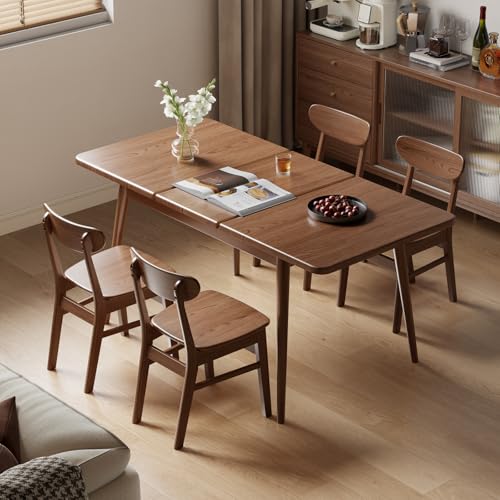
Muwuele 47"-63" Solid Wood Extendable Dining Tables for 4-8, Walnut | Compact Expandable Kitchen Table, Easy Assembly, Mid Century Modern, Dinner Table for Small Space, Dining Room, Apartment
Check price on Amazon
IDEALHOUSE FoldingTable, Drop Leaf Dining Table with 6 Wheels and 2-Layer Storage Shelf, Space Saving Table for Small Spaces (Slate Oak, 50.1" D x 31.4" W x 29.5" H)
Check price on AmazonFrequently Asked Questions
How much extra space does an expanding table need when fully open?
Plan for the table's extended length plus at least 36 inches of clearance on every side for chair pull-out and walkways. In tight rooms, 30 inches is workable but reduces comfort.
Are self-storing leaf tables as sturdy as separate-leaf tables?
Modern self-storing designs use reinforced tracks and locking pins that are very stable. Premium and high-end tier models generally match the rigidity of separate-leaf tables, while entry-level self-storing models may flex slightly under heavy loads.
Can one person extend a large dining table alone?
Butterfly-leaf and many self-storing designs can be extended by one person. Large separate-leaf tables are best handled by two people to avoid twisting the frame or dropping a heavy leaf.
What is the best expanding table for a small apartment?
A drop-leaf or butterfly-leaf model with self-storing leaves is usually the best fit, because it needs no extra storage and shrinks to a compact footprint. See our small-space extension table guide for layout ideas.
How many people can an extended table seat?
Allow about 24 inches of edge per person. A table extended to 72 inches seats six comfortably, 84 inches seats six to eight, and 96 inches or more can seat eight to ten depending on chair width and leg placement.
Final Thoughts
An expanding table is one of the smartest purchases for a home that hosts occasionally but lives daily in a compact footprint. Prioritize the extension mechanism, measure both closed and extended dimensions, and choose a leaf style that matches your storage reality. Do that, and your expanding table will serve everyday breakfasts and holiday dinners with equal ease.
Ready to compare specific models? Browse our curated recommendations above, or explore the broader dining tables and extendable tables collections for more options.