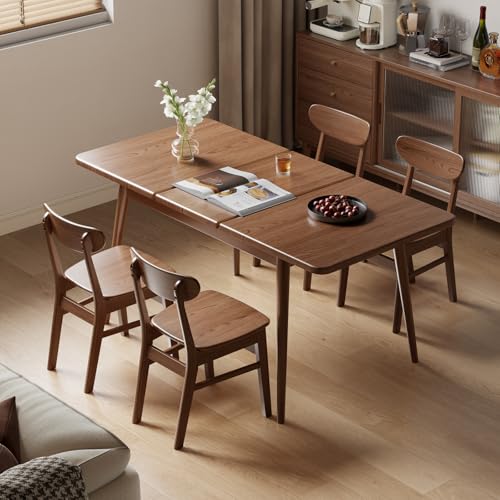
Extendable Kitchen Table: The Complete Buying Guide
Everything you need to know about choosing, using, and styling an extendable kitchen table — from extension mechanisms and materials to sizing and daily practicality.
Why an extendable kitchen table deserves your attention: A kitchen table is the hardest-working piece of furniture in most homes. It serves as a breakfast spot, a homework station, a prep surface, and a gathering place. An extendable kitchen table solves the age-old dilemma of needing a compact table for daily life but a larger surface for holidays, dinner parties, and family visits. This guide walks you through every decision point so you can choose with confidence.
What Is an Extendable Kitchen Table?
An extendable kitchen table is a dining table designed with a mechanism that increases its surface area when needed. The most common approach is adding one or more leaves — removable or self-storing panels that slot into the table's center or ends. When the extra space is no longer required, the table returns to its compact footprint.
Unlike a fixed table, an extendable model adapts to your life. It can seat two to four people comfortably on a normal day, then expand to accommodate six, eight, or more when guests arrive. This flexibility makes it particularly valuable in kitchens and dining areas where floor space is limited but entertaining is frequent.
If you are still exploring the broader category, our guide to expandable tables covers the full range of expanding furniture options, while this page focuses specifically on kitchen-oriented extendable models.
Extension Mechanisms: Butterfly, Drop Leaf, and Separate Leaf
The mechanism is the heart of any extendable kitchen table. It determines how easy the table is to expand, where the leaf is stored, and how seamless the surface feels when extended. There are three main types to understand.
Butterfly Leaf (Self-Storing Leaf)
A butterfly leaf is hinged in the middle and folds inward, storing itself inside the table when not in use. To extend the table, you pull the two halves apart and the leaf unfolds automatically. This is the most convenient mechanism because there is no separate leaf to store and no risk of misplacing it. Mid-range and premium extendable kitchen tables frequently use butterfly leaf systems because they offer a clean, self-contained solution.
For a closer look at this mechanism, see our guide to the dining table with butterfly leaf.
Drop Leaf
Drop-leaf tables have hinged sections on one or both ends that fold down vertically when not needed. When folded, the table can function as a console or a compact two-person table. When raised, the surface doubles or triples. Drop-leaf designs are excellent for very tight kitchens because the folded table occupies minimal depth. The trade-off is that the folded sections are visible and may limit where the table can be placed against a wall.
Separate Leaf (Removable Leaf)
A separate leaf is a panel that is inserted into the table's center or end and stored elsewhere — often in a closet or behind a sofa — when not in use. This is the traditional approach and remains common on solid wood tables. Separate-leaf tables tend to have simpler, more robust mechanisms than self-storing designs, which can make them a solid choice for a long-term investment. The downside is the storage requirement and the effort of retrieving and inserting the leaf.
Sizing and Seating: How to Choose the Right Dimensions
The right size depends on two measurements: your available floor space and the number of people you need to seat in both compact and extended modes. Start by measuring the room and marking out the table's footprint with tape. Leave at least 36 inches (about 90 cm) of clearance on all sides for chairs to pull out and for walkways.
Then consider the extended size. A table that fits perfectly when closed but blocks a doorway when open defeats the purpose. Check the extended dimensions against your room's constraints before committing.
Seating Capacity Guidelines
- Two to four people: A compact table roughly 30–36 inches wide and 48 inches long works well; many extendable models start here.
- Four to six people: Look for a closed length of around 48–60 inches, extending to 60–72 inches.
- Six to eight people: A closed length of 60–72 inches extending to 80–96 inches is typical. Rectangular tables in this range are widely available.
- Round and oval options: Round extendable tables are excellent for conversation and work well in square-ish rooms. Our guide to the round expandable dining table explores these in detail.
For smaller kitchens, a narrow dining table that extends lengthwise can be a smart compromise — it keeps the footprint tight while still allowing expansion for guests. If your space is particularly constrained, our article on the expandable dining table for small spaces offers layout strategies.
Materials and Construction: What to Look For
The material affects durability, maintenance, weight, and the table's visual character. Here is how the main options compare for kitchen use, where spills, heat, and daily wear are part of life.
| Material | Best For | Durability Notes | Tier Guidance |
|---|---|---|---|
| Solid wood (oak, maple, pine) | Long-term daily use; traditional and farmhouse styles | Can be refinished; susceptible to moisture rings if unsealed | Entry-level pine to premium hardwood |
| Engineered wood with veneer | Stable surfaces; modern and mid-century styles | Resists warping; veneer can chip at edges | Entry-level to mid-range |
| Laminate and melamine | Family kitchens; easy-clean surfaces | Highly resistant to stains and scratches; less repairable | Essential tier to balanced tier |
| Glass top with metal base | Small spaces; modern aesthetic | Scratch-resistant but shows smudges; metal base needs care | Mid-range to premium |
| Stone or marble top | Formal kitchen-dining areas; luxury look | Very durable surface; heavy and requires sealing | High-end tier to luxury |
Pay attention to the extension mechanism's construction. A heavy-duty metal glide or a reinforced wooden track will outlast a basic plastic slider. Mid-range models usually offer smoother operation than entry-level ones, and premium tables often use solid brass or stainless hardware. If the table will be extended often, this is one area where stepping up a tier pays off in the long run.
For a deep dive into wood construction, our guide to the solid wood dining table farmhouse style explains grain, joinery, and finish considerations.
Style, Placement, and Kitchen Integration
An extendable kitchen table should feel like part of the kitchen, not an afterthought. Consider how the table relates to your cabinetry, flooring, and lighting. A table with a warm wood tone can bridge traditional cabinets and modern appliances; a white or black finish can create contrast; a glass top can keep a small kitchen feeling open.
Placement matters as much as style. If the table sits against a wall in its compact state, a drop-leaf or one-end extension design is ideal. If it floats in the center of the room, a butterfly-leaf or center-extension model works best because it expands symmetrically. For kitchens with an island, consider how the table and island interact — our guide to kitchen bar seating covers mixed-height layouts.
Style Directions That Suit Extendable Tables
- Farmhouse and rustic: Chunky legs, distressed wood, and bench seating. Pair with a farmhouse table and bench arrangement for a relaxed look.
- Mid-century modern: Tapered legs, clean lines, and warm wood tones. Our mid-century modern dining guide explores this aesthetic.
- Modern minimalist: Slim profiles, neutral finishes, and hidden mechanisms. See our modern expandable dining table recommendations.
- Transitional: A blend of traditional and contemporary elements that works in most kitchens.
If your kitchen is small, a kitchen table and chairs for small spaces set can simplify the shopping process by coordinating table and seating in one purchase.
Practical Considerations Before You Buy
Beyond size and style, a few practical details separate a table you love from one you tolerate. Use this checklist as a final filter.
- Extension ease: Can one person operate the mechanism smoothly? Test it if possible, or read reviews that mention operation.
- Leaf storage: If the leaf is separate, where will you store it? Measure the storage space.
- Seam quality: When extended, the joint between leaf and table should be tight and level. A poor seam catches crumbs and feels unstable.
- Leg placement: Legs at the corners can interfere with seating at the ends. Pedestal or trestle bases offer more legroom — see our pedestal base round table guide for examples.
- Weight: Solid wood tables are heavy. If you move furniture often or live in a rental, consider a lighter construction.
- Finish care: Kitchen tables see spills and heat. Choose a finish you can maintain — polyurethane and lacquer are common; oil finishes require reapplication.
- Chair compatibility: Check that your chairs tuck under the table and that the table height matches standard chair seat heights. Our dining room chair height guide explains the standard ratios.
Care and Maintenance for Extendable Tables
An extendable table has moving parts, so maintenance goes beyond wiping the surface. Keep the extension mechanism clean and free of crumbs; a soft brush or vacuum crevice tool works well. Lubricate metal glides occasionally according to the manufacturer's instructions — usually a dry silicone spray rather than oil, which attracts dust.
For the tabletop, use coasters and trivets to protect the finish from heat and moisture. Wipe spills promptly, especially on wood. If the table has a leaf, store it flat and in a dry place to prevent warping. For a broader maintenance routine, see our dining room table pads guide, which covers protective surfaces for everyday use.
Frequently Asked Questions
What is an extendable kitchen table?
An extendable kitchen table is a dining table with a mechanism that allows the surface to expand, typically by adding one or more leaves, to accommodate more diners. It offers flexibility for everyday use and larger gatherings.
What are the common extension mechanisms?
The most common mechanisms are butterfly leaf (self-storing leaf that folds inside the table), drop leaf (hinged sections that fold down), and separate leaf (removable leaf stored elsewhere). Each offers different benefits for space and convenience.
How do I choose the right size extendable kitchen table?
Measure your available floor space and leave at least 36 inches of clearance around the table for chairs and walkways. Consider the extended size to ensure it fits when fully open, and choose a table that seats your typical daily needs while extending for occasional guests.
Can an extendable table be used outdoors?
Only if it is specifically designed for outdoor use. Indoor extendable tables use finishes and mechanisms that may degrade with moisture and UV exposure. For outdoor options, see our outdoor dining furniture guide.
Is a butterfly leaf table sturdier than a separate-leaf table?
Not necessarily. Sturdy depends on the quality of construction and the mechanism's engineering. A well-built separate-leaf table with a solid track can be just as stable as a butterfly-leaf table. Judge by the specific product, not the mechanism type alone.
Recommended Extendable Kitchen Tables and Related Products
⚠️ AFFILIATE DISCLOSURE: This website contains affiliate links. As an affiliate Associate, we earn from qualifying purchases. If you make a purchase through these links, we may receive a small commission at no additional cost to you. Read our full affiliate policy.

41 in-78 in Extendable Dining Room Table for 4-8, Round Expandable Kitchen Table with Fluted Base, Modern Farmhouse Oval Dinner Tables for Dining Room Kitchen Living Room (Walnut)
Check price on Amazon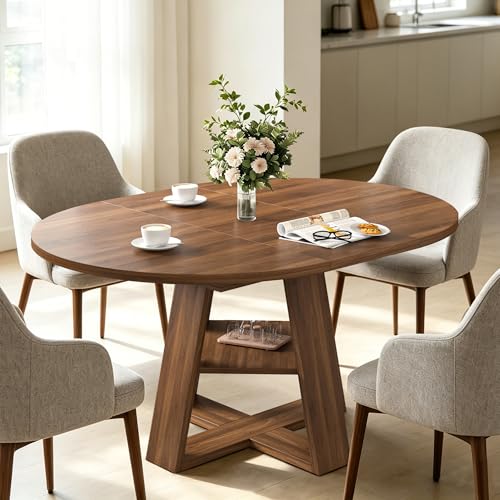
43.3"-59" Extendable Round Oval Dining Table for 4-8 with Storage Shelf | Modern Kitchen Oval Dining Table with Removable Leaves,Space Saving Extendable Table Wood Base for Kitchen Living Room Walnut
Check price on Amazon
GarveeHome 63-83" Extendable Dining Table, Industrial Rectangular Dining Room Table for 6-8 People, Expandable Kitchen Table with Heavy Duty Metal Frame for Dining Room, Kitchen & Parties, Brown
Check price on Amazon
Einhomn Extendable Dining Table for 4-6, 63" Modern Kitchen Table, Farmhouse Dining Room Tables for Dining, Kitchen, Office, Living Room, Rectangular Wooden Tables, Space Saving (Walnut)
Check price on Amazon
Extendable Dining Table with Charging Station, Convertible Folding Console Table for 6-8 People, Space-Saving Dining Table with LED Lights, Wood Rectangle Kitchen Table for Homes, Walnut (No Chairs)
Check price on Amazon
71-87 Inch Extendable Dining Room Table, Rustic Wooden Kitchen Table 6-10 | STHOUYN Expandable Dining Table, Farmhouse Rustic Style, Rectangular Wooden Top, Seats 6-10, Brown Kitchen or Dining Room
Check price on Amazon