
Kitchen Counter Table: The Complete Buyer's Guide
Discover how to choose a counter-height kitchen table that fits your space, your seating needs, and your everyday routine. From ideal heights and seating clearances to materials, styles, and practical layout tips — everything you need to decide with confidence.
Start With the BasicsWhy a kitchen counter table matters: A kitchen counter table sits at the intersection of cooking, eating, and gathering. It creates a natural hub for quick breakfasts, homework sessions, coffee breaks, and casual entertaining — without the footprint of a full dining room. This guide walks you through the decisions that matter most: height, seating, materials, and layout, so you can choose a counter table that works hard every day.
What Is a Kitchen Counter Table?
A kitchen counter table is a dining or gathering surface built at counter height rather than standard dining height. Most counter tables stand around 36 inches (about 91 cm) tall, which aligns them visually and functionally with kitchen counters and islands. This makes them a natural extension of your prep space and a comfortable spot for casual meals and conversation.
Unlike a fixed kitchen island, a counter table is freestanding and can often be moved, extended, or paired with stools and chairs on multiple sides. It bridges the gap between a formal dining table and a breakfast bar, offering more legroom than a bar counter and more flexibility than built-in cabinetry. If you are still comparing formats, our guide to kitchen high top tables explains how counter height fits alongside taller bar-height options.
Counter tables come in many configurations: rectangular tables with seating on two or four sides, square tables for compact corners, round tables that soften tight layouts, and extendable designs that adapt for guests. Many homeowners pair a counter table with a small kitchen island or use it as a standalone breakfast zone in an open-plan space.
How to Choose the Right Kitchen Counter Table
Choosing well comes down to four decisions: height, size, seating, and material. Get these right and the rest — finish, style, and extras — becomes much easier.
1. Start With Height and Seating Pairing
Height is the single most important specification. A counter-height table around 36 inches pairs with counter stools that have a seat height of roughly 24 to 26 inches. If you prefer a taller surface, a bar-height table around 40 to 42 inches pairs with bar stools with a seat height of roughly 28 to 30 inches. Mismatched heights lead to uncomfortable knees, dangling feet, and awkward posture, so always check the pairing before you commit.
For a deeper comparison of seating formats, explore our guides to kitchen counter stools and high top seating. If you are weighing a counter table against a taller format, the high table and chairs overview covers the trade-offs clearly.
2. Measure Your Space and Clearances
Before you fall in love with a shape, measure. Allow roughly 36 inches of clearance around the table for chair pull-out and walkways. Where the table sits against a wall or island on one side, plan at least 30 inches on the open sides for comfortable seating. In tight kitchens, a round or square table often works better than a long rectangle because it preserves circulation.
If your kitchen is compact, our guide to a kitchen island for a small kitchen with seating offers complementary layout ideas that pair well with a counter table. For corner placements, a kitchen corner table can maximize an awkward nook.
3. Decide How Many You Need to Seat
Counter tables are efficient seating machines. A rectangular table that seats four on two sides can often seat six when stools are placed at the ends. Square tables seat four comfortably; round tables seat four with better conversation flow. If your household size fluctuates, an extendable model or a table with a drop-leaf option adds flexibility without permanently occupying floor space.
For households that regularly host, compare a fixed counter table with a kitchen island dining table or an extendable kitchen island that grows with your guest list.
4. Choose Materials That Match Your Routine
Counter tables take daily abuse: hot mugs, spilled juice, homework crafts, and elbows. Solid wood tops offer warmth and repairability; engineered stone and laminate tops resist stains and wipe clean easily; metal frames add industrial durability. For busy family kitchens, a surface with a sealed, easy-clean finish is a practical choice. Pair your table with kitchen counter chairs that match the height and support level you need.
Counter Table Tiers: What to Expect at Each Level
Counter tables fall into broad quality tiers. Understanding what each tier typically delivers helps you match the product to your household's demands — without over- or under-specifying.
Entry-Level Tier
Basic construction with simpler joinery and lighter frames. Suitable for light daily use, secondary seating, or temporary setups. Expect straightforward finishes and fewer size options.
Mid-Range Tier
Solid build with reinforced joints and more stable bases. Better surface finishes and a wider range of sizes and shapes. A strong fit for everyday family use.
Premium Tier
High-grade materials, heavier frames, and refined detailing. Often includes extension mechanisms, protective finishes, and consistent quality control. Built for years of daily use.
Luxury / Commercial-Grade Tier
Flagship construction with premium hardwoods or stone surfaces, precision hardware, and finishes designed for high-traffic environments. The longest service life and the most design flexibility.
As a rule of thumb, mid-range models usually offer the best balance of stability and surface quality for typical households, while premium and commercial-grade tiers make sense for open-plan kitchens that see constant use.
Counter Table vs. Other Kitchen Seating Formats
Counter tables are one option among several. Use this comparison to see where they fit best.
| Format | Typical Height | Best For | Watch-Outs |
|---|---|---|---|
| Standard dining table | ~30 in / 76 cm | Formal meals, long dinners, all ages | Takes more floor area for the same seat count |
| Kitchen counter table | ~36 in / 91 cm | Casual meals, breakfasts, open-plan kitchens | Needs correctly matched counter stools |
| Bar-height table | ~40–42 in / 102–107 cm | Social seating, compact footprints, standing mixers | Higher climb for children and older guests |
| Kitchen island with seating | ~36 in / 91 cm counter | Integrated prep + eating, permanent layouts | Fixed location; harder to reconfigure |
| Breakfast nook / banquette | ~30 in / 76 cm table | Cozy corners, built-in storage | Less flexible for larger groups |
If you are specifically comparing counter height with bar height, our high top kitchen table article and the kitchen high top table and chairs guide go into more detail. For island-based layouts, see island and chairs and island with seating.
Layout and Placement Tips
Where you place the table matters as much as the table itself. A few principles keep the kitchen functional:
- Keep walkways clear: Aim for at least 36 inches between the table edge and the nearest counter, appliance, or wall along main traffic paths.
- Respect the work triangle: Avoid blocking the path between the sink, stove, and refrigerator.
- Use light to define the zone: A pendant or linear fixture over the table visually anchors it. Our guides to hanging dining room lights and chandelier height over a dining table help you get the proportions right.
- Think about flow from the kitchen: Place the table near the prep zone so serving is easy, but not so close that hot dishes pass over seating.
- Plan for storage nearby: A kitchen hutch cabinet or kitchen buffets keeps serveware close at hand.
In an open-plan layout, a counter table can also act as a soft divider between the kitchen and living area, especially when paired with a bench or a set of stools that sit below the tabletop line. If your kitchen layout leans toward a nook, the kitchen breakfast nook guide offers complementary ideas.
Styles and Finishes That Work in Real Kitchens
Counter tables are available in nearly every aesthetic. The most practical approach is to match the table to the dominant material language of your kitchen — wood cabinets, painted cabinetry, stone counters, or metal accents.
- Farmhouse and rustic: Warm wood tops, painted bases, and simple turned legs pair naturally with shaker cabinets. See kitchen farmhouse table and chairs for inspiration.
- Industrial: Metal frames, reclaimed-look tops, and exposed hardware suit loft-style kitchens. The industrial dining table guide covers the look in depth.
- Modern and minimal: Clean lines, slim profiles, and neutral finishes keep small kitchens feeling open.
- Round and corner: Softer shapes ease tight circulation. Explore a kitchen dining table round option for compact spaces.
If you are building a coordinated kitchen zone, browse kitchen furniture for complementary pieces, and review kitchen dining table and chairs sets if you prefer a matched pairing.
Recommended Kitchen Counter Tables & Counter-Height Seating
A curated selection of counter-height tables and matching seating to suit a range of kitchen layouts and quality tiers.
⚠️ AFFILIATE DISCLOSURE: This website contains affiliate links. As an affiliate Associate, we earn from qualifying purchases. If you make a purchase through these links, we may receive a small commission at no additional cost to you. Read our full affiliate policy.
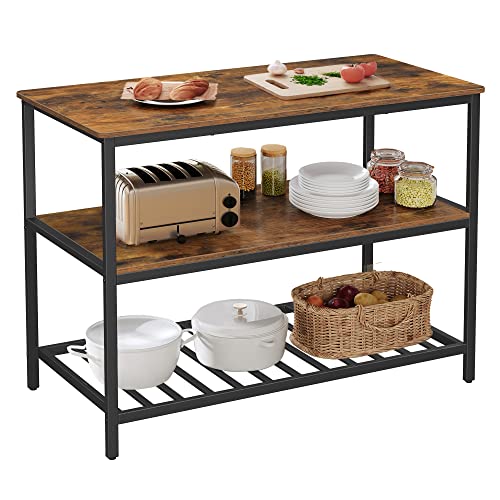
VASAGLE Kitchen Island with 3 Shelves, Storage Cabinet, Steel Structure | Kitchen Shelf with Large Wooden Worktop, 47.2 Inches Width, Rustic Brown and Matte Black, BARNET Collection UKKI01BX
Check price on Amazon
Homleke Kitchen Island with 3 Shelves, Workbench,Metal Frame | Kitchen Shelf with Large Wooden Workstation, Bakers Rack, Kitchen Stand, Metal Frame, Industrial, Rustic Brown and Black
Check price on Amazon
Casual Home Kitchen Island with Solid American Hardwood Top, Natural/White, 40" W (373-91)
Check price on Amazon
Kitchen Island with 3 Shelves, Rolling Kitchen Cart with 6 Hooks and Protective Shelf, Microwave Stand on Lockable Wheels, Bakers Rack Coffee Bar for Dining, Living Room, Outdoor, Metal Frame
Check price on Amazon
SUPERJARE Kitchen Bakers Rack with Power Outlet, Coffee Bar Table 4 Tiers, Kitchen Microwave Stand with 6 S-shaped Hooks, Storage Shelf Rack for Spices, Pots and Pans - Rustic Brown
Check price on Amazon
ThreeHio Rolling Kitchen Microwave Cart, 3 Tier Microwave Table Stand with Storage, Kitchen Utility Cart on Lockable Wheels, Small Coffee Cart Shelf Rack Organizer for Living Room Office, Balcony
Check price on Amazon
CHOEZON 70.9'' Bar Table, Kitchen Dining Table with Power Outlet and Footrest, Industrial Style, for Pub, Living Room, Rustic Brown and Black TBT08UBF
Check price on Amazon
VASAGLE Kitchen Island with 3 Shelves, Storage Cabinet, Steel Structure | Kitchen Shelf with Large Wooden Worktop, 47.2 Inches Width, Golden Oak and Matte White, BARNET Collection UKKI001W09
Check price on AmazonA Practical Buying Checklist
Before you place an order, run through this quick list:
- Measured the available floor space and clearance on all open sides.
- Confirmed the table height and matched stool or chair seat height.
- Checked the seat count against your household and typical guests.
- Reviewed the material and finish for durability and easy cleaning.
- Confirmed assembly requirements, delivery access, and warranty terms.
- Planned lighting and nearby storage for serveware and linens.
If you are still narrowing down formats, the kitchen dining table overview and the kitchen and dining room tables guide can help you compare options side by side. For homes that mix counter and bar seating, see kitchen bar seating and kitchen counter chairs.
Ready to Furnish Your Kitchen Gathering Zone?
Explore our recommended counter tables and matching seating above, then compare features, sizes, and finishes to find the configuration that fits your kitchen. For a broader view of kitchen seating options, start with our kitchen counter stools guide.
Explore Counter StoolsFrequently Asked Questions
What height is a kitchen counter table?
A standard kitchen counter table is typically around 36 inches (91 cm) tall, matching common kitchen counter height. Bar-height tables sit higher at roughly 40 to 42 inches, while standard dining tables are around 30 inches.
How much space do I need around a kitchen counter table?
Allow about 36 inches of clearance around the table for chair pull-out and walkway space. If the table sits against a wall or island on one side, plan for at least 30 inches on the open sides for comfortable seating.
Can a kitchen counter table replace a dining table?
Yes, for many households a counter-height table works as a primary eating space, especially in open-plan kitchens. It is ideal for casual meals, quick breakfasts, and social seating, though formal dining may still call for a standard-height table.
What stool height pairs with a kitchen counter table?
Counter-height tables around 36 inches pair with counter stools that have a seat height of roughly 24 to 26 inches. Bar-height tables around 42 inches pair with bar stools with a seat height of roughly 28 to 30 inches.
Is a round or rectangular counter table better for small kitchens?
Round tables generally ease circulation in tight spaces because they have no sharp corners and allow seating from multiple angles. Rectangular tables maximize seat count along a wall or island. Measure your clearances first, then choose the shape that preserves your walkways.
What materials are best for a busy family kitchen counter table?
Sealed solid wood, engineered stone, and high-pressure laminate tops handle daily spills and hot mugs well. Metal frames add stability. Look for easy-clean finishes and reinforced joints if the table will see constant use.
How does a kitchen counter table compare with a kitchen island?
An island is fixed and often includes storage and prep functions, while a counter table is freestanding and easier to move or reconfigure. Many kitchens benefit from both: an island for prep and a counter table for casual seating. Our kitchen island dining table guide explains combined layouts.